- PGF Seminar Series 2026-27

PGF Seminar Series 2026-2027
I am delighted to thank Cooper Clark for an excellent paper in this years PGF Seminar Series.
They delivered an excellent paper entitled “The Kentish Group Reconsidered: Exploring the Architectural Origins of the Earliest Saxon Churches.”
The talk was a fascinating insight into Cooper’s work and was an accesible insight into the construction of churches to a diverse crowd of historians, archaeologists and classicists. Cooper is a great inspiration to the postgraduate community here at Newcastle University.
Talk abstract:
Cooper is looking at the so-called “Kentish Group”; the eight surviving early Anglo-Saxon churches of Kent built by the Augustinian (Italian) mission or their successors from A.D. 601-697. Some survive as ruins; most survive as foundational remains. These are fairly unique churches with regards to spatial organization and form, or so it seemed at the beginning of research. I am using plan-form comparisons to determine which regions of continental Europe had the greatest architectural influence on the form of these churches.
The PGF seminar series returns this week on the 20th November, 2026 at 1pm in Armstrong Building 2.49 or on teams through this link:
Join: https://lnkd.in/e3b45Pyp
Meeting ID: 314 764 131 633 286 1
Passcode: UD7is3tHWe look forward to welcoming the PGF’s very own Rebeka Erdélyiová and Natasha Kee for a double bill speaking on “How Do You Organise Magic? Occult Societies, Gentlemen’s Clubs and the Bureaucratisation of Enchantment in Britain, 1880–1930.”AND! “Hiding in Plain Sight: Catholic False Imprints in London After the Deposition of James II.”
- Call for Papers 2027!
The Editorial Team are pleased to announce the Call for Papers for the 19th edition of Pons Aelius, the postgraduate journal for the School of History, Classics, and Archaeology at Newcastle University. Pons Aelius aims to provide a supportive environment for postgraduate and early career researchers to gain experience of the publishing process and receive feedback from like-minded peers. The 19th edition will be an open issue – we welcome previously unpublished submissions on all topics within the disciplines of History, Classics, and Archaeology.
We would love to read work from all areas of HCA and encourage you to have a go!
Please find the Call for Papers and the Style Guide for the 19th edition of Pons Aelius on the “Call for Papers,” page.
Submissions, and any questions, should be emailed to ponsaelius@newcastle.ac.uk. Further instructions are included in the Call for Papers and Style Guide. - PGF Seminar Series 2026

I am delighted to thank Alexander Iles for being the first speaker in this years PGF Seminar Series.
They delivered an excellent paper entitled “The Reenactment Continuum: Experience the “Sliding Scale” of Authenticity, Immersion and Experience in Roman Living History.”
It was a captivating talk that really piqued the audience’s interest on how we disseminate history through live action reenactment, but also on the ethics of this dissemination. We are very lucky to have Sandy as part of the postgraduate group here at Newcastle University.
Talk abstract:
Sandy is investigating historical reenactment, which presents the past to the public to be experienced, commented on and embeds ideas of societies and cultures into the public narrative. The tension between public education and personal immersion will be discussed, and how groups utilise their time away from the public to conduct reenactment displays such as religious rituals, promotions, and entertainment authentically for community bonding and the reinforcement of the group’s and individuals’ commitment to the presentation of the past, but also the personal experience and expression of the self through living history.
The PGF seminar series returns this week on the 13th November, 2026 at 1pm in Armstrong Building 2.49 or on teams through this link:
Join: https://lnkd.in/e3b45Pyp
Meeting ID: 314 764 131 633 286 1
Passcode: UD7is3tH
We look forward to welcoming Cooper Clark speaking on “The Kentish Group Reconsidered: Exploring the Architectural Origins of the Earliest Saxon Churches.” - What’s New for 2026?
Website spring clean:
We are in the process of updating and cleaning up the website! This means some past issues of Pons Aelius now have new URLs.
Pons Aelius’ Senior Editor is contacting previous contributors where possible to let them know their work has moved. If your work isn’t where it used to be, it will be on one of our new Pons Aelius issue pages, under the Pons heading on the left side of the page.
The Committee page will be updated to include the 2025-’26 team soon.
Upcoming events:
The team are working hard behind the scenes to put together the 2026 Conference and Seminar Series – stay tuned!
Social media:
Pons Aelius is now on LinkedIn!
Find our other links and contact details at our Linktree.
More updates coming soon!
- Pons Aelius 17 (May 2025)
In This Issue
Steve Kendall, Talking to a Whalebone Box about Poetry: The Franks Casket and the Creative Process.
Zenia Duell, Classics in Prison.
Nina Büchner, Pandora and Eve: Women as the Origin of Evil in Creation Mythology.
Sophie Norman, Vocalising Female Rebellion in Early Modern Finnmark’s Witch Trials.
T.N. Gibson, “All in the name of progress… and for a few lousy bob”: Brassed Off, Rebellion and Deindustrialisation.
t.gibson6@newcastle.ac.uk
Ally Keane, ‘It became a symbol of my incapacity and I hated it’: Resistance to High-Technology Augmentative and Alternative Communication, c. 1980-2020.
a.j.keane@newcastle.ac.uk
Bernardo Carvalho De Mello, Global South Narratives of Rebellion in International Human Rights Law.
Barnaby Falck, The Bunny Game – A modern counter-cultural rebellious masterpiece of female empowerment and subversion of filmmaking norms.
- PGF Newsletter October 2020
- MA Poster Submissions 2021
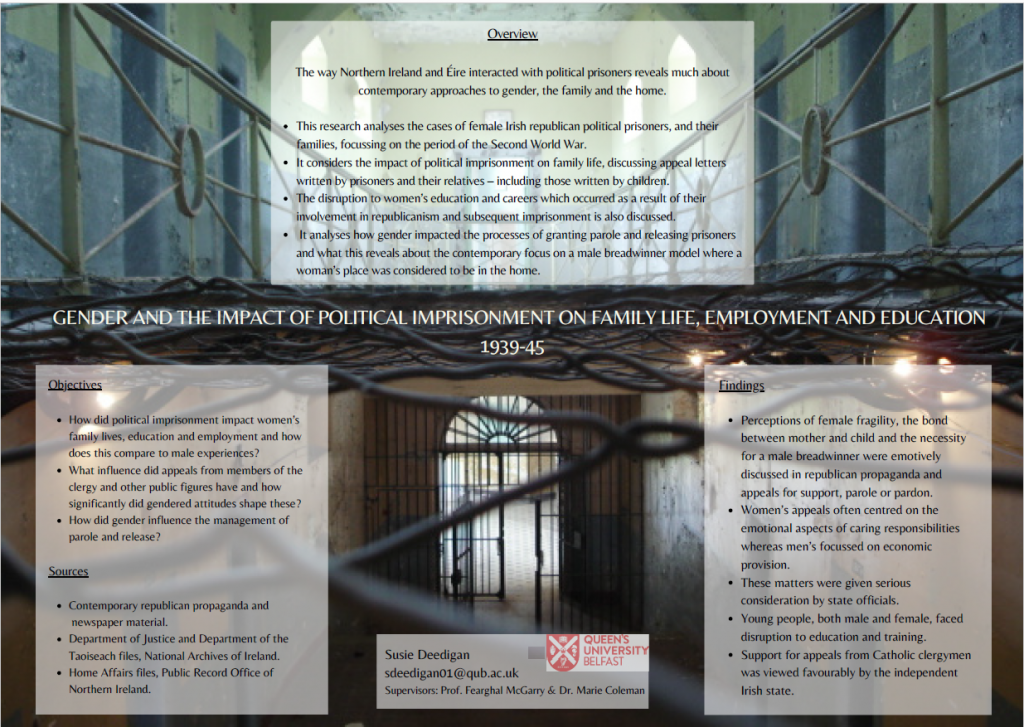
Susie Deedigan, Queen’s University Belfast 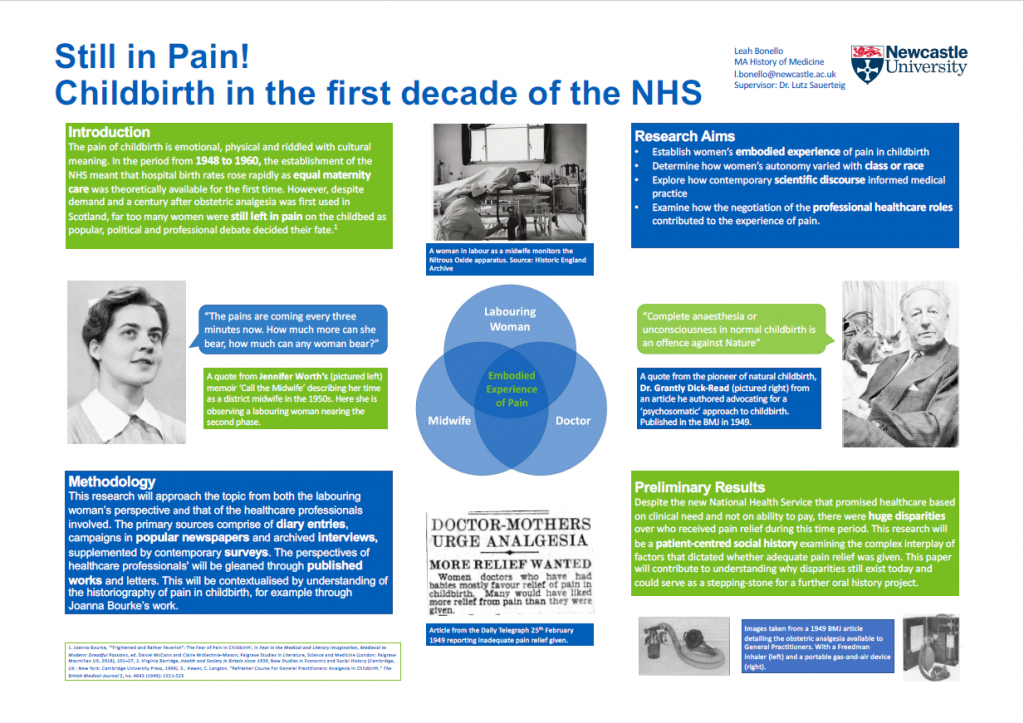
Leah Bonello, Newcastle University 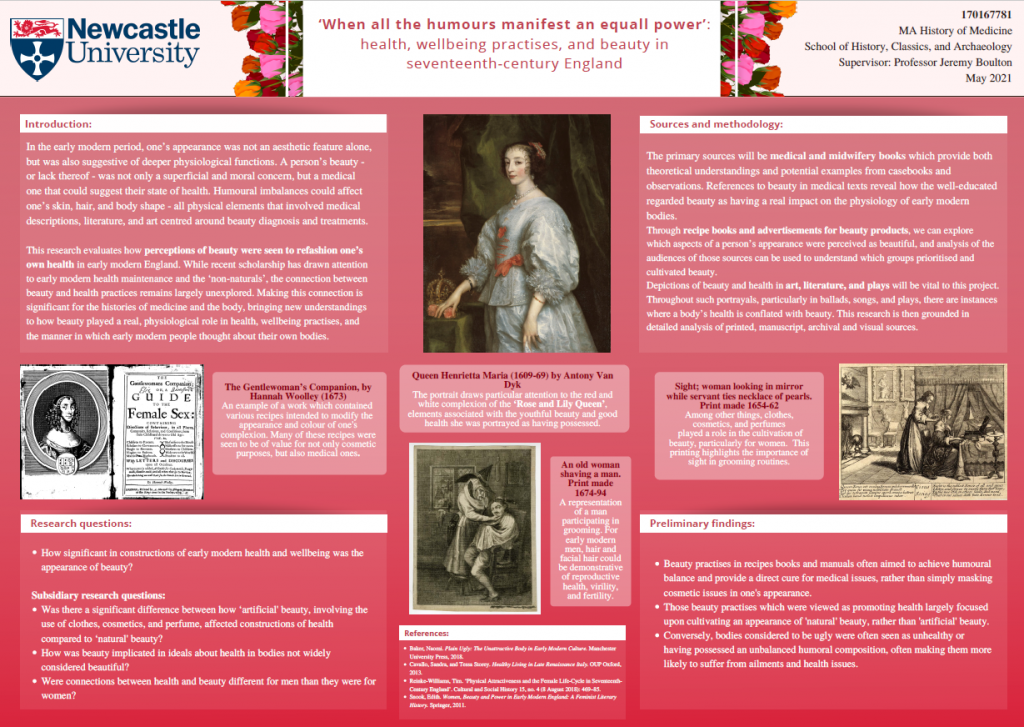
Lucy Elliot, Newcastle University 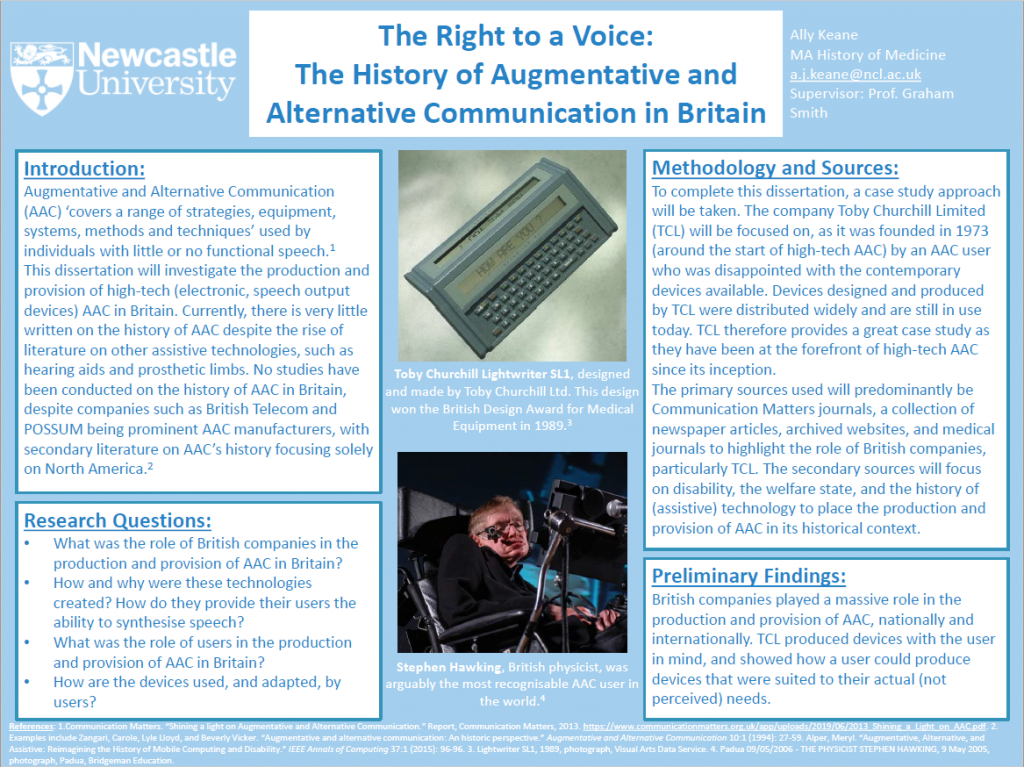
Ally Keane, Newcastle University 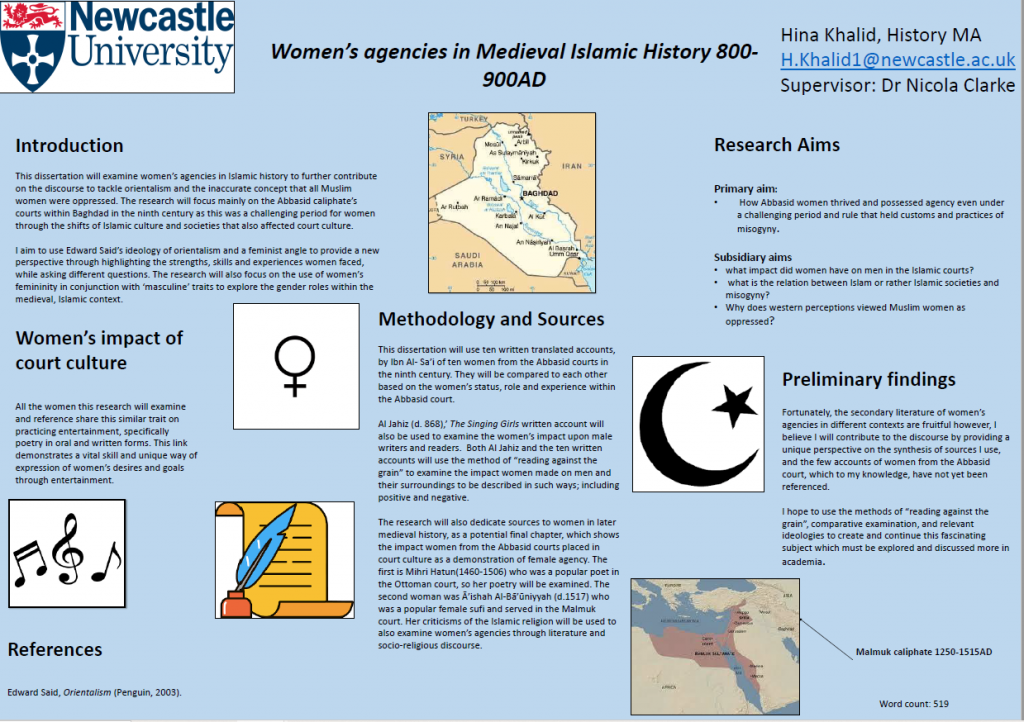
Hina Khalid, Newcastle University 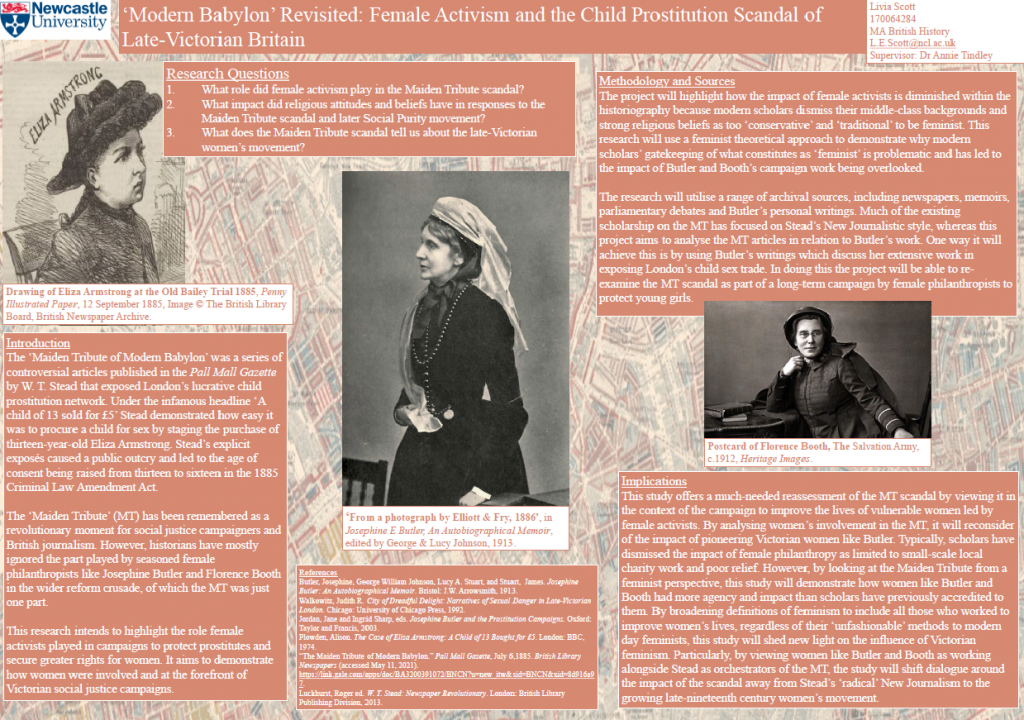
Livia Scott, Newcastle University 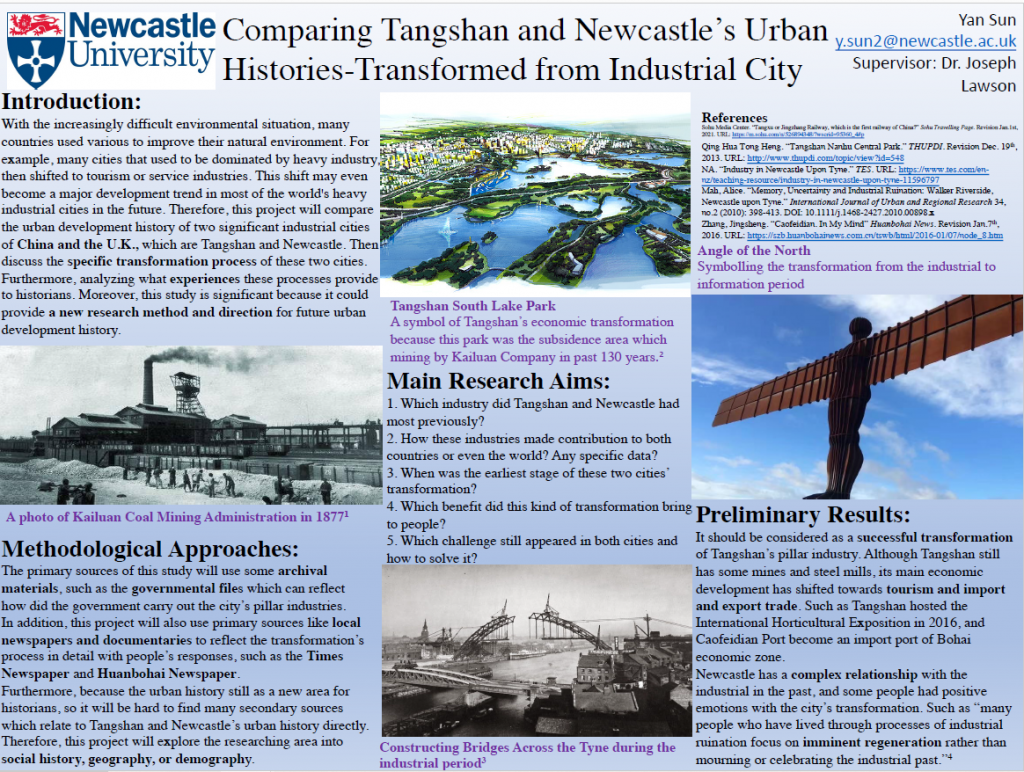
Yan Sun, Newcastle University 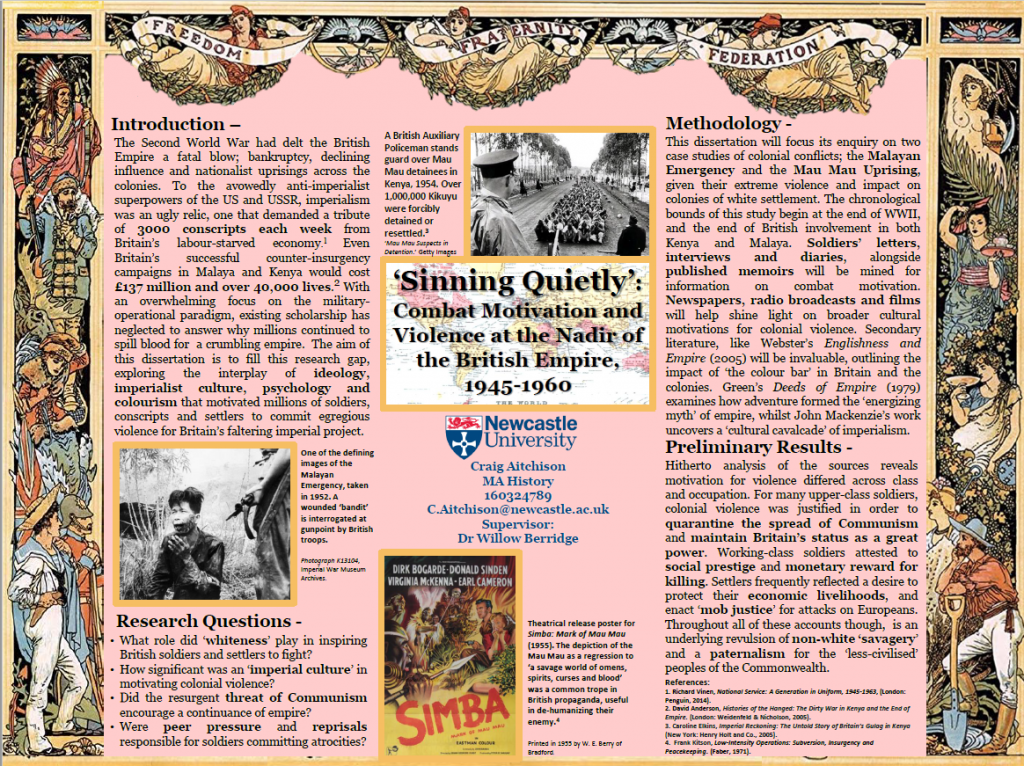
Craig Aitchison, Newcastle University 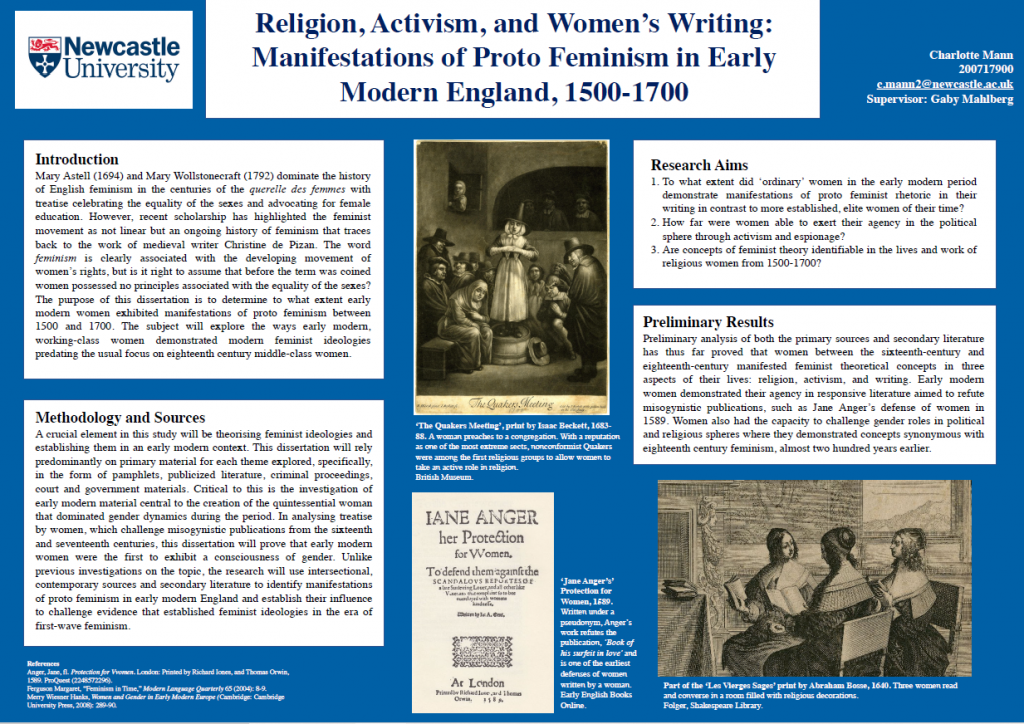
Charlotte Mann, Newcastle University - Annual Postgraduate Conference – 19th May 2021

We are excited to invite you to our 19th Annual Postgraduate Conference, on the 19th May 2021.
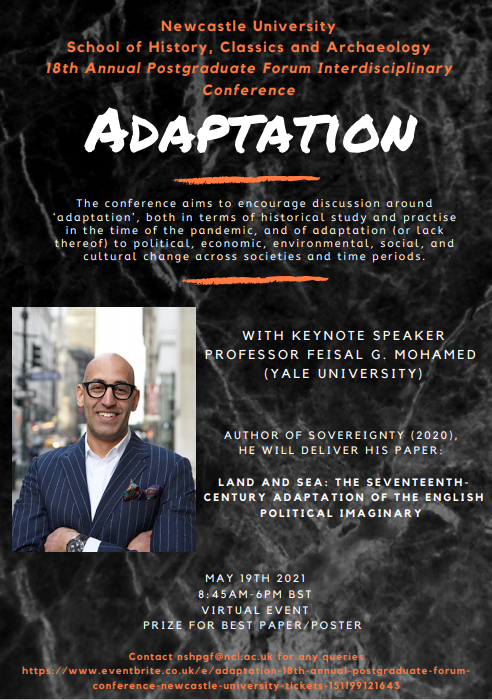
This virtual conference aims to encourage discussion around ‘adaptation’, both in terms of historical study and practise in the time of the pandemic, and of adaptation (or lack thereof) to political, economic, environmental, social, and cultural change across societies and time periods. Papers will be presented in cross-disciplinary thematic panels, and we will be hearing from postgraduate students from across the globe as well as a little closer to home in Newcastle!
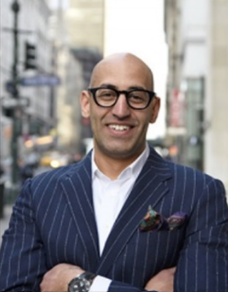
We are delighted to be joined by Yale University’s Professor Feisal Mohamed as our keynote speaker, with his paper entitled Land and Sea: The Seventeenth-Century Adaptation of the English Political Imaginary
Everyone welcome – see the link below to register! https://eventbrite.co.uk/e/151199121643
Conference schedule (all times are BST)
8:45-9:00 – Welcome
STREAM A
Panel – Material Culture
Chaired by Eleanor Harrison
09:00- 9:20 – Liz Shaw (Newcastle University), ‘Adapting Roman motifs in regional brooch design.’
09:20 – 09:40 – Goran Durdevic (Capital Normal University), ‘Magic, illusion and adaption: reflection and mirrors in Qin – Han and Roman empires.’
09:40 – 10:00 – David Johnson (Newcastle University), ‘Adapting the British Home in the Empire.’
10:00 – 10:20 Q&A
Panel – Adaptation of Historical Practice and Media
Chaired by Rob Granger
10:30 – 10:50 – John Pearson (Newcastle University), ‘Camera, Lights, Action! A Personal Approach to using Existing Film and Video as an Ethnoarchaeological Source.’
10:50 – 11:10 – Hannah James Louwerse (Newcastle University), ‘Staying flexible: how to build an oral history archive.’
11:10 – 11:30 – Kieran Shackleton (University of Glasgow), ‘Adapting the Holocaust Memory Centre: Rethinking Memory Seventy-Six Years Later.’
11:30 – 11:50 – Rebecca Whiting (University of Glasgow), ‘Re-thinking rights to archives.’
11:50 – 12:10 – Q&A
Panel – Ideology & Belief
Chaired by Leanne Smith
13:10 – 13:30 – Olivia Kinsman (University of Bristol), ‘SEKHMET: An Ancient Goddess for Modern Times.’
13:30 – 13:50 – Daniel Sutton (St John’s College Oxford), ‘When Words Won’t Adapt: Language and Authority in Tacitus’ Annals.’
13:50 – 14:10 – Samantha Dobbie (University of Glasgow), ‘Adapting to Revolution: Women in Revolutionary Paris, October 1789.’
14:10 – 14:30 – Katharine McCrossan (University of Glasgow), ‘Co-operation, Competition, and Consumerism: The Scottish Co-operative Movement in the 1950s.’
14:30 – 14:50 Q&A
Panel – Mobility & Identity
Chaired by Rob Granger
14:50 – 15:10 – Giulio Leghissa (University of Toronto), ‘SB XIV 11979 and Women Mobility between North Africa and Egypt.’
15:10 – 15:30 – Neil McClelland (University of Glasgow), ‘Natives’ and Foreigners’ Mutual Adaptation in Late-Medieval Florence.’
15:30 – 15:50 – Anais Delcol (University of Glasgow), ‘Adaptation to a new culture as a way of reinventing female identity.’
15:50 – 16:10 – Daniel Riddell (Northumbria University), ‘Scandinavian and German Merchant Migrants to Newcastle in the 19th Century: British Businessmen?.’
16:10 – 16:30 Q&A
16:40 – 17:40 – Keynote speaker – Feisal Mohamed (Yale University), ‘Land and Sea: The Seventeenth-Century Adaptation of the English Political Imaginary’
17:40 – 18:00 -Prize giving & closing speeches
STREAM B
Panel – Landscapes and Their Challenges
Chaired by Jerome Ruddick
10:30 – 10:50 – Laura Stops (University of Exeter), ‘Politics, Passages and Peripheries: The adaptation of the Porta Esquilina for a new imperial age.’
10:50 – 11:10 – Katerina Gottardo (Durham University), ‘Adaptation to the environmental context: the substructures of caveae in Roman theatres in the northern-central Italy.’
11:10 – 11:30 – Huilin Yang (University of Glasgow), ‘Exploring the role of olive cultivation in the Mediterranean ecosystem using archaeological evidence and the Annales framework.’
11:30 – 11:50 – Mark Mather (University of Queensland), ‘Roman Supply Lines – How the Gallic Landscape Necessitated Adaptation.’
11:50 – 12:10 – Q&A
Panel – Religion & Society
Chaired by Harriet Palin
13:10 – 13:30 – Arnau Lario-Devesa (University of Barcelona), ‘Re-editing the past, or how to fabricate continuity: The case-study of the roman sanctuary of Can Modolell (Cabrera de Mar, Barcelona) and the neighbourhood of Saint John.’
13:30 – 13:50 – Öznur Özdemir (Sakarya University), ‘Muslims’ Fiscal Adaptation After the First Islamic Conquests.’
13:50 – 14:10 – Hina Khalid (Newcastle University), ‘How Abbasid women thrived and possessed agency even under a challenging period and rule that held customs and practices of misogyny.’
14:10 – 14:30 – Q&A
Panel -Reinterpreting & Reusing the Past
Chaired by Katherine Waugh
14:50 – 15:10 – Jessica Habib (University of Glasgow), ‘Debating the Colonial Identity of the Ottoman Empire: Caliphate and Colonizer?’
15:10 – 15:30 – Shelby Judge (University of Glasgow), ‘Madeline Miller’s Circe as the archetype of contemporary feminist adaptations of Greek myth’
15:30 – 15:50 – Elly Polignano (Newcastle University), Marc.Arg. AP 5.63: multiple levels of adaptation
15:50 – 16:10 – Berklee Baum (University of Oxford), ‘The Adaptability of Memorialization and Memory.’
16:10 – 16:30 Q&A
END STREAM
- PGF Semester 2 Seminars 2021 – Wednesdays 1-2pm
*Everyone is welcome – email Leanne at l.smith28@newcastle.ac.uk for Zoom details.
· 3rd February – Rob Granger (Newcastle University), “Nightmares and Miracles: Franco’s Madrid, 1939 – 1975”
· 10th February – Clare Tonks (University of Edinburgh), “Material Culture of Battlefield Tourism at Waterloo”
· 17th February – Henry Brown (University of Oxford), “Anarchists in Uniform: The Militarisation of Anarchist Culture during the Spanish Civil War (1936 – 1939)”
· 24th February – Claire Heseltine (University of Oxford), “‘And her loveliness’: the wounding and death of Penthesilea in Roman art”
· 3rd March – Oded Haim (Ben-Gurion University of the Negev), “From Defeat to Victory: Why did Rome Win the Second Punic War?”
· 10th March – Jamie Gemmell (University of Edinburgh), “Projects of Racialisation: Oroonoko and African Identity in the Seventeenth-Century Atlantic World”
· 17th March – Indigo Reeve (University of Edinburgh), “A Stressful Life: Childhood Health in South-East Scotland”
· 24th March – Meena Menon (University of Leeds), “Social Movements and Local Sovereignty in the Age of Transnational Capital and Ecological Devastation in Postcolonial India”
· 5th May – Cathy Bishop (Swansea University), “Practicalities of incense in New Kingdom Egypt”
· 12th May – Yolanda Panou (University of Edinburgh), “Becoming a victim of μανία: Representations of child killing on the Athenian stage”
· 2nd June – Kathryn Watts (University of Edinburgh), TBC · 9th June – Mihai Hotea (University of Nottingham), “Should democratic leaders engage in bilateral summits with dictators? A case-study of the US, UK and communist
- Introducing the PGF Committee: Leanne Smith, Seminar Co-Ordinator

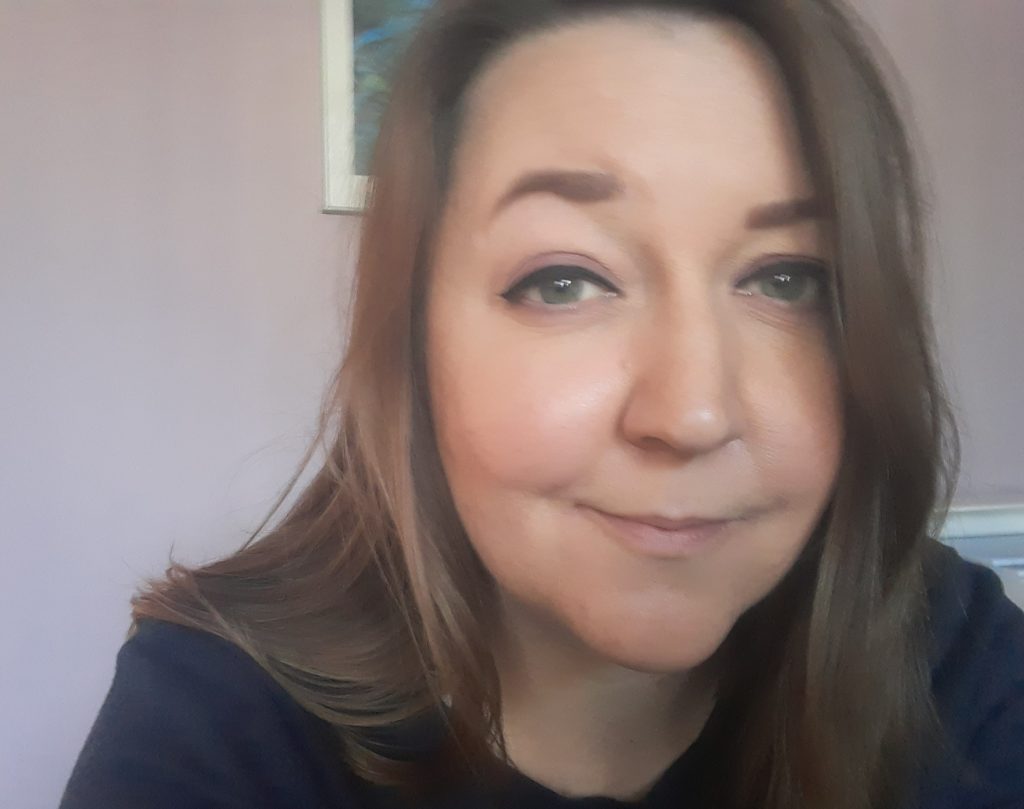
Tell us a little bit about yourself
I live with my son Isaac (11) and my cat Arabella (Bella). Isaac is my absolute world. He’s the reason I decided to go to university as I want to inspire him to follow his dreams. I absolutely love watching documentaries, my favourite was about ordinance survey maps! I also have a slight obsession with James Blunt.
Tell us a little bit about your research
My research is focused on the political & religious thought of the Fifth Monarchy Men in England during the seventeenth century. They were a millenarian sect that believed it was their purpose to reform society ready for the second coming of Christ. The current historiography of the group has tended to concentrate on their religious ideas and has dismissed their engagement with political ideologies, such as republicanism.
What was it that got you interested in your current research topic?
I was researching for an essay during the first year of my BA and stumbled across the Fifth Monarchists. I found it strange that it was written during the time that they were ‘never to be forgotten sect’ and yet they have largely been forgotten. They have been overshadowed by other seventeenth century radical groups that have been considered by some historians to engage with political concepts that we are certainly more familiar with in modern society. The religious beliefs of the Fifth Monarchy Men do not fit comfortably within this secular narrative.
What has been the best/most enjoyable part of your PhD so far?
I recently delivered my first paper. This was originally due to take place in my first year but was delayed due to Covid-19 but thankfully I was able to present this online. I was extremely nervous and practically lost my voice practising my talk, but it was really enjoyable. I also got some really good feedback and advice on other avenues to pursue.
And what has been the most challenging?
Dealing with my guilt as a parent. There are often times when I will work over the weekend or during school holidays and I feel like a terrible Mam.
Has Coronavirus impacted your research?
Thankfully, most of my sources are available online but the first lockdown really impacted as the schools were closed and I had to take time to help Isaac with his schoolwork. The pandemic has also impacted my mental health much more than I thought it had. I think being away from my friends and away from the university I just felt like I wasn’t part of anything anymore. That’s why I am loving my role as series seminar co-ordinator I now feel like I am part of a community!
What would be your most important advice for someone just starting their PhD?
Be kind to yourself and DO NOT compare your PhD journey with anyone else’s
What are your post-PhD plans?
The dream is to be a lecturer.
- Introducing the PGF committee: Rob Granger, Chairman

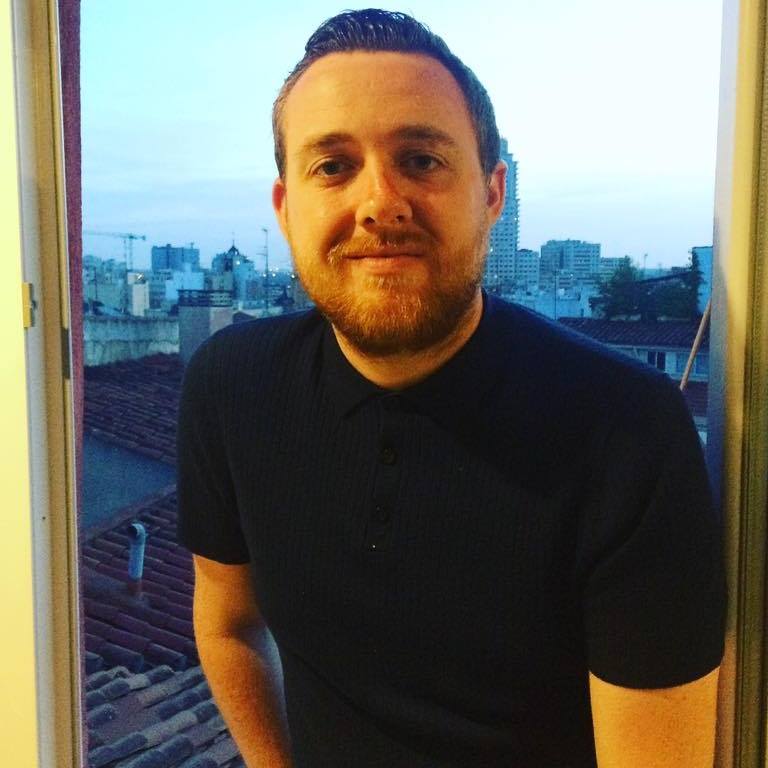
Hi, I’m Rob and I’m a second year PhD student in history and currently the Chair of our Postgraduate Forum at Newcastle. After two years in Madrid trying (and mostly failing) to speak Spanish with a Yorkshire accent, and being torn between missing my dog back in the UK, and being able to go to rooftop bars in November, I’ve ended up back in Newcastle – where I completed my BA and MA degrees – to continue an academic path that started out with a second year essay on the Franco dictatorship.
My thesis will explore the later (c.1964 – 1975) Franco regime’s attempts to generate social and political consent during a period of growing unrest that has traditionally been seen as an era of terminal decline for the dictatorship. For obvious reasons, I haven’t been able to get to Spain, so progress has been difficult, but this experience has taught me that there are always more people in the same boat as you as you might think.
A piece of advice I’d definitely give is to use Twitter as an academic networking tool, which I’ve only started to do relatively recently, but has already led to both productive working relationships and personal connections with other PhD students researching modern Spanish history, who are going through many of the same challenges and frustrations at the minute as me, particularly in terms of travel and access to archives etc. If all goes according to plan, the goal post-PhD would be to try and find someone who’s willing to pay me to continue to think, read and write about modern Spanish history!
- PGF Seminar 18th November, 1-2pm

We will be hearing from Elly Polignano a first year PhD candidate within our school. Her research focuses on the wide-spread literary form of the epigram and her thesis will offer the first critical edition and commentary of Marcus Argentarius’s thirty- seven epigrams. Elly will deliver her paper “P.Oxy. 3723: limits and ambiguity on the elegiac genre“.
For more information please contact Leanne – l.smith28@newcastle.ac.uk
- PGF Newsletter October 2020Please find the October newsletter using the link below: PGF Newsletter Oct 2020
- PGF Seminar 11th November, 1-2pmOur next seminar will take place online on Wednesday 11th November 1-2pm. Adrian Pole Seminar We will be hearing from Adrian Pole a current PhD candidate at University of Edinburgh. His research focuses on cross-cultural interactions between international volunteers in the Spanish Civil War and the people, places, and politics of 1930s Spain. Adrian will deliver his paper “No exit today – It’s a Revolution!’ Britons in Revolutionary Catalonia, 1936”. For more information please contact Leanne – l.smith28@newcastle.ac.uk
- Postgraduate Forum Seminars – Semester 1 TimetableWe have a full schedule for our first semester covering a broad range of fantastic subjects. All the seminars for semester 1 will take place online and details of the Zoom meeting will be sent in the week prior to the seminar. Grab a cuppa and join us on Wednesday’s 1-2pm.
- 11th November – Adrian Pole (University of Edinburgh), “‘No exit today – It’s a Revolution!’ Britons in Revolutionary Catalonia, 1936”
- 18th November – Elly Polignano (Newcastle University), “P.Oxy.3723: limits and ambiguity on the elegiac genre”
- 25th November – Harry Lewis (University of Edinburgh), “Jacobite Rebellions in the Caribbean”
- 2nd December – Katherine Waugh (Newcastle University), “The Industrial Past in the Deindustrialised Present: Exploring cross-generational experiences of County Durham’s pit closures”
- 9th December – Alice Robinson (Newcastle University), “Mapping Ancient Rome in Percy Shelley’s Writing”
- 16th December – Marcela Delia (University of Edinburgh), “Justices in that pairt: revisiting the Aberdeen witchcraft trials in light of a recent discovery (c. 1597)”
- 13th January – Leanne Smith (Newcastle University), “Politics of the Apocalypse: William Aspinwall’s godly republicanism”
- 20th January – Thomas Little (Newcastle University), “My Secret Life—the erotic adventures of a Victorian gentleman”
- 27th January – Jerome Ruddick (Newcastle University), “The Festival of Despoina: Creating mythological narratives through material culture”
- 16th Annual PGF ConferenceOur annual post-graduate forum conference is less than two weeks away! This year’s theme is ‘Conflict’ and a variety of papers are lined up from History, Classics and Archaeology. Here is our Conference program. Feel free to come and go throughout the day, registration is not necessary. Hope to see you there, The PGF Committee
- Newsletter 20 – 26 NovemberDear all, Due to the fact that there was no PGF Seminar last week, we are pleased to announce that we have not one, not three, but two(!) seminars for you to enjoy this Wednesday! We hope to see you there, or at one of the other seminars being given this week! Best wishes, The PGF Committee PGF SEMINARS: Date/Time: Wednesday 22 November 2017, 13:00. Venue: Room 1.03, Armstrong Building. ‘BACKWATER ECONOMIES? A FOODWAY FRAMEWORK FOR EXAMINING WETLAND WORLDVIEWS IN THE PREHISTORIC PAST‘ BY PHD CANDIDATE FLOOR HUISMAN (DURHAM UNIVERSITY) One of the major problems we face when trying to study past worldviews is the way in which our own, modern western worldview influences our research, from the questions we ask, to our final interpretations. Within the sub-discipline of wetland archaeology, for instance, we often ask why past communities chose to live in such marginal landscapes. We assume that wetlands were ‘special’ in some way, either as ‘ritual’ or ‘sacred’ places, or as resource rich environments. We assume a particular worldview amongst the wetland communities living there, one focussed on ‘the wild’, which sets them apart from contemporary, ‘domestic’ ‘dryland’ communities. Yet rather than assuming the presence of such opposing worldviews, we should assess to what extent the landscape or environment in which people lived truly affected their worldview and the formation of particular community identities. This paper will explore how we may be able to do this by considering prehistoric communities’ (inter)relation with the environment through a study of past foodways and environmental change. It will present the preliminary results of my PhD research which examines the use of domestic and wild plant and animals in relation to a changing environment in and around the later prehistoric East Anglian Fens (c. 4000 BC-40 AD). It asks if and when a wetland worldview and accompanying identities came into being as the East Anglian Fens changed from a dryland basin into Britain’s largest wetland. Thus, this paper explores a new approach to understanding past worldviews, by integrating archaeological with environmental data. It is hoped this will allow us to move beyond our modern worldviews and gain a better understanding of past worldviews and the way these shaped communities. AND ‘A CONTROVERSIAL TRIBUNICIAN STATUTE: THE PLEBISCITUM CLAUDIANUM AT THE BEGINNING OF THE SECOND PUNIC WAR (218 BC)’ BY PHD CANDIDATE ROBERTO CIUCCIOVE (NEWCASTLE UNIVERSITY) The Plebiscitum Claudianum was controversial tribunician bill, which dealt with very significant economic matters especially related to sea-trade, involving also, at its very core, the political relations between the senatorial elite and the emerging equestrian order. The year 218 BC represented a crucial moment in the history of Rome and the whole Mediterranean world. We are at the very beginning of the Second Punic War, a conflict that will reshape the politicalmilitary order for many decades to come. In the same year a lex Claudia was proposed and passed. As usual, there will be refreshments in the form of tea, coffee and biscuits will be provided. HISTORY SEMINAR: ‘THE SACRED AND THE SATIATED: HISTORY, ARCHAEOLOGY, AND THE LIMINAL SPACE OF BLACK RESISTANCE’ BY PEGGY BRUNACHE (UNIVERSITY OF DUNDEE) Date/Time: Wednesday 22 November 2017, 16:00. Venue: Room 1.05, Armstrong Building. Traditional scholarship of the Black diaspora has predominantly focused on the examination of primary and secondary historical documents. Moreover, the historiography of slavery of the French Antilles, for example, has been weaker than other regions, especially when compared to British and American counterparts. More recent historical studies have shifted to critically engage larger questions as to how enslaved and free black communities actively participated in strategies to either escape or circumvent gendered and racialized systems of oppression. Since the late 1980s, historical archaeology has risen to the challenge to provide a unique contribution to further our understanding of past lifeways of the Black Atlantic via engendered methodological frameworks for studying artefact patterning and examining the nature of material culture. This presentation hopes to progress critical dialogue on Black agency and choices by engaging place, material culture, and space, through an alternative understanding of conceptual sites of conflict and resistance. I will consider two geographically disparate 19th century archaeological sites, one in the French Caribbean and the other in North America, associated with the slave economy to consider new transformative theories on Black resistance as liminal space for identity formation and societal transformation. This production of knowledge serves as an exploration for re-historicising the past through an intersectionality of structurally hierarchical categories of difference in the archaeological study of enslaved Africans and their descendants. http://www.ncl.ac.uk/hca/seminars/item/thesacredandthesatiated.html CLASSICS AND ANCIENT HISTORY RESEARCH SEMINAR: ‘PHILOLOGICAL NETWORKS: EDITING THE CLASSICAL TEXT IN EIGHTEENTH-CENTURY CAMBRIDGE’ BY DR KATHERINE EAST (NEWCASTLE) Date/Time: Wednesday 22 November 2017, 17:00. Venue: Room 2.50, Armstrong Building. http://www.ncl.ac.uk/hca/seminars/item/philologicalnetworks.html ARCHAEOLOGY SEMINAR: ‘TEXTILES AND TRADE IN THE ATLANTIC IN THE 18TH CENTURY’ BY PROFESSOR GIORGIO RIELLO (WARWICK) Date/Time: Thursday 23 November 2017, 16:00. Venue: Room 2.16, Armstrong Building. http://www.ncl.ac.uk/hca/seminars/item/textilesandtradeintheatlanticinthe18thcentury.html EVENT: ‘MARTIN LUTHER KING, JR. AND THE POOR PEOPLE’S CAMPAIGN AT FIFTY’ BY DR KERRY TAYLOR (ASSOCIATE PROFESSOR OF HISTORY, THE CITADEL, CHARLESTON, SOUTH CAROLINA, USA) Date/Time: Tuesday 21 November 2017, 18:00. Venue: Room G.33, Barbara Strang Teaching Centre. A specialist in twentieth-century US, labour, African American and oral history, Dr Kerry Taylor came to the Citadel after serving as the Associate Director of the Southern Oral History Program in Chapel Hill. He co-edited volume 4 and volume 5 of the Papers of Martin Luther King, Jr. (University of California Press, 2000 and 2005) and American Labor and the Cold War (Rutgers University Press, 2004). In addition to directing The Citadel Oral History Program, Taylor has been extensively involved in grassroots organising in Charleston and across the South, particularly in the “Fight for 15” movement to organise fast food workers for a $15-an-hour minimum wage and union recognition. http://www.ncl.ac.uk/hca/events/item/martinlutherkingjrandthepoorpeoplescampaignatfifty.html EXHIBITION: ‘PATHS ACROSS WATER: LOST STORIES OF TYNESIDE AND THE CARIBBEAN’ Until 26 November. Venue: Old Low Light in North Shields Come for the history, the poetry table, the oral stories, a video artwork reacting to shifts in the wind outside, a story-telling booth that will create both an oral archive and a digitally mixed soundscape exploring people’s responses to the sea and to the paths of migration connecting the North East with not only the Caribbean but also the rest of the world. And so much more. MUSEUM EXHIBITION: ‘FRONTIER FASHION: GLASS BANGLES OF THE ROMAN NORTH’ Until 3 January 2018. Venue: Great North Museum A mini exhibition Frontier Fashion: Glass Bangles of the Roman North that focuses on Newcastle University archaeologist Dr Tatiana Ivleva’s research on Roman glass bangles in Britain. Tatiana is particularly interested in the popularity of glass bangles in Northern Britain, on both sides of Hadrian’s Wall. A small number of fascinating artefacts are on show in the display which is taking place in the new temporary exhibition space, formerly the Mithraeum. Further details can be found here.
- Newsletter 30th October – 5th NovemberHi everyone! With the days getting shorter, the temperature dropping, and clouds gathering, we can truly say: ‘Winter is coming’. The PGF Committee, however, wants to stay in denial for a little while more, so our very own History PhD candidate Ayshah Johnston will take us to the warm, tropical island of Barbados during the second PGF Seminar of this semester! We hope to see you there (we have hot drinks to keep you warm!) or at one of the other seminars this week! Best wishes, The PGF Committee PGF SEMINAR: ‘”PITY MY DISTRESS”: PAUPER WOMEN’S APPEALS FOR AID UNDER THE 1880 POOR RELIEF ACT IN BARBADOS’ BY AYSHAH JOHNSTON (HISTORY PHD CANDIDATE NEWCASTLE) Date/Time: Wednesday 01 November 2017, 13:00. Venue: Room 1.03, Armstrong Building. The historiography of Poor Relief has focused largely on the oppressive laws to which the poor were subjected for over a century after emancipation, and on the evolution of relief practices from meagre allowances and compulsory almshouse admittance to developed social assistance policies and modern medical care. This paper moves away from these discussions towards an illumination of the experiences of people living in poverty through a selection of letters written by paupers to the Inspector of Poor in St. Philip, Barbados, seeking relief for themselves or their families. In a parish where, according to contemporary observation, the Poor Law Guardians applied the harshest criteria in determining suitability for relief, these rare surviving letters are a poignant window onto the hardships, fears and hopes of the poor in late nineteenth century Barbados. By presenting these touching vignettes this paper seeks to reveal a level of care and advocacy within families and communities which challenges the official notion that abandonment and weak kinship ties were the root causes of destitution. While they could not influence the law, the writers did their utmost to plead their cases and persuade the Poor Law Guardians to assist them. Ayshah is in her third year of a PhD on Poor Relief in the Anglophone Caribbean, a collaborative doctoral award from Newcastle University and The National Archives. She is a museum educator and specialises in fusing academic research with public engagement. Her passion besides history is literature and she is a three-time winner of the Jamaica Cultural Development Commission’s annual short story competition, with two of the stories subsequently published in an anthology of winning entries. Refreshments in the form of tea, coffee and biscuits will be provided! ARCHAEOLOGY RESEARCH SEMINAR: ‘THE NORTHERN PICTS PROJECT: LATE ROMAN AND POST-ROMAN SOCIETIES IN NORTHERN BRITAIN C.300-900 AD’ BY DR GORDON NOBLE (ABERDEEN). Date/Time: Wednesday 01 November 2017, 16:00. Venue: Room 1.04, Armstrong Building. The Picts are a ‘lost people of Europe’ and a past society of enduring public fascination. First mentioned in late Roman writings as a collection of troublesome social groupings north of the Roman frontier, the Picts went on to dominate northern and eastern Scotland until late first millennium AD. Northern Picts is a project that aims to uncover the archaeological traces of Pictish society in northern Scotland. Read more about the project here. http://www.ncl.ac.uk/hca/seminars/item/thenorthernpictsproject.html CLASSICS AND ANCIENT HISTORY RESEARCH SEMINAR: ‘THUCYDIDES’ PERICLEAN SPEECHES’ BY PROFESSOR ELIZABETH IRWIN (COLUMBIA). Date/Time: Wednesday 01 November 2017, 17:00. Venue: Room 2.50, Armstrong Building. Find more information here http://www.ncl.ac.uk/hca/seminars/item/thucydidespericleanspeeches.html ARCHAEOLOGY TALK: ‘THE EXTENDED LIFE COURSE AND PREHISTORIC EUROPEAN MORTUARY PRACTISES’ BY CHRIS FOWLER Date/Time: Thursday 2 November, 15:00. Venue: Room 2.49, Armstrong Building (one off room change to the usual strand schedule). Chris Fowler will be presenting (part 2) of his talk on “The Extended Life Course and Prehistoric European Mortuary Practises”. Feedback from different periods and disciplines welcome.
- Postgraduate Forum Seminars – Semester 1 TimetableThis year we have scheduled many exciting seminars and talks. It was absolute pleasure to get such a good turnout for our first proper seminar last week. Don’t worry if you’ve missed it, here is the timetable for what else is on this semester. Make sure to write the dates down in your calendars and be there (or be square!). We are looking forward to seeing all your lovely faces! Wednesday 18th October, 1-2pm, Armstrong 1.03 Tom Whitfield, Archaeology PhD candidate, Newcastle University ‘It’s Always Sunny in Colonial Williamsburg’ – The Virginian Gentry have an Identity Crisis [1764-1775] Wednesday 1st November, 1-2pm, Armstrong 1.03 Ayshah Johnston, History PhD candidate, Newcastle University ‘”Pity My Distress”: Pauper women’s appeals for aid under the 1880 Poor Relief Act in Barbados’ Wednesday 8th November, 1-2pm, Armstrong 1.03 Thomas Stewart, History PhD candidate, Edinburgh University ‘The impact of the 1973 Dundee East by-election on the SNP in Dundee’. Wednesday 22nd November, 1-2pm, Armstrong 1.03 Roberto Ciucciove, Classics & Ancient History, Newcastle University ‘A controversial tribunician statute: the plebiscitum Claudianum at the beginning of the Second Punic War (218 BC)’ & Floor Huisman, Archaeology PhD candidate, Durham University Backwater economies? A foodway framework for examining wetland worldviews in the prehistoric past Wednesday 8th December, 1-2pm, Armstrong 1.03 Christopher Whittaker, Archaeology Masters, Newcastle University Breedon Hill, Leicestershire: an archaeological investigation at a multi-period hilltop site. & Rowan Thompson, History PhD candidate, Northumbria University ‘England expects every man will do his duty’: Trafalgar Day, Naval Commemoration and National Identity, 1895-1939 Wednesday 13th December, 1-2, Armstrong 1.03 Madeleine Pelling, History of Art PhD candidate, University of York Writing the Museum: Mary Hamilton’s A Catalogue of Curiosities at Bulstrode and Horace Walpole’s The Duchess of Portland’s Museum
- Newsletter 23rd-29th OctoberHi all, Here is our newsletter for this week! You will notice there is no PGF Seminar this week 🙁 but we have compiled a number of other super interesting events for you! Unfortunately, some of the seminars will overlap, so unless you have a Time-Turner (in which case, please give a seminar on that!) you will have to choose wisely. GREEK ARCHAEOLOGY MASTERCLASS BY PROFESSOR FRANÇOIS LISSARRAGUE (EHESS AND CURRENT LEVENTIS VISITING PROFESSOR AT EDINBURGH UNIVERSITY) Date/Time: Wednesday 25 October 2017, 13:30-15:00. Venue: Room 2.49, Armstrong Building. ARCHAEOLOGY RESEARCH SEMINAR: ‘LIVING WITH MONUMENTS: RECENT RESEARCH ON NEOLITHIC ACTIVITY AT AND AROUND AVEBURY.’ BY PROFESSOR JOSHUA POLLARD (SOUTHAMPTON). Date/Time: Wednesday 25 October 2017, 16:00. Venue: Room 2.16, Armstrong Building. http://www.ncl.ac.uk/hca/seminars/item/recentresearchonneolithicactivityatandaroundavebury.html HISTORY RESEARCH SEMINAR: ‘MARRIAGE, SLAVERY AND ARABIAN IDENTITY IN LATE ANTIQUITY.’ BY MAJIED ROBINSON (UNIVERSITY OF EDINBURGH) Date/Time: Wednesday 25 October 2017, 16:00. Venue: Room 1.05, Armstrong Building. In this talk, Majied Robinson will demonstrate how statistical analysis of gender relations amongst the tribe of Muhammad can be used to create a new narrative of tribal and ethnic belonging in early Islamic history. Among the topics addressed will be the political and economic origins of Mecca, the emergence of the Quraysh as a distinct tribal entity, and Arabian ethnogenesis in the post-conquest period. http://www.ncl.ac.uk/hca/seminars/item/marriageslaveryandarabianidentityinlateantiquity.html CLASSICS AND ANCIENT HISTORY RESEARCH SEMINAR: ‘BODY AND ARMOUR: HEROIC WARRIORS IN ATTIC VASE PAINTING’ BY PROFESSOR FRANÇOIS LISSARRAGUE (EHESS) Date/Time: Wednesday 25 October 2017, 17:00. Venue: Room 2.50, Armstrong Building. http://www.ncl.ac.uk/hca/seminars/item/bodyandarmourheroicwarriorsinatticvasepainting.html ARCHAEOLOGY RESEARCH SEMINAR: ‘IBERIAN ENTANGLEMENTS: THE USE AND REUSE OF ATHENIAN POTTERY IN ANCIENT SPAIN’ BY DR DIANA RODRÍGUEZ PEREZ (OXFORD) Date/Time: Thursday 26 October 2017, 16:00. Venue: Room 2.16, Armstrong Building http://www.ncl.ac.uk/hca/seminars/item/iberianentanglementstheuseandreuseofathenianpotteryin ancientspain.html —————————————————————————- And to finish off the exciting events for this week, if you’re looking for a trip to Durham: The Modern European History Group at Durham has the following event: ‘THE GREEK COLONELS’ – REFIME, THE TRANSNATIONAL ANTI-TORTURE CAMPAIGN AND THE RISE OF GLOBAL HUMAN RIGHTS STANDARDS’ BY KONSTANTINA MARAGKOU (LSE); SEMINAR Date/Time: Thursday 26 October 2017, 5.15pm. Venue: History Department, Seminar Room 1. Enjoy, and we’ll catch you next week! The PGF Committee
- Newsletter 16th-22nd OctoberHi everyone! This week there are multiple research seminars, including a wonderful PGF Seminar(!), going on at the School this week. Furthermore, there is a temporary museum exhibition at the Great North Museum. Hopefully we will catch you at one of the events! Best wishes, The PGF Committee PGF SEMINAR: ‘‘IT’S ALWAYS SUNNY IN COLONIAL WILLIAMSBURG’ – THE VIRGINIAN GENTRY HAVE AN IDENTITY CRISIS [1764-1775]’ BY THOMAS WHITFIELD (NEWCASTLE ARCHAEOLOGY PHD CANDIDATE) Date/Time: Wednesday 18 October 2017, 13:00. Venue: Room 1.03, Armstrong Building. In this seminar he will give a brief overview of his research findings, discuss what led him [a PhD Candidate researching eighteenth-century North-East England] to undertake research into Colonial Virginia and talk about the experience of working in an institution where his output will be incorporated into the public interpretations of one of America’s most popular tourist attractions. Throughout the 1760’s Virginia’s gentry were dogged by a succession of political crises and scandals; both relating to wider imperial affairs and to local, provincial matters. Unsettled and unnerved by these scandals and crises, the political elites of the colony were necessitated to re-habilitate their public images if they wanted to survive re-election and hold onto their seats in the House of Burgesses. In his research, Tom uses a combination of textual, visual and material sources to demonstrate just how Virginia’s gentry went about trying to rehabilitate their image by shifting their political alignments between two key individuals of the period, John Wilkes and William Pitt [the elder]. CLASSICS AND ANCIENT HISTORY RESEARCH SEMINAR: ‘HIPPONAX (AND ARCHILOCHUS) IN THE MUSEUM: ANCIENT SCHOLARSHIP ON ARCHAIC GREEK IAMBOS.’ BY DR ENRICO EMANUELE PRODI (OXFORD) Date/Time: Wednesday 18 October 2017, 17:00. Venue: Room 2.50, Armstrong Building. http://www.ncl.ac.uk/hca/seminars/item/hipponaxandarchilochusinthemuseum.html ARCHAEOLOGY RESEARCH SEMINAR: ‘THE ENVIRONMENTAL IMPACT OF THE BALTIC CRUSADES: NEW UNDERSTANDINGS OF CONQUEST, COLONISATION AND RELIGIOUS CONVERSION IN MEDIEVAL NE EUROPE.’ BY DR ALEKSANDER GRZEGORZ PLUSKOWSKI (READING). Date/Time: Thursday 19 October 2017, 16:00. Venue: Room 2.16. They constructed castles, encouraged colonists, developed towns and introduced Christianity. At a time of deteriorating climate, their impact on the local environment, especially plants and animals, would have been profound. Since many aspects of the natural world were sacred to the Baltic tribes, this impact would be synonymous with the cultural changes that created a new world at this frontier of Christendom. (read further) MUSEUM EXHIBITION: ‘FRONTIER FASHION: GLASS BANGLES OF THE ROMAN NORTH’ Date/Time: 12 October 2017 – 3 January 2018. Venue: Great North Museum A mini exhibition Frontier Fashion: Glass Bangles of the Roman North that focuses on Newcastle University archaeologist Dr Tatiana Ivleva’s research on Roman glass bangles in Britain. Tatiana is particularly interested in the popularity of glass bangles in Northern Britain, on both sides of Hadrian’s Wall. A small number of fascinating artefacts are on show in the display which is taking place in the new temporary exhibition space, formerly the Mithraeum. Further details can be found here.
- Lunchtime talks at Durham UniversityIf you are looking for more opportunities to talk about your research, we offer you another one – organised by our friends in the Department of Archaeology at Durham. The Prehistory of Eurasia Research group has started a series of lunchtime talks. Meeting times are each week on Tuesday from 1-2pm. In these informal sessions members of the group and others working on prehistoric topics present their latest research with each presentation being c. 20-25 mins long and followed by a few questions and discussion. They are currently looking for papers on any topic within Eurasian Prehistory. It is another great way to get your research out there! Just email Floor Huisman at f.j.huisman@durham.ac.uk to get more information and available dates.
- WelcomeWe would like to welcome all new postgraduates to Newcastle and of course welcome back everyone else! We are really excited to meet you all!
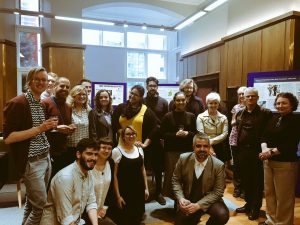 The committee has changed quite a bit this year and we have some great ideas for the coming months so watch this space!
So what do we do? In a nutshell:
- Seminar series
- Socials
- Christmas and end of year parties
- Journal
- Blogging and other social media
- Conference
As we all know, doing your PhD or MA is hardly a walk in the park; everyone is isolated by the uniqueness of their research, which can make it seem like no one really understands what you are going through. We also know that it can be difficult for people to get involved if they don’t live locally, if they work, or are doing their Postgraduate degree part time. That is why, this year, we are making a concerted effort to match our lively presence within the School as well as online – find us also on twitter and facebook!
Posts by NewcastlePGF https://www.facebook.com/NewcastlePGF https://www.facebook.com/groups/PGFNewcastle/We aim to get to know each other better and share our research interests. We will use this space to advertise our events and update you through our monthly newsletters. In the next few days we will collecting information for our postgraduate profiles, which we would like to post up on this site for you all to know who we are and what we do.
There is lots going on, so we hope to see you all at our events and perhaps even blogging for us!
The PGF committee.
- Congratulations to the Winners of our 14th Annual Postgraduate Forum Conference
14th Annual Postgraduate Forum Conference Winners
School of History, Classics and Archaeology
Newcastle University
19th May 2017
‘Movement’
This interdisciplinary one-day conference brought together Postgraduate students studying histories relating to the theme of Movement. How do we study the past, not as static, but as dynamic and changing? How does the movement from one context to another change how we interpret evidence? What are the effects of movement on societies, material, and intellectual cultures? How has the idea of movement, or a movement, been used for political, social, or artistic purposes?
We heard many fascinating papers covering a broad range of topics relating to movement as well as a large array of posters from our very own Masters students.
We are pleased to announce the winners of this years conference are:
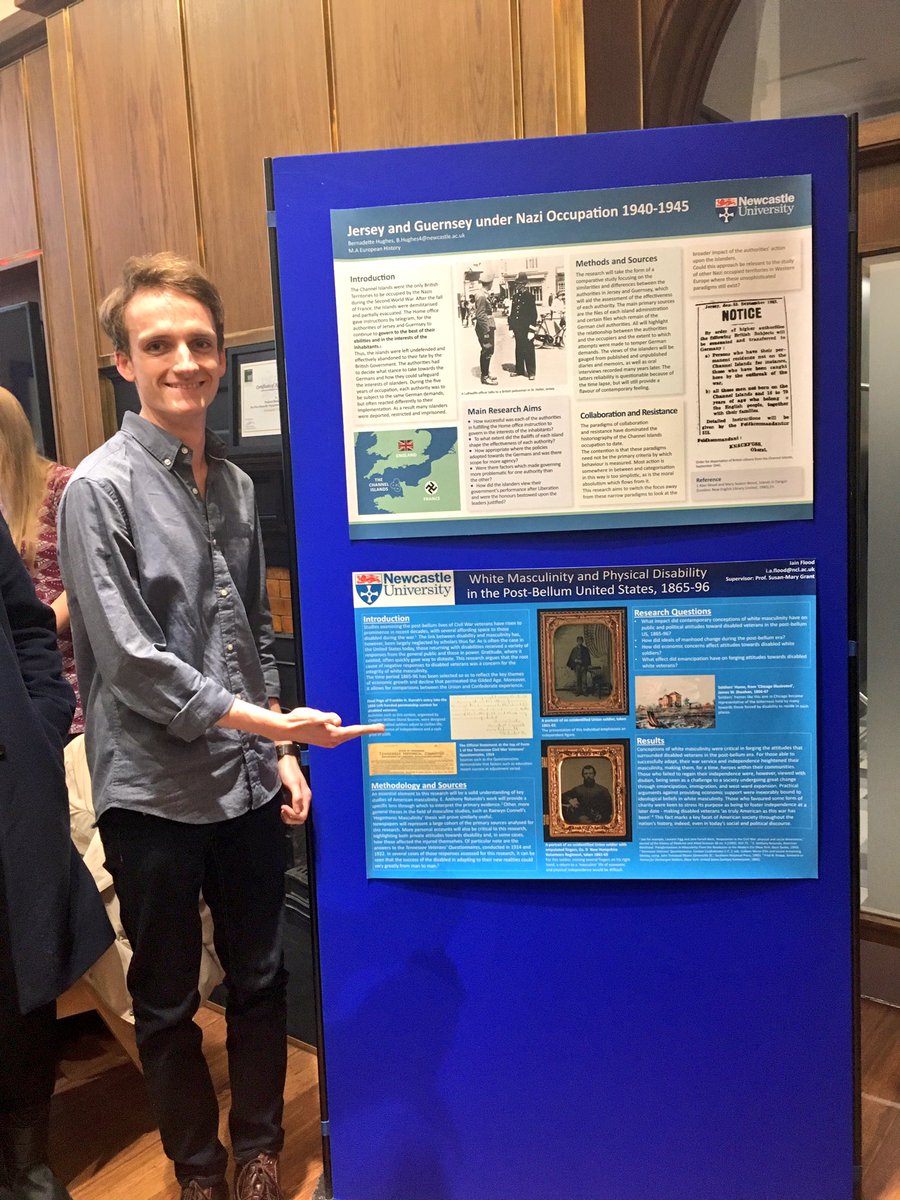
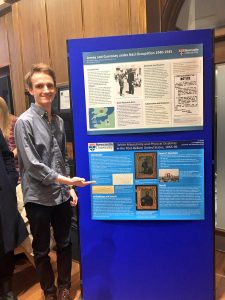
Best Poster: Iain Flood, Newcastle University
“White masculinity and physical disability in the post-bellum United States, 1865-96.”
Best Paper Runner-up: Oznur Ozdemir, Leeds University
“Re‐evaluating an Early Islamic Mass Movement: Looking at the Abbasid Revolution from an Economic Perspective.”
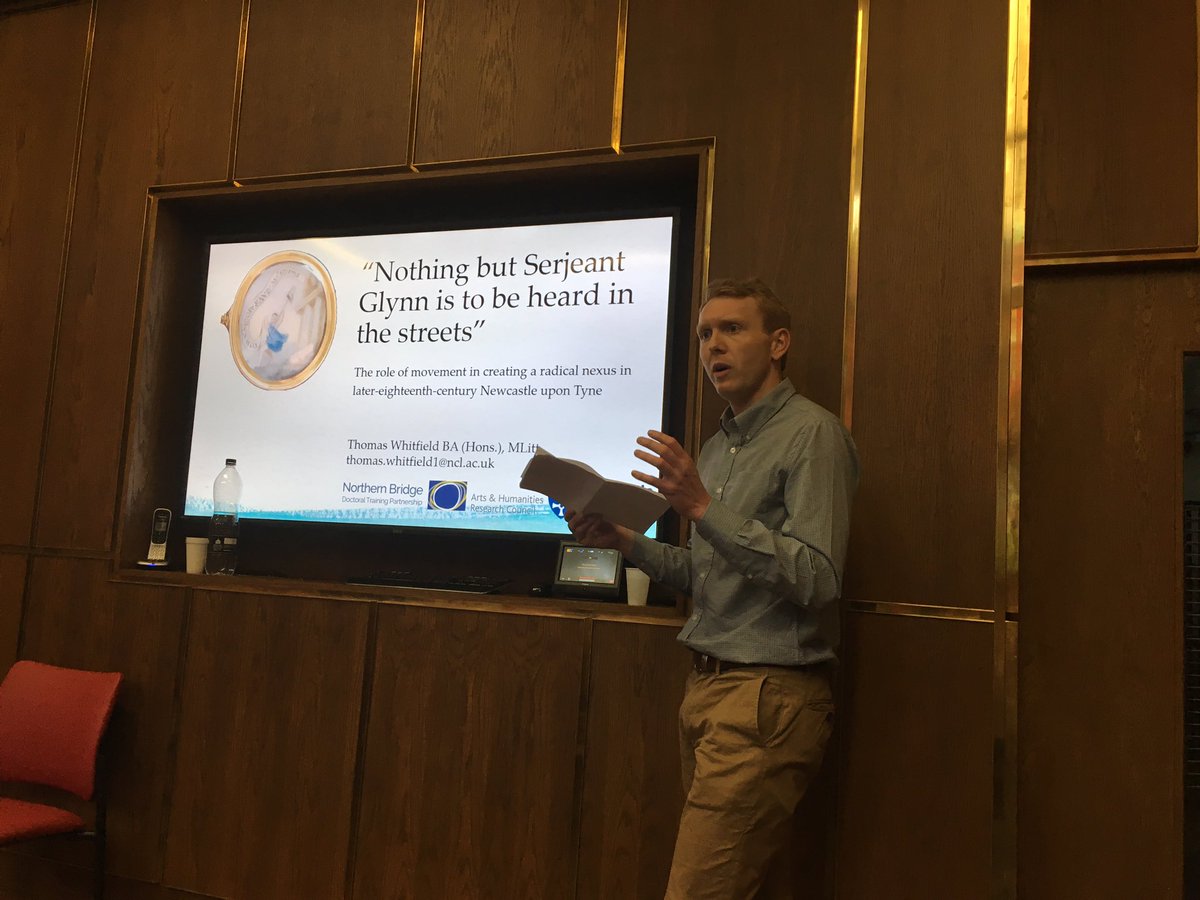
Best Paper: Thomas Whitfield, Newcastle University
“’Nothing but Serjeant Glynn is to be heard in the streets’– The role of movement in creating a radical nexus in later-eighteenth-century Newcastle upon Tyne.”
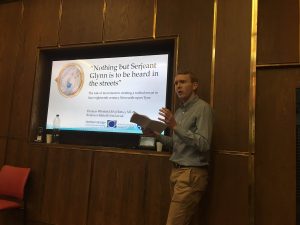
We would like to thank everyone who contributed and attended the conference. It was a huge success, we look forward to next year!
- 14th Annual Postgraduate Forum Conference Program14th Annual Postgraduate Forum Conference School of History, Classics and Archaeology Newcastle University 19th May 2016
‘Movement’
Time Programme 9.00-9.50 Registration and coffee (Armstrong Reception Rooms) 9.50-10.00 Chair’s welcome (Armstrong Reception Rooms) 10.00-11.30 Panel I: Cultural movement (4 papers) chair: tbc (Armstrong Reception Rooms) Fernando Sanchez (Trinity College, Dublin) “(Re)constructing cultural distinctiveness: cultural diplomacy or propaganda? The 1977-1979 touring exhibition, Treasures of Early Irish Art, 1500 B.C. to 1500 A.D.” Amber Roy (Newcastle University) “Identifying movement and use in ground and polished stone” Lakshmi-Pearl Quigley (University of Edinburgh) “Movement and ‘In‐between‐ness’: Liminality in theories about difference in ‘race’ and gender history” 11.30-12.00 Tea/coffee I (Armstrong Reception Rooms) 12.00-13.30 Panel II: Movement and positioning (3 papers) chair: tbc (Armstrong Reception Rooms) Lorena Zanin (University of Leeds) “Who comes, who goes and who stays: movements and interests in the North eastern corner of Italy straddling the foundation of Aquileia.” Sara Borrello (Newcastle University) “Moving Matrons: The case of Servilia” Kimberley Foy (Durham University) “’Keeping State’: Space, performance and languages of diplomacy at the Early Stuart Court, 1603-1642.” 13.30-14.30 Lunch (Armstrong Reception Rooms) 14.30-16.30 Panel III: Social movement (4 papers) chair: tbc Gorka Etxebarria (University of the Basque Country) “From the imminent breakup with Francoism to the Basque National Liberation Movement: the role of ETA armed organisation in a changing political environment (1974‐1983)” Oznur Ozdemir (University of Leeds) “Re‐evaluating an Early Islamic Mass Movement: Looking at the Abbasid Revolution from an Economic Perspective” Emilio Zucchetti (Newcastle University) “Clashes and riots in ancient Rome: a postmodern perspective on Roman social struggles.” Thomas Whitfield (Newcastle University) “’Nothing but Serjeant Glynn is to be heard in the streets’– The role of movement in creating a radical nexus in later-eighteenth-century Newcastle upon Tyne.” 16.30-17.00 Tea/coffee II (Armstrong Reception Rooms) 17.00-18.00 Keynote address (room G17) chair: tbc Graham Smith (Royal Holloway) “Movement in oral history: Revisiting Mrs Smereka remembering her Ostarbeiter journey” 18.00- Prize giving and wine reception (Armstrong Reception Rooms) 19.30- Dinner at Piccolino - Call for Papers – 14th Annual Postgraduate Forum Conference
Call for Papers
14th Annual Postgraduate Forum Conference
School of History, Classics and Archaeology
Newcastle University
19th May 2017
‘Movement’
This interdisciplinary one-day conference seeks to bring together Postgraduate students studying histories relating to the theme of Movement. How do we study the past, not as static, but as dynamic and changing? How does the movement from one context to another change how we interpret evidence? What are the effects of movement on societies, material, and intellectual cultures? How has the idea of movement, or a movement, been used for political, social, or artistic purposes? We welcome any papers exploring the movement of people, objects, and ideas.
We invite proposals for twenty-minute papers from all postgraduate historians, classicists, ancient historians, and archaeologists. Suggested topics include, but are not limited to:
- Migration and population movements
- Journeys and travel
- Trade and connections
- Social movements
- Cultural, Literary or Philosophical movements
- Scientific movements
- Movement of/within the body
- Movement of soul/emotions
- Physical movement such as gesture or dance
We also invite poster submissions from postgraduate students. In order to offer the opportunity to present work in the earlier stages of research, poster submissions are not necessarily required to fit with the theme of the conference.
The PGF Committee is more than happy to announce that keynote this year will be presented by: Dr. Graham Smith (Royal Holloway, University of London), with a paper entitled “Movement in oral history: Revisiting Mrs Smereka remembering her Ostarbeiter journey”.
Please send abstracts of no more than 300 words nshspgf@ncl.ac.uk by 10th April 2016. If you have any ideas, questions or enquiries, please feel free to get in touch.
Tea/coffee and lunch will be provided, and the conference will be followed by a reception where there will be prizes for the best paper and poster. Afterwards, there will be an optional dinner, at extra charge.
Follow us at @NewcastlePGF
https://www.societies.ncl.ac.uk/pgfnewcastle/
- History Lab 2017: Creating Dialogue.

History Lab 2017: Creating Dialogue.
Teesside University, Wednesday 5 April 2017.
The Curve T1.01, 12:30 – 6:00pm
12:30 – 1pm: Registration 1:00 – 2pm: Welcome and Panel 1 – Thinking about Militarism and Peace (Chair: Sophie Roberts) Rowan Thompson, (PhD, Northumbria University) ‘An essential institution in British aviation’: The Air League of the British Empire, Empire Air Day and the creation of ‘airmindedness’ in the 1930s Jasmine Calver, (PhD, Northumbria University) The Comité Mondial des Femmes contre la Guerre et le Fascisme and the Comitern: French and Soviet women’s anti-fascist collaboration in the 1930s 2:00 – 2:20pm: Break 2:20 – 3:20pm: Panel 2 – Rediscovering History through Alternative Sources (Chair: Natasha Neary) Laura Flannigan, (MA, York University) Edmund Dudley’s Tree of Commonwealth and discourses on royal morality in the early sixteenth century Tracey Jones, (PhD, Teesside University) ‘Colliery Amazons and Venuses’: The ‘Picturesque’ Pit Brow Women of Wigan 3:20 – 3:30pm: Break 3:30 – 5:00pm: Panel 3 – Public History and Collaboration (Chair: Rebecca Saunders) Judith Phillips, (PhD, Teesside University) National identity, gender, social class and cultural aspiration in mid-nineteenth century England and France: Josephine Bowes (1825-1874), collector and museum curator Spencer Brown, (MA, York University) ‘What should York remember?’ A community history project Harriet Beadnell, (PhD, York University) Organising Postgraduate Conferences – The pros and cons of planning student-led events and some tips on where to start 5:00 – 5:15pm: Break 5:15 – 6:00pm: Keynote – Dr Ben Roberts (Teesside University), Title TBC 6:30pm: Conference Dinner at Al Forno Restaurant, Southfield Road, Middlesbrough. Please register via: https://www.eventbrite.co.uk/e/creating-dialogue-symposium-tickets-32689403887?aff=eac2 Registration closes on 24th March 2017. - NEWCASTLE CLASSICS AND ANCIENT HISTORY RESEARCH SEMINARS, SPRING 2017Please find below the programme for the Classics and Ancient History Research Seminars taking place this semester at the School of History, Classics and Archaeology, Newcastle University. All seminars begin at 5.00 pm on the given day and, unless specified below, take place in Room 2.50 on the 2nd floor of the Armstrong Building. (A campus map may be foundhere.) Further details about the final session listed below, a commentary workshop on Hesiod’sTheogony led by Profs Jenny Strauss Clay and Athanassios Vergados, will be circulated in due course. I or Micaela Langellotti will be sending out a weekly notice in advance of each seminar, along with contact details about that week’s dinner arrangements. Any enquiries may be directed us at john.holton@newcastle.ac.uk and micaela.langellotti@newcastle.ac.uk.All are very welcome to attend!Wednesday 15th FebruaryYoung Research Panel (PhD candidates, Newcastle University)Roberto Ciucciove: Lex Marcia Atinia: new strategies of communication and legislative productivity within the Romannobilitas at the beginning of the II century BCChris Mowat: An Intersex Manifesto: Naming the non-binary constructions of the ancient worldJames Mullen: Beyond Persianization: the adoption of Near Eastern traditions by Alexander the GreatWednesday 22nd FebruaryDr Rolf Strootman (Utrecht)Global empire, local religion: Religious patronage and imperial integration in the Hellenistic Near EastThursday 23rd February (Room TBC)Dr Claudia Beltrao da Rosa (UNIRIO/Newcastle)Images of the Gods in CiceroWednesday 1st MarchProf. Nicholas Purcell (Oxford)Micro-global history puts the ancient Mediterranean in its placeWednesday 8th MarchDr Jamie Wood (Lincoln)From Cyprian to Priscillian: making and breaking bishops in late Roman Spain,ca. 250-ca. 400Wednesday 15th MarchProf. Costas Panayotakis (Glasgow)The collection of Latin moral maxims attributed to the playwright PubliliusWednesday 22nd MarchDr Caroline Vout (Cambridge)Classicism Meets Modernity: Greek and Roman Art in the Nineteenth CenturyWednesday 26th AprilDr Katherine McDonald (Exeter)Writing women: understanding the goddess ReitiaWednesday 3rd MayDr David Lewis (Nottingham)Occupational hazards: measuring the extent of the division of labour in the economy of classical AthensWednesday 10th MayDr Oliver Passmore (Newcastle)Deixis and Identity in the OdysseyWednesday 17th MayDr Lisa Hau (Glasgow)Pathos with a Point. Reevaluating ‘Tragic History’Wednesday 24th May (Room 1.04, Armstrong Building)Prof. Jenny Strauss Clay (Virginia) and Prof. Athanassios Vergados (Heidelberg/Newcastle)Workshop: Commentary on Hesiod’s Theogony
- Newcastle University Roman Archaeology Seminar Series, Semester 2 Winter/Spring 2017All the following seminars are on Tuesdays at 18:00 hrs in Armstrong Building room 1.06 7 Feb 2017 – James Harland (York University) ‘The End of Roman Rule and the Adventus Saxonum: Rethinking Ethnicity in post-Roman Britain’ 21 Feb – Simon Esmonde Cleary (Birmingham University) ‘The Mediterranean Mattered More: Imperial weakness and local responses either side of the Channel at the turn of the fourth and fifth centuries A.D.’ 28 Feb – Indra Werthmann (Durham University) ‘The Image of the Past: Reassembling identities through Roman objects in early Anglo-Saxon society, 5th to 7th century AD’ 7 Mar – Barbara Birley (Vindolanda Trust) ‘Recent work at Vindolanda, excavations and artefacts’ 14 Mar – David Breeze (Edinburgh) ‘Bearsden: Life in a Roman fort’ 21 Mar – Alexis Haslam (Pre-Construct Archaeology) ‘Industry and Magic: Quarrying and Selective Deposition in Ewell, Surrey’ 25 Apr – TBA 2nd May – TBA All welcome. Colleagues wishing to join the speaker for dinner are asked to contact Tatiana Ivleva (Tatiana.ivleva@ncl.ac.uk) in advance
- Newcastle University History Seminar Series, semester 2, 2016-7All the following seminars are in Armstrong Building room 1.03. Professor Richard Clay, Professor of Digital Humanities, ‘Vandalism and Terrorism during the Revolutionary France’, Wednesday, 22 February. 3.30pm. Dr Michael Pierse, Queens University Belfast, ‘Thinking Globally about Irish Working-Class Writing?’, Wednesday 1 March, 5pm. Professor Thomas Scharf, Professor of Social Gerontology, ‘Constructing home over the life course in rural Ireland: towards a model of at-oneness’, Wednesday, 15 March, 5pm. Dr Laurence Marley, National University of Ireland, Galway, ‘Empire, faith and class in a Belfast mill district: 1914-21’, Wednesday, 22 March, 5pm. Dr Brian Kelly, Reader in American History, Queen’s University Belfast ‘WEB Du Bois, Black Agency, and the “Slaves’ General Strike”: Problems in the Historiography of US Emancipation’, Wednesday, 3 May, 5pm. Dr Emma Cheatle, NUHRI Post-doctoral Research Fellow, Newcastle University, ‘Object, Landscape and Confinement in the Writing of Mary Wollstonecraft’, Wednesday, 10 May, 5pm. Professor Neville Kirk, Manchester Metropolitan University, ‘Transnational Radicalism: The Case of Tom Mann and Robert Samuel Ross’, Wednesday, 17 May, 5pm. All welcome. We particularly welcome PG students. Refreshments provided
- CALL FOR PAPERS – MOVEMENT: THE 14TH ANNUAL PGF CONFERENCE
Call for Papers
14th Annual Postgraduate Forum Conference
School of History, Classics and Archaeology
Newcastle University
19th May 2017
‘Movement’
This interdisciplinary one-day conference seeks to bring together Postgraduate students studying histories relating to the theme of Movement. How do we study the past, not as a static, but as dynamic and changing? How does the movement from one context to another change how we interpret evidence? What are the effects of movement on societies, material, and intellectual cultures? How has the idea of movement, or a movement, been used for political, social, or artistic purposes? We welcome any papers exploring the movement of people, objects and ideas.
We invite proposals for twenty-minute papers from all postgraduate historians, classicists, ancient historians, and archaeologists. Suggested topics include, but are not limited to:
- Migration and population movements
- Journeys and travel
- Trade and connections
- Social movements
- Cultural, Literary or Philosophical movements
- Scientific movements
- Physical movement such as gesture or dance
We also invite poster submissions from postgraduate students. In order to offer the opportunity to present work in the earlier stages of research, poster submissions are not necessarily required to fit with the theme of the conference.
Please send abstracts of no more than 300 words to nshspgf@newcastle.ac.uk by 10th April 2017. If you have any ideas, questions or enquiries, please feel free to get in touch.
Follow us at @NewcastlePGF
- PGF EVENT NEWSLETTERPGF Event Newsletter Week ending on Sun 19 February 2017 Research Seminars • 21 February, 6pm @ Armstrong Bldg. 1.06: The Mediterranean Mattered More: Imperial weakness and local responses either side of the Channel at the turn of the fourth and fifth centuries A.D. • 23 February, 5pm @ Armstrong Bldg. 2.16: ‘Mirrors for Men: New findings with respect to Technology and Culture of Medieval Swords from Europe and Japan’ between medieval Europe and Japan • 9 March, 5pm @ Armstrong Bldg. 2.16: Settlement and Social Power: Landscapes of Authority in Early Medieval England • 6-7 March, Time TBA @ Newcastle University: Ancient Conceptions of Music: An interdisciplinary workshop Newcastle Events • 22 February, 3:30pm @ Armstrong Bldg. 1.03: ‘Vandalism and Terrorism during the Revolutionary France’ • 1 March, 5pm @ Armstrong Bldg. 1.03: ‘Thinking Globally about Irish Working-Class Writing?’ PGF Seminar This Wednesdays @ 1pm: Armstrong Bldg. 1.03 GO TO OUR FACEBOOK PAGE FOR MORE INFORMATION! @NEWCASTLEPGF ***If you would like to promote your event, please email us! (A.S.Martinez- Lopez2@newcastle.ac.uk) ***
- REFLECTIONS ON JUDITH BUTLER AND KINSHIP TROUBLE by Chris Mowat
Reflections on Judith Butler and Kinship Trouble.
Last Wednesday I had the chance to travel to London for the 2017 Housman Lecture given by Professor Judith Butler, hosted by the Department of Greek and Latin, UCL. For those not familiar with her work, Professor Butler is perhaps best known for her ground-breaking work in Gender and Queer Theory, and has published much on these topics over the past three decades, as well as on psychoanalysis, power structures and identity politics. The lecture was called “Kinship Trouble in The Bacchae”, a discussion of what we mean by “kinship”, how we form/break kinship bonds and, to keep in theme with the lecture series, how we can see these bonds and roles played out in Greek tragedy. The lecture is available to stream (https://www.youtube.com/watch?v=ixwrw0PMC8I), and it is well worth watching if you get the chance, so I won’t repeat the content here, but there are a couple of things that, I think, are worth reflecting on. Firstly, though it does not relate to the lecture directly itself, it was important the way in which Butler began by pointing out the fact that the lecture had been scheduled to be in a room with no disability access. There is a particular irony here, given Professor Butler’s lifelong work on bodies and how they affect identity politics, and the fact that she is a major influence on Disability Studies as a discipline. The room situation was not originally the case, but the university moved the lecture on account of so many people booking tickets. ‘Room for more people’ doesn’t seem to me, however, a good enough reason to deliberately exclude others based on accessibility, contravening the Equality Act 2010. The room we were in looked quite newly built (or at least newly redesigned), so one wonders why the room was designed without access for everyone in mind? Universities and institutions will use the excuse of old buildings and old designs as the reason why they are restricted in how they can design their rooms, but, in all the constant building work and redesigns that happen on campuses (and I think of our own Armstrong Building, which has been a building site for as long as I have been here), this excuse seems somewhat lacking. Butler explained that though the room was out of her control, she had made opportunities to meet with those who had been unable to attend, over the following few days. But this is certainly something we should probably all be thinking more about in planning and attending academic events. The lecture itself was then a tour de force of Butler’s usual style of questioning norms and structures we presuppose to be in place by showing that, often, they are only retroactively seen to have been there when they are broken, or at least pushed to extremes. Kinship is more than just a biological, familial bond, a fact particularly prevalent in structures of ‘queer kinship’, but how far does it go, and why is it always necessarily so fragile? At what point does one become ‘kin’, and what effect does that have on the way we treat others? The lessons that Butler brought from Greek tragedy, particularly Euripides’ Bacchae, was that they make it evident we need laws about and knowledge of kinship, and kinship boundaries, in order to not commit violent acts against kin. But this opens a whole new set of questions, not least leaving us wondering if that, then, means it is okay to commit violent acts against non-kin; similarly, when we look at the number of domestic abuse cases, and the statistics of crimes committed by family members and loved ones upon each other, does knowledge of kinship really stop violent acts? The title of the lecture was obviously referencing to Butler’s seminal first monograph, Gender Trouble (1990), and indeed the concept of kinship got the level of treatment given to the concept of gender in that earlier work. But what I found particularly interesting was the way Professor Butler brought the conclusions of these two lines of questioning. Gender Trouble has a feeling of dissatisfaction of the social structures that pervade and restrict certain people through enforcing conformation, and the lingering question of whether we really need them; “Kinship Trouble in the Bacchae” has a feeling of dissatisfaction at different social structures, but left the lingering question of whether we have a responsibility to operate and utilise those structures, extending the boundaries of “kin” to protect and help others on an immediate but also a global scale. Chris Mowat, - FIVE TIPS FOR… AN ERASMUS SEMESTERI spent a semester at Leiden University, Netherlands, under the Erasmus scheme. I t was a great experience; I gained new skills, made amazing friends, and saw wonderful places. Here are a few tips on how to get the most out of your semester abroad:
 One. Pack well
One of the best things I did before I left was really think about what I wanted to take with me. I flew, so I only had hand luggage and a 20kg bag in the hold. Sounds loads right? Nope!
 It turned out to be quite hard to pack 4 months into just two bags.
My suggestion is to make a list of the essentials before you pack so you don’t leave anything you really need behind.
But all is not lost, the postal service is great!
 Two. Get to know your neighbours
Accommodation varies between cities. You may end up halls, or in private housing. But, wherever you end up get to know those around you.
I lived in a studio flat in a building made up of likewise apartments. It was great living on my own but if I hadn’t met my neighbours I think I would have been quite lonely, especially as I lived far away from the friends I made at Uni.
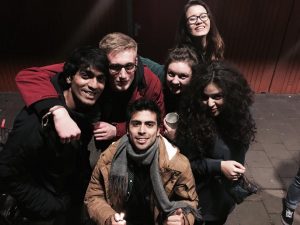 So…
If you live in a building or halls there may be a group on Facebook you can join – I posted on a group like this saying knock on my door to say hi, and people did!
You should also knock on your neighbours doors, go out and say hi when you hear people talking outside your room. And, if there is a communal area, use it!
 Three. Explore
A semester abroad is a great opportunity to see and experience new places. Start by getting to know the city you live in, I find walking the best way. Arm yourself with a map and don’t be afraid of getting a
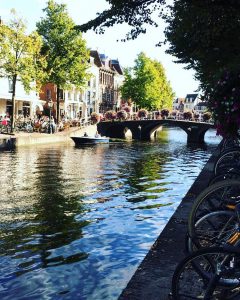 bit lost, sometimes the best places are found this way
Also, take advantage of being in Europe, there are loads of cheap connections by coach and train to various European cities. Have fun!
 Four. Embrace new Language
Although there are many who people begin an Erasmus semester as part of a language course there are also just as many who don’t and could spend their whole time speaking their native language. Yes, this is easy, especially when a lot of people speak good English, but why not take advantage of your new location to learn a new language! Or at least a few words, it is respectful and they will always come in useful.
 Five. Look after yourself
You’re in a new city, there is so much to experience – A new nightlife to explore; a different dating scene. Have fun, but remember to look after yourself. No one wants to get ill, or even worse, hurt! So remember to be careful, and look after yourself..
- Don’t drink too much if you are unsure of your way around,
- Try to have a few good nights of sleep,
- Eat properly, I am sure this wont be hard with a new countries cuisine to try!
- Date responsibly
- Most importantly – explore, get involved, socialise, and have fun!
- VISUALISING LABOUR: CALL FOR PAPERS
Workers and Work in Photography and Film
The Labour and Society research at Newcastle and Northumbria Universities is organising a two-day conference on the photographic and filmic representations of labour on the 5th– 6th May 2017 at Newcastle University. There will be keynote addresses from Professor Jonathan Long (Durham University) and Dr Simon Dell (UEA). We would welcome short abstracts (300 words) for papers relating to any aspect of the conference’s theme. Visualising labour is not a neutral process. Surveillance, propaganda and advertising have depicted labour on behalf of capital or the state. Through genres such as social documentary or activist film and photography, that hegemony has been challenged. This conference seeks to draw together labour historians and scholars of visual culture to examine the visual representations of labour. This cross-disciplinary dialogue has the potential to develop a fruitful exchange of insights, affinities and critical perspectives. We particularly encourage papers from those working in the following areas: · Media representations of work and workers. · Worker-photography movements. · Photographic or filmic representations of the experience of working people. · Gender and the visualisation of labour. · The relationship between photography or film and labour movements. · Photography of place and labour. · Visual imagery, memory and labour. · Photography and emotional labour. · Representations of unemployment and the unemployed. Please submit abstracts (300 words) and a short CV to Ben Partridge at b.partridge@ncl.ac.uk before 31st January. - Democracy and people power conference, DurhamThis cfp could be of interest to some of us – contact the organisers for more information. Call for Papers: “We the People: We the People: Democracy, Democratization and people power in the 21st Century”. Conference organized by the SGIA PhD Association 8th December 2016 Senate Suite, Durham Castle. Building on last year’s successful conference, this conference is organised to offer doctoral researchers across all universities in the North East (Northumbria, Sunderland, Teesside, Newcastle and Durham) an opportunity to present their work and receive feedback from peers and academics in a cooperative environment. Moreover, participants will be able to gain invaluable experience in conference participation and have the chance to expand their network with other students in the region. The conference will address three main areas: theories of democracy, democracy in state institutions and democracy outside and beyond the state. Submissions with a national, regional or global focus are all welcome, and are expected to contribute to academic debate either in a theoretical, empirical, or methodological perspective. Abstract length should be no longer than 200 words, and should include the title of the proposed paper, the author’s name and institutional or departmental affiliation. Please send your abstracts to Edward Walker or Elisabeth De Vega Alavedra at sgia.pa@durham.ac.uk by the 15th of July 2016 deadline. We look forward to receiving your abstracts! Best wishes, Edward Walker and Elisabeth de Vega Alavedra for the SGIA PhD Association For more information on the SGIA PhD Association, email us at sgia.pa@durham.ac.uk or contact us through Facebook at https://www.facebook.com/groups/sgia.phd.association/
- 13th Annual Postgraduate Forum Conference
Room 2.22, Research Beehive, Newcastle University‘Individuals and Communities’
20th May 2016
9.00 – 9.15 Tea and Coffee Panel 1 Chair: Lauren Emslie 9.15 – 9:45 George Scratcherd (University of Oxford) The four horsemen of the AME Church: ‘Great Men’ and the challenges of black church historiography. 9.45 – 10.15 James Mullen (Newcastle University) God, King, and the Land: The relationship between Neo-Assyrian Kings, their subjects and the God Aššur. 10.15 – 10.45 David Astbury (Newcastle University) Can path creation theory restore the agency of individuals and communities in the past? 10.45 – 11.15 Tom Whitfield (Newcastle University) “Wilkes and Liberty”—Punch bowls and the later-eighteenth-century Wilkite agitations. 11.15 – 11.30 Tea and Coffee Panel 2 Chair: Amy Shields 11.30 – 12.00 Mareike Ahlers (Newcastle University) All for One and One for All—Identifying heterarchial structures in Early Neolithic barrow building communities. 12.00 – 12.30 Henry Clarke (University of Leeds) Negotiating individual identities within the community in Central Spain, 2nd century BC – 2nd century AD. 12.30 – 1.00 Kate Caraway (University of Liverpool) Group size and community cohesion in Archaic Greece: Towards a methodology. 1.00 – 2.00 Lunch and poster session Panel 3 Chair: Lucy Cummings 2.00 – 2.30 John Bowman (Newcastle University) Derwentcote Forge Cottages: A steel making community in the Derwent Valley 1841-1891. 2.30 – 3.00 Lawrence Mills (University of Glasgow) Building the Old College 3.00 – 3.30 Alberto Cafaro (University of Pisa) Praefecti fabrum and Roman politics. 3.30 – 4.00 Andrew Marriott (Newcastle University) Entrenched Views. Accessing the people of the First World War through Material Culture 4.00 – 4.30 Tea and Coffee 4.30 – 5.30 Keynote: Dr Valentina Arena (UCL) ‘The Individual and the Community in Republican Political Thought’ 5.45 Reception and prize giving (Student Common Room, Armstrong Building) - PGF Conference ProgrammeIt’s that time of year again: the sun is out, the birds are singing… and the PGF Conference is soon! The theme for this year’s conference, if you didn’t know it yet, is Individuals and Communities. We have a great day lined up for you, some interesting papers from across the disciplines and across the country (and beyond!), so come along to the Research Beehive on campus on 20th May. There will also be posters on postgraduate research. You can find the programme here. UPDATE: The research beehive can be found at number 25 on the campus map. You can follow us @NewcastlePGF for information and live tweeting. Use the hashtag #PGFConference to join the discussion.
- Exploring Classical and Historical Northumbria: Warkworth CastleDr. Susanna Phillippo will be continuing her ‘Exploring Classical and Historical Northumbria’ trips this Sunday (17th April) with a visit to Warkworth Castle and Hermitage. Details are as follows: Depart c. 12.10, return c. 18.05 Cost: £7.80 for transport A visit to the impressive medieval Percy fortress in the scenic town of Warkworth. • Picturesque town dominated by showpiece medieval castle, home to a number of key players in English history, notably the Percy family (the original ‘kings in the north’). • Wars of the Roses, the English Civil War and several wars with Scotland(!) feature among the many historical events in which the castle and town played a part. • Castle features in Shakespeare’s *Henry IV* plays: the scenes which he set here make use of elements from classical writers Plutarch and Virgil — we shall hear about these on site, and visit the exact locations! • Unique 13th-century hermitage elaborately carved out of the solid stone of the river bank. As with previous trips, entrance to the castle is free by special arrangement with English Heritage. We travel by bus: the X18 from Haymarket bus station, outside Marks and Spencers. Schedule: Meet at Haymarket bus station (usually Stand Q), ideally by *12.05*. Catch 518 bus at 12.13. Arrive Warkworth (via part of the scenic Northumbria coastal route) 13.40 Best to bring sandwiches to eat on the bus: refreshments including hot drinks are available at the Castle but there’s no cafe as such. The bus drops us close to the castle; we’ll have ample time to explore it, and hopefully the hermitage (to which visitors are ferried by English Heritage rowing boat!) before heading downhill into the village for a refreshment stop in one the village’s excellent cafés/pubs (one of the latter serves particularly good scones!). We will aim for the 16.37 bus back from Warkworth, getting back to Haymarket at 18.06. Buses leave at 37 minutes past each hour, though, so you can catch an earlier or later bus back if you like. Cost: An Arriva all-day ticket (£7.80) is the cheapest option. Entrance to the castle is free; otherwise, just bring money for refreshments. If you would like further details, email Dr. Phillippo at susanna.phillippo@newcastle.ac.uk.
- Newsletter, week 12.04.16Sorry the newsletter is late this week (IT fault…). If you would like to promote an event, please get in touch (m.ahlers1@ncl.ac.uk). Research Seminars Archaeology: Tuesday 12th April, 6-8 pm, Armstrong Building, Room 1.06 Stephanie Moat (Newcastle University): ‘New Perspectives on Provincial Religious Statuary: A Case Study from Roman Britain and North Africa’ Classics and Ancient History: Wednesday 13th April, 5-7 pm, Armstrong Building, Room 2.50 Eric Csapo (Sydney): ‘Choregic dedications and what they tell us about comic performance in the fourth century BC’ Further School Events The Extraordinary Gertrude Bell Exhibition 30th January 2016 – 3rd May 2016, Great North Museum Newcastle University Public Lectures 14th April, 5:30-6:45pm, Curtis Auditorium, Herschel Building Sian Reynolds (Professor of French, University of Sterling): ‘Children of the revolutionaries’ Live Music 14th April, 1:10-2pm, Brunswick Methodist Church, Newcastle Sarah Beth Briggs (piano): Beethoven: Bagatelles, Op. 199, Nos. 1-4 Hayden: Sonata in C, Hob XVI/50 Debussy: Reflets dans l’eau (from first book of Images) Chopin: F Minor Fantasy, Op. 49 Free admission 14th April, 4:30-5:30pm, Spaces 4 and 5, Culture Lab, King’s Walk Student Performances including Alex Guthrie (piano), Nishant Verma (drums), Mark Johnson (drums), Joe Harmsworth (guitar), Grace Alexander (keys) Free admission, limited capacity
- Just a minute with… Emma Nicholson
 Dr. Emma Nicholson finished her PhD on Philip V of Macedon in Polybios’ Histories at Newcastle in December 2015 and is currently teaching in the department. her research interests include Hellenistic history, historiography, epigraphy, leadership, cultural politics, cultural values and interstate relations. Traveller, artist, lover of movies, good food, good beer, and books. find her on Twitter.
- How did you come to be interested in your current area of research?
- What advice would you have for current UG or early stage PG students?
- What book are you currently reading?
- If you were a biscuit, what sort would you be?
- What has been the highlight of your week?
- What is the most important life skill you learnt whilst being a PGR student?
- Do you have favourite hidden gems of Newcastle?
- What has been the most significant/memorable moment of your academic career so far?
- What do you enjoy the most about being part of the history, classics and archaeology department at Newcastle?
- What would your perfect day away from work be?
- What is your favourite movie quote?
- What’s next for Emma?
- ScARF student networkThe Scottish Archaeological Research Framework (ScARF) will be giving a seminar 12-13 on 21st March in Armstrong 2.09. This will be a great opportunity for anyone working on aspects of Scottish history and archaeology to network and think about their own research in the wider context. More details can be found here.
- Newsletter, week 22.02.16Once again, the newsletter. If you would like to promote an event, please get in touch (m.ahlers1@ncl.ac.uk). Research Seminars Archaeology: Monday 22nd February, 5-7 pm, Armstrong Building, Room 2.28 Dr Eugene Costello (NUI Galway)’ Booley houses and herders: an historical archaeology of transhumance in the west of Ireland’ History: Wednesday 24th February, 5-7 pm, Armstrong Building, Room 1.04 Aditya Sarkar (University of Warwick): ‘Arrears Due: Wage-Payment and the Labour Question in Late-Colonial Bombay’ MedLAB: Thursday 25th February, 5-6.30 pm, Armstrong Building, Room 2.16 Philip Garrett (Newcastle University): Title TBC Further School Events The Extraordinary Gertrude Bell Exhibition 30th January 2016 – 3rd May 2016, Great North Museum Newcastle University Public Lectures Tuesday 23rd February, 5:30-6:45pm, Curtis Auditorium, Herschel Building Helen Berry, Professor of British History, Newcastle University: Gertrude Bell and the ‘Woman Question’ Free admission Thursday 25th February, 5:30-6:45pm, Curtis Auditorium, Herschel Building Clive Morton OBE, Professor of Corporate Governance and Business Development, Middlesex University Business School: Tackling uncertainty in organisations –the future: opportunity or threat? Live Music Thursday 25th February, 4:30-5:30pm, Spaces 4 and 5, Culture Lab, King’s Walk Student Performances Including Desmond Lau (clarinet), Masoud Hardan (guitar), Joe Reeve (saxophone), Abigail Brierley (trumpet), Liam Mulpetre (guitar) Free admission, limited capacity
- Newsletter, week 15.02.16The return of the weekly newsletter! If you would like to promote an event, please get in touch (m.ahlers1@ncl.ac.uk). Research Seminars Archaeology: Archaeology Seminar Series Thursday 18th February, 4-5 pm, Armstrong Building, Room 2.16 Andy Jones (Cornwall Archaeological Unit): ‘The Whitehorse cist’ Classics and Ancient History: Wednesday 17th February, 5pm, Armstrong Building, Room 2.50 Ruth Morello (Manchester): ‘Making Fabricius take the cash: traditional exempla andhte problem of modernity’. Further School Events The Extraordinary Gertrude Bell Exhibition 30th January 2016 – 3rd May 2016, Great North Museum Newcastle University Public Lectures 16th February, 5:30-7pm, Curtis Auditorium, Herschel Building The British Academy Debates: ‘does religion do more harm than good? ‘ If you would like to attend please register at www.britishacademy.ac.uk/faith Live Music 18th February, 1:10-2pm, Brunswick Methodist Church, Newcastle Rose Consort of Viols (Ibi Aziz, John Bryan, Alison Curm, Andrew Kerr, Roy Marks) ‘Flights of Fancy: fantasias, In nomines and dance music from Tudor and Stuart part-books, including music by Tallis, Byrd, Ferrabosco, and Holborne’ Free admission 18th February, 4:30-5:30pm, Spaces 4 and 5, Culture Lab, King’s Walk Student Performances Including Dan Lewis (drums), Sarah Berry (violin), Dario Lozana-Thortnon (guitar), Rosie Brownhill (piano accordion) Free admission, limited capacity
- Just a minute with… Chris Mowat
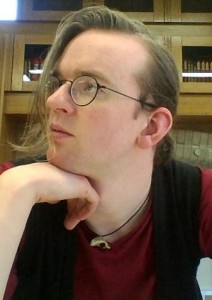 Chris Mowat is a second year Classics and Ancient History PhD student, and our current IT and Social Media person. His research is on gender construction and divination in the Roman world. He is also organising AMPAH 2016. He is on twitter @chrismologos
Though currently away on research in Germany, we still managed to get him to answer a few questions…
- If you could time-travel back to any moment in the past where and when would it be?
- What book are you currently reading?
- What did you want to be as a child?
- Can you describe your research in three words?
- What are your three most overused/cliché words or phrases?
- What’s the worst Classics-related joke that you’re heard and/or are guilty of telling?
- Have you got any hidden talents?
- If given complete freedom to start over, what profession would you like to do and why?
- What is your favourite movie quote?
- Individuals and Communities: the 13th Annual PGF conference
20th May, 2016
Humans are often considered ‘social animals’, existing only within larger groups, though still maintaining a unique identity. This interdisciplinary one-day conference seeks reflect on the shifting relationship between individuals and communities across history. Defining the relationship between the individual and a (or several) social group(s) is difficult task. A community and an individual often construct carefully curated identities, which are either mutual or distinct. Humans have constantly created communities, approaches to the study of which are wide-ranging and indeed interdisciplinary. Equally, throughout our history individuals have emerged and their eminency has endured the test of time. Prominent and conspicuous these great individuals stand as role-models and exempla. Yet others, individuals who are not famous (either in their own, or our time) often prove to be just as important. What role can we, as historians and archaeologists, play in reviving and bringing back the individual from a historical period, ancient or more modern? Can we restore their agency? How important is the individual experience in society? How are communities organised?We invite proposals for twenty-minute papers from postgraduate historians, classicists, ancient historians, and archaeologists. Suggested topics include, but are not limited to:· Individuals in communities· Individuals outside communities· Outsiders and exile· Individuals in history· Agency· ‘Great-Man’ theory· Public and private religion· Organisation(s) and landscape· Social roles· International relations· Social communication· Family· Gender and sexuality· Creating society· Class and raceWe also invite poster submissions from postgraduate students. In order to offer the opportunity to present work which is in the earlier stages of research, poster submissions are not necessarily required to fit with the theme of the conference.Please send abstracts of no more than 300 words to l.emslie@ncl.ac.uk by Friday 1st April 2016. If you have any ideas, questions or enquiries, please feel free to get in touch. - PGF Lunchtime SeminarThe next lunchtime seminar is Wednesday 20th, at 1pm, in Armstrong 1.04. John Bagnall (History) will be talking to us about : The New Official History: Charles Moore, Margaret Thatcher and the Falklands Crisis ‘Earlier this year, Charles Moore released the second of his three volume official biography of Margaret Thatcher. Moore was given unrivalled access to, not only Thatcher herself, but her wealth of private papers concerning her time as British Prime Minister. His first volume, published in 2013, ended with the Falklands Affair of 1982 and the second volume, picks up from this point and continues until the end of her time in office. The Falklands Affair was a dispute between the United Kingdom and Argentina over the sovereignty of the Falkland Islands. The dispute garnered international tension when a nine week conflict was fought between the two nations in 1982. Moore’s work uses Thatcher’s own papers and memory of the affair to give a new account of the conflict. As this work was undertaken before the source material was released for public research purposes, it is at the forefront of study of 1980s British Political history. This paper aims to examine what Moore adds to the existing knowledge of the Falklands Affair in the context of Lawrence Freedman’s two volume Official History of the Falklands Campaign published in 2005. Freedman too was given access to source material from government departments before it was released to the public and produced, at the time, the most comprehensive study of the Falklands Campaign that had been done. This paper compares the work done by Moore to the work of Freedman to highlight what new insights Moore has offered on the Falklands Affair. This paper scrutinises the source material used by each author as well as their methodologies and conclusion to produce an analysis of how much has been added by Moore to our understanding of one of the most crucial aspects of Thatcher’s Britain, the Falklands Affair.’ Come along for discussion, tea, coffee and biscuits!
- Default title
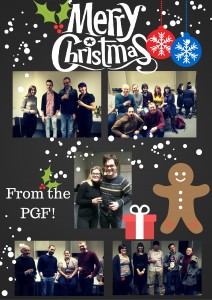
See you in the New Year!
- Just a minute with… Amy Shields
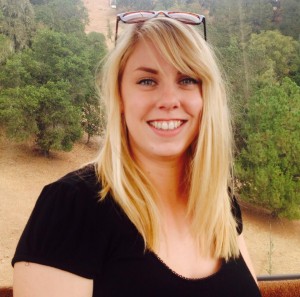 Amy Shields a third year history PhD student, and current editor of our postgraduate journal, Pons Aelius. Her research focuses on seventeenth century republicanism in England, Venice, and the Dutch Republic. She is on twitter @ahshields90
- What did you want to be as a child?
- What advice would you have for current UG or early stage PG students?
- What is the most important life skill you learnt whilst being a PGR student?
- What has been the most significant/memorable moment of your academic career so far?
- If given complete freedom to start over, what profession would you like to do and why?
- What book are you currently reading?
- What has been the highlight of your week?
- Do you have favourite hidden gems of Newcastle?
- Newsletter, week 14.12.2015It is the last week of term before Christmas, just a couple of things are happening this week, then we are all free! Happy holidays everyone! PGF Lunchtime Seminar Thursday 17th December, 1-2pm, Armstrong Building, Room 3.41 Amber Roy and Andrew Marriott (both archaeology) Research Seminars Archaeology: Roman Archaeology Seminar Series Tuesday 15th December, 6-7:30 pm, Armstrong Building, Room 1.06 Tatiana Ivleva (Newcastle University): ‘Global adornments: glass banlges in Late Iron Age Roman period Europe and Britain’ History: Wednesday, 16th December, 5-7pm Armstrong Building, Room 1.04 Mark Knights (Warkwick University): ‘Corruption and anti-corruption in seventeenth and eighteenth century Britain’
- Christmas Party – Tonight!

- Newsletter, week 7.12.15There is a lot going on this week, so here is this week’s events newsletter. If you would like to promote an event, please get in touch (m.ahlers1@ncl.ac.uk). PGF The Importance of being ‘Visible’ Tuesday 8th December, 6:30pm, Armstrong Building, Room 3.38 Question and answer session on academic life and career perspectives Ask your own questions beforehand on twitter and facebook #AskThePGF PGF Christmas party Friday 11th December, 5.30pm, Armstrong Building, Room 1.09 Everyone is welcome Research Seminars Archaeology: Roman Archaeology Seminar Series Tuesday 8th December, 6-7:30 pm, Armstrong Building, Room 1.06 David Mason (Durham County Council): ‘Research excavation at Binchester Roman fort and extra-mural settlement’ Classics and Ancient History: Monday, 7th December, 5-7pm Armstrong Building, Room 2.50 Hector Williams (UBC): ‘Goddesses, Whores, Vampyres and Archaeologists: Excavating Ancient Mytilene’ Further School Events Archaeology Careers Fair Wednesday 9th December, 4pm, Armstrong Building, Room 1.06 Archaeology drinks Wednesday 9th December, 5:30pm, Armstrong Building, Room 1.06 Newcastle University Public Lectures
9th December, 5:30-6:45pm, Curtis Auditorium, Herschel Building Baroness Altmann (Minister of State for Pensions) ‘Pensions and ageing society’
- Just A Minute With… Dr. Rob Dale
 Dr Rob Dale is Lecturer in Russian History, specialising in twentieth-century Russian and Soviet history, especially the late Stalinist period (1945-1953). He studied for a BA in History at York, an MA in History at the School of Slavonic and East European Studies and a PhD in Russian History at QMUL. Find him on twitter @DrRobDale
- Which famous historian would you most like to meet for a drink, and why?
- What advice would you have for current UG or early stage PG students?
- What book are you currently reading?
- What is the most important life skill you learnt whilst being a PGR student?
- What do you enjoy the most about being part of the history, classics and archaeology department at Newcastle?
- What would your perfect day away from work be?
- What’s the question you’d most like to have been asked (and why)?
- If given complete freedom to start over, what profession would you like to do and why?
- What is your favourite movie quote?
- What’s next for Rob?
- Organising a Conference, or: How to act like a swan!By Mareike Ahlers (Archaeology PhD) Graciously gliding across the water, swans have the uncanny ability to present a serene picture of themselves to the world above the water. Underneath the water, however, their feet are paddling frantically to keep them afloat. This sounds very much like organising a conference. On the 20/21st November 2015, my colleague, Lucy Cummings, and I hosted the 2nd Neolithic and Early Bronze Age Research Student Symposium (NEBARSS). Full of new experiences, it was both our first go at organising a conference and our first time presenting an academic paper. You can imagine then, that this was a little daunting! Our conference was a great success. Everyone—guests, colleagues, and staff—was really pleased with how it went. Our effort and organisation certainly paid-off, but it was not without its difficulties. Starting on Friday evening, Newcastle’s own Dr Chris Fowler gave the keynote on ontologies in Neolithic and Bronze Age Britain and Ireland, followed by a wine reception. This was a great start to the conference. The excellent keynote set the tone for the rest of the conference, and the wine reception provided the opportunity for everyone to meet. The occasion also gave the speakers the chance to loosen up and calm down any nerves with a glass of wine (or two!) … While we proceeded to stress about making dinner plans, double-checking that people had places to stay, and cleaning up and clearing everything away before rushing down to meet everyone for dinner. But the world seems much more relaxed after an amazing curry! But the organisation does not stop there. On Saturday morning (the main day of the conference), Lucy and I met at the department well before 8am, doing more clearing and setting up coffee, biscuits and poster boards… These are wobbly A4 folding screen boards onto which we had to fit A1 posters. Just a little hiccup. Trying to get your nerves under control throughout the morning is especially tricky if you know that your own, very first, paper is coming up in just a few minutes. While finally getting the chance to tell your audience about henges and long barrows, a little piece of paper telling you that only there are only 5 minutes remaining is vying for your attention. They seemed really off-putting! But, we are told that it happens even to the best. After that it is finally time to relax… well, at least until lunch time. While everyone else was enjoying the delicious food platters and sandwiches, we were already starting to think about the next session: making sure that all the power point presentations are working, water is ready at the lectern to slake any sudden thirst, and the session leader has some information to use when introducing the speaker. Finally, after the last session and when all thanks have been given, the first sip of your cold drink in the pub is the best feeling of the whole day. Everyone is happy, the conference is a success, no fatal mishaps, no wine or coffee on the carpets. You managed pass the whole day off like a swan. Time to breathe … and start thinking about the next one!
- The Importance of being ‘Visible’By Sam Petty (PhD History) Tuesday 8th December, 6.30pm, Armstrong 3.38: “The Importance of being ‘Visible’” question and answer session.
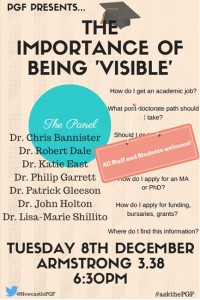 I’m sure many of you would agree that academic life can be a fairly bewildering experience. Trying to get on with your research is a difficult enough enterprise in its own right. When you factor in applying for conferences and funding, planning research trips, and partaking in the oft-maligned practice of ‘networking’, it can all seem a bit too much.
The idea for this event came from several discussions about the value of the advice that our more experienced colleagues can give to us. My own experience of organising an academic conference for the first time was made much easier by being able to repeatedly saunter over to a colleague’s desk and ask her how she’d done things for her conference the year before (“never underestimate the frequency and cost of refreshments”). Equally, being able to pitch my conference paper to non-specialist colleagues was a great way to learn how to get my argument right for an audience that would only know the basics of my research.
I also wish that I knew things ‘then’ that I know now. I wish I could go back and tell undergraduate me what it would be like doing a Masters. I wish I could go back and tell the Masters me how the PhD funding and application process was structured. I wish I could go back and tell first-year PhD me not to spend six months on a mostly fruitless research thread that I still haven’t fully resolved.
The point is, is that although I have had to learn things through trial and error, it doesn’t mean we need to perpetuate this cycle of misery (there’s only so much ‘character building’ I can take). I’d like to give advice to other students who went through the same experiences as I did. I’d also like to talk to some of our academics so that I don’t make the same mistakes as they did when they were at the same point in their career.
Sometimes it seems, however, that there is rarely the right forum to receive (and give!) this sage knowledge – there are only so many times you can ambush someone in the corridor or the staff room before you feel like you’re unduly imposing on their time and freedom of movement!
With this in mind, the Postgraduate Forum have teamed up with several of the School’s academics to try and help you navigate the murky byways of academic life.
Our academic panel will consist of Dr. Chris Bannister, Dr. Robert Dale, Dr. Katie East, Dr. Philip Garrett, Dr. Patrick Gleeson, Dr. John Holton, and Dr. Lisa-Marie Shillito. We hope that this group represents the different disciplines in our School, so that there will be something relevant and representative for all of us who attend. Our panel will take questions from the crowd, and then when we’ve drained their knowledge (but hopefully not their patience), we can all just meld into informal groups to carry on the conversation.
Use the hashtag #AskThePGF to get your questions in before the event (although there will be time at the event to ask any you might have.
This is an event is for any students that are interested in attending, not just PhDs. This includes any Masters or MLitt students who are thinking about ‘the next step’, or any UGs who are contemplating postgrad study. We’re hoping for a useful, inclusive, and informal event that will hopefully set the ball rolling for more interaction in the future.
- Newsletter, week 30.11.15.Apologies for the delay, this week’s newsletter is now here. If you would like to promote an event, please get in touch (m.ahlers1@ncl.ac.uk). Research Seminars Archaeology: Thursday 3rd December, 4-5pm, Armstrong Building, Room 1.06 Audrey Horning (Queens University Belfast): ‘Worlds in Motion: archaeological exploration of early modern identity in Ireland and America’ Classics and Ancient History: Wednesday 2nd December, 5-7pm Armstrong Building, Room 2.50 Phillip Horky (Durham University): ‘The spectrum of animal rationality in Plutarch’ History: Wednesday 2nd December, 5-7pm Armstrong Building, Room 1.04 Sean O’Connell (Queens University Belfast): ‘Looking beyond the Troubles: social memory in Belfast’s docklands’ Further School Events Night at the Museum Thursday 3rd December at the Great North Museum from 6-9pm Newcastle University Public Lectures 1st December, 5:30-6:45pm, Curtis Auditorium, Herschel Building Naveed Sattar (Professor of Metabolic Medicine, Glasgow University) “Cholesterol, statins and heart attack risks: the truth of the matter” 3rd December, 5-30-6:45pm, Curtis Auditorium, Herschel Building Karen Sands-O’Conner (Professor of English, Buffalo State College, New York) “From abolition to Zephaniah: a brief history of literature for the Black British child”
- Five Tips for… Organising a ConferenceOne. Create a timetable
One of the best things we did in the lead up to the conference was create a to-do list and a timetable for completion. This really helped us to stay on track, and made sure we didn’t forget anything. There are a lot of things to keep in mind when organising a conference and having a well-planned schedule allowed us to stay on track making the whole process a little smoother.
Delegates at the NEBARSS conference
Two. Don’t worry if something goes wrong
No matter how organised you think you are, there will always be something you haven’t thought about. But it is Ok. Our delegates were a particularly amenable group, but really anyone will appreciate that there are little details that may go wrong (like the microphone in our case!) and that it is not the end of the world.
Three. Acquire some free pens: freebies mean everything!
Of course, they don’t, not really, but everyone appreciates a good
selection of items in their conference packs. It is also a very good way of making contacts within larger organisations and businesses, local or national. It is a good way of obtaining financial support for your conference. The earlier you start this process, the better. You are far more likely to get support if you ask in advance. Organisations often have deadlines for funding, so do your research. Some publishing companies are also really keen to hear what universities are up to. In fact, on account of this our conference report is being printed in ‘Past’, the Prehistoric Society magazine.
the NEBARSS conference pack
Four. Enjoy the day!
Even though there was a lot of work leading up to the day, and a lot of running around and frantic organising on the day itself, it pays off! Every one of our delegates came up to us at the end of the conference and thanked us for the day for organising it so well. This was of course so thoughtful, but well-received and valuable feedback which made it all worth it!
Five. Don’t buy too many biscuits!
Incredulously, there is such a thing as too many biscuits! Don’t panic though, they are a welcome, if fleeting, addition to the office… That is until everyone blames you for tempting them.

Mmmm…..
- Just a Minute with… Lauren Emslie
 Lauren Emslie, 2nd year PhD student in classics, studying religion and theology in the late Roman republic. She is also currently chair of the PGF and organising AMPAH 2016.
She has a self-defined “slight social-media aversion” (although likes meeting people in person!), so it took a while, but we finally got her to sit down and answer a few questions for us…
1. How did you come to be interested in your current area of research?
From a young age I was fascinated by ‘the Romans’. When I came to university I started learning Latin and from there fell in love with ancient literature.
2. What advice would you have for current UG or early stage PG students?
Keep reading!
3. Can you describe your research in three words?
Religion, Gods, and Cicero
4. What book are you currently reading?
The Secret History, by Donna Tartt
5. What is the most important life skill you learnt whilst being a PGR student?
When to use a backpack for your books.
6. Do you have favourite hidden gems of Newcastle?
It may not be so secret, but the view down the river from the Free Trade Inn on any day is one of my favourites.
7. What is your favourite movie quote?
“For a special agent, you’re not having a very special day, are you?” (Waverly, The Man from U.N.C.L.E. (2015))
Thanks Lauren – see you around here soon!
- And on that bombshell…by Andrew Marriott (2nd year Archaeology PhD). It’s difficult to proceed down PhD’s journey (what else is life these days?) without being reminded that the 21st-century scholar must make an impact. With my research, the North East’s First World War Trench Art, I should have something of a head-start. After all, there can be few events that have so profoundly affected the region, while the war’s centenary has placed events such as Ypres, Gallipoli and the Somme high in the public consciousness. Exploring one aspect of that conflict’s material culture (items used in the prosecution of war and now transformed into artistic souvenirs or agents of commemoration), is stimulating some novel investigativeapproaches. My research is the first to be conducted through the interrogation of a detailed database of trench art which I am currently constructing. I am also applying an adapted form of an artefact-centred interview, a technique pioneered by Dr Jane Webster, Newcastle University. As I embark on my second year I thought I might share some issues around the idea of research impact. Tilting at windmills or slaying dragons? The deeper we engage in scholarship the more we are entitled, indeed we have a duty, to challenge received wisdom in our particular academic discipline. Conflict studies in general, and the First World War in particular, is a land of windmills and dragons. In getting to grips with the context of my thesis, I am becoming increasingly aware of changing social agendas and the relativist interpretations of the Great War and its outcomes. Archaeologists love context. For a pot sherd recovered from a stratigraphic layer in a trench, context can be simple to establish. It’s a matter of understanding deposition processes and dating cues. However, my ‘trench’ is the war itself. Its context spans a century populated by academics, politicians, social scientists, poets and artists, all offering their own interpretations of war, its morals and dynamics. I see some of the war’s critique, especially that from the 1960’s, including Alan Clarke’s ‘Lions led by donkeys’, as a windmill and possibly no longer even deserving of a tilt. But what of the works of Siegfried Sassoon, Wilfred Owen and Robert Graves, or more precisely, interpretations of their writing and how they have been deployed by those with a particular academic or cultural agenda? As I scan the horizon of my work I’m aware that I will need to navigate windmills and be wary of dragons. Why not find impact by slaying the more villainous?
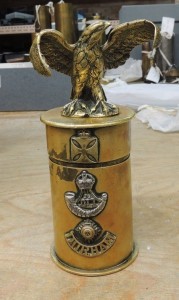
A shell case in the Durham Light Infantry Museum. The cross and eagle had been incorrectly assessed as German. The piece was most likely owned by a British padre.
Who wants impact anyway? It is a sad indictment of our times that our society is often careless of its heritage. I am working with a range of museums, libraries, local authorities, charities and community groups, indeed the Beamish Museum is a strategic partner. These bodies are essential in allowing me to establish a critical mass regarding my research data. They will also be important in disseminating my findings, allowing them to be of wider scholarly and social benefit. And yet, even now, one of my key sources, the Durham Light Infantry Museum, is threatened with closure. They need our impact if they are to survive. And, as a counter to second-year stasis, I am very fortunate in the motivation I can gain from social engagement during research. As well as developing outreach activities, I have already been able, through examination of family-owned pieces of trench art, to establish more secure narratives concerning ancestors who fought in the war and, in one case, resolve for his descendant, the fate and final resting place of one veteran. As we approach the century of the Battle of the Somme, I already sense a degree of First World War fatigue in some media and public organisations. As the subject’s novelty loses some traction, I see an opportunity to establish a more long-term and academically-founded interest in the material culture of the war and how successive generations approach it through its artefacts. If you are aware of any trench art in the region that retains a family biography, I would be delighted to hear from you. Details can be found here.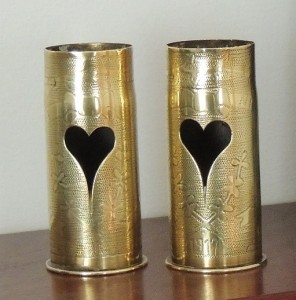
Research suggests that these shell cases are associated with the engagement or marriage of a soldier on the Western Front and his fiancé who worked in a munitions factory in the North of England.
- Events Newsletter, week 16.11.15Here is this week’s newsletter. If you would like to promote an event, please get in touch (m.ahlers1@ncl.ac.uk). Research Seminars Archaeology: Roman Archaeology Research Seminar Tuesday 17th November, 6-7:30pm, Armstrong Building, Room 1.06 Nick Hodgson (Tyne and Wear Archives and Museums): ‘WallQuest Community Archaeology and the discovery of the fort baths at Wallsend (Segedunum)’ Classics and Ancient History: Wednesday 18th November, 5-7pm, Armstrong Building, Room 2.50 Edward Harris (Durham University): ‘Trials in Thucydides and Xenophon’ History: Wednesday 18th November, 5-7pm, Armstrong Building, Room 1.04 Katrina Navickas (University of Hertfordshire): ‘Protest and the Politics of Space and Place, 1789-1848’ Further School Events Neolithic and Early Bronze Age Research Student Symposium 20th and 21st November Keynote lecture by Dr Chris Fowler 20th November, 5:30-7pm, Armstrong Building, Room 1.06 ‘The powers that be’ and powerful events: ontologies in Neolithic and Early Bronze Age Britain and Ireland Student Symposium on 21st November, 9am – 4:30pm, Armstrong Building, Room 1.06 If you would like to attend either the keynote lecture or the actual symposium please get in touch the with the organisers Lucy Cummings and Mareike Ahlers at nebarss2015@gmail.com Please find futher information at https://nebarss.wordpress.com/ Newcastle Early Modern Forum Symposium Wednesday 18th November, 6pm, Percy Building Italian Exchanges: Venice and Rome in Renaissance English writing and its perception with Caitlin Phillips (Durham University): ‘Protest, Magic and the Reformation’ Amy Shields (Newcastle University): ‘Why Venice? Plato Redivivus and the Role of the Noble Venetian’ Megan Holman (Northumbria University): ‘Men may construct things after their fashion: Reading Graphic Novel Shakespeare’ Newcastle University Public Lectures
Wednesday 18th November, 5:30 – 7pm, Curtis Auditorium, Herschel Building Celebrating Student Research Scholarships and Expeditions 2015
Thursday 19th November, 5:30-6:45pm, Curtis Auditorium, Herschel Building Amanda Vickery (Professor in Early Modern History, Queen Mary University): Mutton dressed as lamb (British Society for Eighteenth-Century Studies Patron’s Lecture) - Northern Bridge Autumn School – October 2015A number of our AHRC funded PhD students attended the Northern Bridge Autumn School, hosted by Queens University Belfast. We set off from Newcastle Airport with the weather forecast to rain, rain, rain, with a little more rain scheduled for Belfast for the next few days. We were pleasantly surprised to land in a slightly grey but DRY Belfast. We had time to wander around the city of Belfast, to see some of the street art, the infamous ’Big Fish’, the Ulster Museum and we even squeezed in a visit to Maggie May’s Café, which was as nice as people had reported, and so we pass on the recommendation (see photo below)!The main aim of the Wednesday timetable was to give this year’s newly funded students a chance to talk and get to know each other, and to hear about their research topics; whilst for the 2014/2015 group it was a chance to catch up with each other’s progress and adventures since the Newcastle event in June 2015. While the new starters were perfecting their ‘elevator pitch’ (ie. Sell yourself to a prospective boss in the time it takes you to climb 7 floors in a lift!), we spent time reflecting on the advantages of being part of the Northern Bridge partnership. We also highlighted areas in which more could have been made as a new starter, and this was the spark for the afternoon session, which we were to run for the new cohort. This ‘Peer Feedback’ session also included a pitching session for possible training events to be run and organised through Northern Bridge by us, the students. The focus of the afternoon was careers and employability; we heard from a Northern Bridge student who had undertaken a placement that had benefitted her research and provided a possible career path post-PhD. It certainly gave us some food for thought! The day was concluded with a drinks reception in the wonderful Great Hall of Queen’s University followed by a meal at an Italian restaurant (also followed by a visit to the nearby pubs and bars for some!).
Belfast side streets & artwork (left & top right); Maggie May’s milkshake & ice cream sundae after a trip to the Ulster Museum! (bottom right)
Thursday’s sessions included thematic-based interdisciplinary group networking, followed by a Keynote lecture by Professor Richard Clay (Newcastle University) titled “from coins to Internet in 45 minutes(ish)”. Professor Clay outlined some interesting ideas about the use of marks, graffiti and prints to change perception and re-code public space using examples through history—from early coinage to modern-day street art. The closing session focussed on ways of disseminating research via the media, discussing ‘being Mary Beard’ – an academic who regularly presents her research interest to the public through documentaries, radio programmes, and her blog, alongside her academic publications. This session also brought up very current issues regarding gender and the representation of academics (women academics, in particular) within the media. It was a short but thought provoking session which raised questions about women in academia and in the media, and how we can move to change these stereotypes. This is obviously an issue which is currently being scrutinised and addressed by academia and the wider public alike. The autumn conference was a great introduction for the new starters, and provided some food for thought for those of us in stage 2 of our PhD projects – How will we disseminate our work? What road will be taken, an academic or non-academic path? What makes my CV stand out from all the others? Time to start planning! -Lucy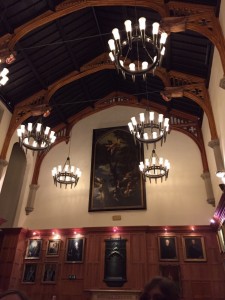
The Great Hall, Queen’s University, Belfast.
- Events Newsletter, week 9.11.15This week’s newsletter, once again! If you would like to promote an event, please get in touch (m.ahlers1@ncl.ac.uk). Research Seminars Archaeology: Archaeology Research Seminar Tuesday 12th November, 6-7pm, Armstrong Building, Room 1.05 Paddy Gleeson (Newcastle): ‘Building kingdoms and ruling landscapes: practices of kingship in the Atlantic World’. Further School Events Field trip organised by Dr Susanna Phillippo (please get in touch with her if you are interested) Sunday 15th November: Hadrian‘s Wall trip (Walltown crags, Thirlwall castle, Greenhead) • Walltown crags, Thirlwall castle, Green head • An introduction to the Wall: a circular walk along the highest and one of the most dramatic stretches of the Wall, perched on Walltown Crags, with impressive views (weather permitting!) to Scotland and the Pennines. • Walk from Greenhead village to ruins of Thirlwall Castle (with its legends of buried treasure and a magical dwarf!) ad past site of the Roman fort of Carvoran/Magnis. • Visit to Roman Army Museum (also a wet weather alternative!) Newcastle University Public Lectures
10th October, 5:30-6:45, Herschel Building, Curtis Auditorium Eric Cross (Dean of Cultural Affairs, Newcastle University): ‘One hundred years of Bach performances’.
- Just a Minute with… Lucy Cummings
 Lucy Cummings, our very own Seminar Series Co-Ordinator, is a 2nd year archaeology PhD student studying the henge monuments of the British Isles. Newcastle University ‘lifer’ so far – BA, MA and now PhD here in the department. Currently organising the 2nd NEBARSS conference (https://nebarss.wordpress.com). Occasionally uses twitter, follow her if you don’t mind archaeology/football related tweets.
1. How did you come to be interested in your current area of research?
In archaeology: from an open-day session ran by Dr Mark Jackson, which changed my mind from applying for a chemistry degree to archaeology!
In henges/Later Neolithic: From first year UG lectures on monumental space and enclosure of ‘special’ places in the landscape – especially when the functional use was so up in the air! It was very intriguing, and a theme through quite a few of my UG and MA pieces of work, which has now led to my current PhD topic.
2. What is the worst advice you have even been given?
‘Lose your accent to do well’ –Everyone likes the Yorkshire accent – who wouldn’t?
3. What has been the highlight of your week?
Actually ticking something off of my ever-growing ‘To Do’ list!
4. What is the most important life skill you learnt whilst being a PGR student?
That things are never as bad as they seem after a decent sleep!
5. What do you enjoy most about being part of the History, Classics and Archaeolgy department at Newcastle?
I’ve been here from UG to PGR so I definitely love it here! Everyone is friendly and encouraging, and it is a great department to be in as a student. It’s always good when you can have a laugh with your lecturers!
6. What did you want to be as a child?
A vet, and then a CSI officer – until I realised I don’t like blood/needles/wounds of any kind.
8. What is your favourite place on earth?
The Lake District is a favourite area of mine, for the walking, the scenery and also the wild animal park!
Also, skiing (anywhere) – being at the top of a snowy mountain gives you stunning views and is a great way of relaxing and clearing the mind.
9. What’s next for Lucy?
I will be co-hosting a conference here at Newcastle at the end of the month (and giving my first conference paper- scary!), then after that it will be a couple of months of focused reading and data collection to get ahead in my research.
Thanks Lucy! Good luck with the conference!
- AMPAH 2016The Annual Meeting for Postgraduates in Ancient History will take place here at Newcastle University on Saturday 19th March 2016. Call for Papers ‘Messages and Media’ The world is full of messages. From text to images to sounds, messages dominate society, past and present. How can we explore this phenomenon in and through ancient history? What are media? Where is the message? AMPAH 2016, as usual, invites papers of all topics from postgraduate students of Ancient History and Classics, but in particular we would like to explore sending and receiving in the Ancient World whether through images and statues, through text, inscriptions, or the proverbial ‘writing on the wall’; from ‘putting on a show’, to performing in the public arena, how do we interpret their interactions? And how can we, as ancient historians, use media to ‘get our message across’? Topics welcomed include, but are not limited to: • Sending and Receiving • Public Image • Politics as performance • Propaganda as medium • Graffiti, papyrology, and non-elite media • Music and poetry • Popular culture in the Ancient World • Public inscriptions • Historiographical context • Reception and recreation • Messages to and from the gods • Transmitting ideologies • Rhetoric and media • History and its message Please send abstracts of no more than 300 words for papers of twenty minutes to ampah2016@newcastle.ac.uk by Monday 11th January 2016.
- Events Newsletter, week 25.10.15This week’s newsletter is up, folks – to see it in .pdf form, ! If you would like to promote an event, please get in touch (m.ahlers1@ncl.ac.uk). Research Seminars Archaeology: Roman Archaeology Research Seminar Tuesday 27th October, 6-7pm, Armstrong Building, Room 1.05 Jane Webster (Newcastle): ‘A dirty window on the Iron Age’? Recent developments in the archaeology of Celtic (and Romano-Celtic) religion. Classics and Ancient History: Classics and Ancient History Research Seminar Wednesday 21st October, 5-7pm, Armstrong Building, Room 2.50 Edith Foster (CWRU): ‘The Paradoxical Battle Narratives of Xenophon’s Hellenica’ Further School Events Archaeology Nights Out (For all archaeology Staff and PG) Thursday 29th October, from 5pm onwards at Bar Loco on Leazes Park Road; for more Information please contact Maria Duggan Newcastle University Public Lectures
27th October, 5:30-6:45, Herschel Building, Curtis Auditorium Paul Finkelman, (F Sallows Professor of Human Rights Law, University of Saskatchewan): Fighting slavery and human trafficking: what we can learn from the American abolitionists.
29th October, 5:30-6:45, Herschel Building, Curtis Auditorium Dr Alexandra Harris, (Senior Lecturer in English Literature, University of Liverpool): ‘Journeys in weatherland.’
- Events Newsletter, week 19.10.15Here is the first of our weekly events-newsletters. If you would like to promote an event through our newsletter please get in touch with me (m.ahlers1@ncl.ac.uk). PGF Lunchtime Seminar Wednesday 21st October, 1-2pm, Armstrong Building, Room 2.50 Xu Hong (UCD): ‘Did Philip intend to invade Italy: A case study of the application of the Realist theories to the Hellenistic international relations’ Research Seminars Archaeology: Archaeology Research Seminar: Thursday 22nd October, 4-5pm, Armstrong Building, Room 2.16 Matthew Haysom (Newcastle University): ‘Reconstructing life on Late Bronze Age Crete’ Classics and Ancient History: Classics and Ancient History Research Seminar Wednesday 21st October, 5-7pm, Armstrong Building, Room 2.50 Edith Foster (CWRU): ‘The Paradoxical Battle Narratives of Xenophon’s Hellenica’ History: Wednesday 21st October, 5-7pm, Armstrong Building, Room 1.04 Tim Strangleman (University of Kent): ‘Visualising Work in the Twentieth Century: Guinness and the Life and Death of an English Brewery’ Further School Events Field trip organised by Dr Susanna Phillippo (please get in touch with her if you are interested) Sunday 25th October: Corbridge/Corstopitum: Roman site and village (afternoon) • Corstopitum fort: important ‘crossroads’ settlement in Roman times, predating Hadrian’s Wall: extensive remains and a good museum including the famous ‘Corbridge Lion’; also the chance to walk along a Roman road! (the Stanegate); • Corbridge village: one of the Tyne valley’s most attractive, including partly Saxon church creatively reusing Roman stonework (also excellent tea shops and at least one historic pub!) Newcastle University Public Lecture: 20th October, 17:30-18:45, Curtis Auditorium, Herschel Building All changed, changed utterly Clare Marx, President of the Royal College of Surgeons (free admission, no pre-booking required) 22nd October, 17:30-18:45, Curtis Auditorium, Herschel Building Culture in question: ‘everyday participation’ and the contest over cultural value Dr Andrew Miles, ESRC Centre for Socio-Cultural Change, University of Manchester
- PGF Seminar – Wednesday 21st October 1pmWe are delighted to announce our first PGF seminar will be given by Xu Hong from UCD.Wednesday 21st October in room 2.50 (Armstrong Building, next to the reading room) at 1pm.Tea, coffee and biscuits will be available as always – please come along and support our first postgraduate guest speaker.
Xu Hong – ‘Did Philip intend to invade Italy? A case study of the application of the Realist theories to the Hellenistic international relations’
The PGF seminar series is a fantastic opportunity for postgraduate students to deliver papers about their current research or research interests. This has been a great success in past years, so this year we will be developing this series in order to offer more flexibility. Therefore, we offer you the opportunity to present either a 20 minute paper or an extended paper of 30-50 minutes. This could be at lunchtime (usually between 1pm and 2pm on Wednesdays) or perhaps, in the evening (with the opportunity for taking questions in the pub!). If you would like to give a presentation, please do get in touch. If have any other ideas regarding the structure of a seminar or seminar sessions which you would like to do, if you know of postgraduate students from another university you would like to invite to give a paper, or if you have any questions or ideas then please do get in touch – we are open to new thoughts and aim to be as flexible as possible!We look forward to hearing from you. - Just a minute with… Dr James Gerrard
 Dr James Gerrard is a lecturer in Roman archaeology here at Newcastle, he studied at Sheffield for his BA in Archaeology and Prehistory, before completing his MA (in Archaeological Research) and PhD (Pottery and the end of Roman Britain: the view from south-western Britain) at York. Check out his project blog: https://blogs.ncl.ac.uk/luftonarchaeology/
After a busy couple of weeks of student inductions, he answered a few questions for us:
1. How did you come to be interested in your current area of research?
As a child, I was inspired to study the Romans and the end of the Roman period by the novels of Rosemary Sutcliff (Eagle of the Ninth; The Lantern Bearers). I was also lucky enough to grow up in Somerset surrounded by Roman and early medieval sites.
2. What book are you currently reading?
101 Dalmatians. Seriously. My daughter was reading it and I thought I’d regress to childhood. It’s a great story, charming, serious and in places downright ironic.
3. If you were a biscuit, what sort would you be?
A garibaldi (squashed fly) biscuit, or perhaps a ginger nut.
4. What has been the highlight of your week?
Meeting all the new students!
5. What is the most important life skill you learnt whilst being a PGR student?
That life is hard but you can survive its ups and downs.
6. What do you enjoy the most about being part of the history, classics and archaeology department at Newcastle?
It’s a great, friendly place with brilliant colleagues and excellent students.
7. What did you want to be as a child?
An archaeologist
8. Can you describe your research in three words?
No. Perhaps: End, Roman, Britain
9. What would your perfect day away from work be?
Somewhere wildish – the countryside or coast. It’d need to have no mobile signal and perhaps a nice pub for some food and drink.
10. What is your favourite movie quote?
‘Remember, short controlled bursts’ (Corporal Hicks in Aliens)
Thanks James!
- Neolithic and Early Bronze Age Research Student Symposium – confirmed speakersWe have now confirmed our list of speakers for the 2nd NEBARSS conference, to be held here at Newcastle University in November in the historic Armstrong Building. The full list can be seen below, or can be downloaded in PDF form here. Dr Chris Fowler will give a keynote lecture on Friday 20th of November, his paper is titled: ‘The powers that be’? Powerful events in Neolithic and Early Bronze Age Britain This keynote will be followed by a wine reception, nibbles, and a lively discussion. Saturday 21st is devoted to current research students, with postgraduate researchers from across Britain and Ireland presenting their work. There will also be a poster display highlighting new and exciting research projects. Registration is now, and all those who wish to attend are required to register online here. http://webstore.ncl.ac.uk/browse/extra_info.asp?compid=1&modid=2&catid=53&prodid=414 Registration is open to undergraduate and postgraduate students, postgraduate and early career researchers, lecturers and independent archaeologists, and members of the public who have an interest in prehistoric archaeology. The registration fee includes the conference pack, tea/coffee throughout, lunch, the wine reception and associated nibbles! There is information on accommodation, travel, and things to do in Newcastle as well as instructions and how to find the Armstrong Building on our website here. (link) https://nebarss.wordpress.com/conference-archive/newcastle-2015/2015-conference-pack/ Please get in touch if you have any questions or queries. We hope to see you in November for what promises to be an exciting and engaging symposium!
- Welcome (and welcome back)The new academic year is about to start. For some of us, this means coming back to work after a bit of time off; for some of us, this means coming to a new start at a new university (and for some of us, this means no change, if, like me, you have just been working through your summer). This also means a new PGF committee. Some roles have been filled, but there are still opportunities open and available. This is also going to be a good opportunity for current and new students to meet and mix, so whether you are arriving or returning, get yourself down to the Percy Building, room G13, this Monday at 4pm to find out what you can do for the PGF, but also what the PGF can do for you!
- 12th Edition of our E-Journal – Call for Papers!
Call for Papers
12th Edition of the Postgraduate Forum E-Journal
School of History, Classics and Archaeology, Newcastle University
Disruptions
The theme of this year’s issue of the PGF E-Journal seeks to reflect on the way in which “disruptions” have shaped historical disciplines and processes.
Studies of history are littered with the disruptions of peoples and places, politics and religion, memory and belief, but the term itself is rarely used. Does the concept of disruption offer any new perspective, and how do we recognise and define these disruptions? Does the term disruption have any genuine utility? Can we look at disruptions on a macro and micro scale? How do we deal with disruptions to scholarly narratives when new theories, interpretations, and material are discovered?
We are seeking abstracts for papers of 4000 words. Suggested topics include, but are not limited to:
- Historiographical Disruptions
- Material Disruptions
- Disruptions of Landscape
- Political Disruptions
- Social Disruptions
- Economic Disruptions
- Ideological/Philosophical Disruptions
- Religious Disruptions
- Medical Disruptions
- Urban or Rural Disruptions
- Disruption of Memory
- Natural or Environmental Disruption
- Textual Disruptions
- Narrative Disruptions
Please send abstracts of 250-300 words along with a CV to Amy Shields (amy.shields@ncl.ac.uk) by 28th August. If your paper is selected, the deadline for the final paper will the 2nd October.
- NEBARSS 2015 – Call for Papers!
2nd Neolithic and Early Bronze Age Research Student Symposium
November 2015
We are holding a postgraduate research student conference here at Newcastle University focusing on the Neolithic and Early Bronze Age archaeology of Britain and Ireland. The conference will be preceded by a keynote speaker (tbc.) and a wine reception, which will provide delegates with a relaxed and friendly environment to discuss their research interests with other PG students and Newcastle staff members, as well as external archaeologists and interested parties.
The conference does not have a theme in order to allow researchers to present aspects of their research projects as they so wish. We are now accepting abstracts for both papers and posters from postgraduate researchers, early careers researchers or independent archaeologists. Click here to download our abstract submission form.
We would also encourage poster abstracts from Masters students who wish to present the results of their dissertations, or new PhD students wanting to present their key research interests and research questions.
If you are interested in attending but not giving a paper or creating a poster we will be opening registration in July , so keep an eye out for further information or email us to be put on our email list.
email: l.b.cummings@ncl.ac.uk or nebarss2015@gmail.com
View our Call for Papers poster for more information.
We hope to hear from you soon!
- “Disrupting the Notion”: A Postgraduate Conference
Last Friday (22nd May 2015) saw Newcastle University’s 12th Annual Postgraduate Forum Conference go off with a bang. A really fantastic range of papers and posters were presented from Newcastle and beyond, displaying some really varied research.
The theme of the conference was “Disruptions”, which had taken root from marketing and commercial theory, as chair Amy Shields explained in her introduction. I think it is fair to say that each paper developed and worked with this theme in really varied and fruitful directions.
The first panel comprised of Skylar Arbuthnot, Samuel Pearson and Victoria Hughes. Arbuthnot gave us some interesting food for thought in local archaeology by suggesting that the understood disruption of Roman settlement could be rethought if we looked for forts in different places. Pearson followed this with an interesting discussion of Lollards and Lollardy heretics in Elizabethan England, and the evidence for and against familial conversion. Finally Hughes looked at some of the Christian responses to a Pagan emperor in the Roman world, and the disruption they felt it caused to their religion.
This was followed by a quick break and a discussion from our keynote speaker, Harry Dickinson (Edinburgh University) who showed a fantastic range of caricature imagery from Britain during the French Revolution and the comedic responses that disruption caused in this country. He almost caused a disruption of his own when he revealed in a denouement that he is, although local, a Sunderland supporter!
After that was a very posh spread for lunch!
Our second panel was Stephanie Moat, Andrew Marriot and myself, Chris Mowat. Moat took the idea of non-classical art styles being regarded as “inferior” in classical archaeologist scholarship and disrupted it herself with the theory of mimetic practice. Marriott then took us to one of the world’s biggest disruptions, the First World War, and looked at how trench art can actually provide new ways of thinking about the historical, military and social developments and outcomes of the war. Thirdly my own paper looked at dreams in the Roman Republic as not simply a disruption of sleep but also a message of potential disruption to the future, and how gender reinforced structures of importance, even in sleep.
The third panel had John Burke and Anthony Stewart. Burke provided stimulating discussion regarding the ongoing disruption of the island of Cyprus by looking at the ‘ghost-town’ of Famagusta, and Stewart took us into Haiti with a look at the local religion of Vodou and the island’s cultural understanding and treatment of mental illnesses.
The poster session showed off, in particular, some of the varied work being done by Masters students.
The final panel of the day was Steven Server and Ben Morton. Server took us through the political climate of the US in the ‘6os and ‘70s through the lens of risk theory, and the disruptions to society and politics during the period. Finally, Morton brought us back to thinking about the theme as a whole and the way we as historians, classicists and archaeologists look at static movement and disruption.
At the wine reception, the Keith Wrightson and Norman McCall prizes were presented. The runner up prize was presented to Andrew Moat, and the winner for the best paper was Stephanie Moat; for posters, Victoria Bell won the runner up prize, with Stacey Astill being the winner.
I, on behalf of the PGF, would like to give a big thank you to Keith Wrightson and Norman McCall for, as always, supporting our event and taking a keen interest in our postgraduate research community – Thank You.
As well, we would like to thank the speakers and audience through the day for the stimulating presentations and fascinating discussion. The whole day was a great success and a lot of good fun. We would all also like to thank Shields for organising and chairing a fantastic conference – thank you!
See you all next year!
Chris Mowat
PGF Committee Member
- E-Journal: A quick update!
We have now finished uploading the back issues of our Historical Studies Postgraduate E-Journal. You can find them listed under the ‘E-Journal’ tab (hover over the tab to reveal the list. Please Note: this may not work if you are using Internet Explorer), or use the menu on the right hand side of the page.
If you come across any broken, incorrect, or missing links, please let me know! You can do so via email (l.emslie@ncl.ac.uk). Thank you.
Lauren (IT Officer)
- Disruptions!
Updated conference programme. We look forward to seeing you all on Friday!
9.00 Tea/Coffee Reception 9.20 Introduction Panel 1 – Chair: Sam Petty 9.30 Skylar Arbuthnot (Newcastle, PhD) The End of Extramural Settlements in the Hadrian’s Wall Frontier Zone 10.00 Samuel Pearson (Durham, MA) Hereditary Heretics: The Experience of Conversion in Lollard Communities, c. 1500-1550 10.30 Victoria Hughes (Newcastle, PhD) “What an evil the Roman world is breeding!” Responses to the Emperor Julian’s Reign Break 11.15 Keynote Speaker – Harry Dickinson (Edinburgh) British Caricatures and the French Revolution. Lunch Panel 2 – Chair: Lauren Emslie 1.00 Stephanie Moat (Newcastle, PhD) Mimetic Practice in Religious Iconography: A Case Study of Roman Britain 1.30 Andrew Marriot (Newcastle, PhD) Disruptive Influences and a Lack of Discipline? World War 1 Trench Art 2.00 Chris Mowat (Newcastle PhD) Calpurnia and the Disruption of the Roman State Break Panel 3 – Chair: Amy Shields 2.45 John Burke (Newcastle, PhD) A Lost City in the Sand: The Memorial Legacy of Conflict through the Greek Cypriot ‘ghost-town’ of Famagusta 3.15 Antony Stewart (Newcastle, PhD) The Disruption of Leonce Joachim, 1934: How the anthropologist’s informant became the subject of an international debate on Haitian psychology, Vodou and mental health Break and Poster Session Panel 4 – Chair: David Lowther 4.30 Steven Server (Oxford, MSc) Extralaw and Disorder: Disruptions in Political Culture Surrounding State Risk Management, 1964-1976 5.00 Ben Morton (Newcastle, PhD) Disruptions, Scales and the Medieval Village: Questioning the Nucleated-Dispersed Paradigm 5.30 – Conclusion and Thanks 6.00 – Wine Reception – Student Common RoomDisruptions!
12th Annual Postgraduate Forum Conference 2015
22nd May 2015
Research Beehive, Old Library Building
- Disruptions! Conference Programme
We are pleased to announce our programme for the annual PGF conference (22nd May 2015 at Newcastle University). All Welcome!
‘Disruptions’
12th Annual Postgraduate Forum Conference 2015
22nd May 2015
Room 2.22, Research Beehive, Old Library Building
9.00 Tea/Coffee Reception 9.20 Introduction Panel 1 – Chair: TBC 9.30 Skylar Arbuthnot (Newcastle, PhD) The End of Extramural Settlements in the Hadrian’s Wall Frontier Zone 10.00 Samuel Pearson (Durham, MA) Hereditary Heretics: The Experience of Conversion in Lollard Communities, c. 1500-1550 10.30 Victoria Hughes (Newcastle, PhD) “What an evil the Roman world is breeding!” Responses to the Emperor Julian’s Reign Break 11.15 Keynote Speaker – Harry Dickinson (Edinburgh) British Caricatures and the French Revolution’. Lunch Panel 2 – Chair: TBC 1.00 Stephanie Moat (Newcastle, PhD) Mimetic Practice in Religious Iconography: A Case Study of Roman Britain 1.30 Alan McCarthy (University College Cork, PhD) Enduring the Most: The Censorship and Suppression of Cork’s Nationalist and Loyalist Newspapers during the Irish Revolution, 1916-1923 2.00 Chris Mowat (Newcastle PhD) Calpurnia and the Disruption of the Roman State Break Panel 3 – Chair: TBC 2.45 John Burke (Newcastle, PhD) A Lost City in the Sand: The Memorial Legacy of Conflict through the Greek Cypriot ‘ghost-town’ of Famagusta 3.15 Antony Stewart (Newcastle, PhD) The Disruption of Leonce Joachim, 1934: How the anthropologist’s informant became the subject of an international debate on Haitian psychology, Vodou and mental health Break and Poster Session Panel 4 – Chair: TBC 4.15 Andrew Marriot (Newcastle, PhD) Disruptive Influences and a Lack of Discipline? World War 1 Trench Art 4.45 Steven Server (Oxford, MSc) Extralaw and Disorder: Disruptions in Political Culture Surrounding State Risk Management, 1964-1976 5.15 Ben Morton (Newcastle, PhD) Disruptions, Scales and the Medieval Village: Questioning the Nucleated-Dispersed Paradigm 5.45 – Conclusion 6.00 – Wine Reception - “Joan was Quizzical…”Our first charity fundraising event was a success! On Wednesday (11th March) we held a Pub Quiz in aid of Comic Relief at the Hancock Pub near campus. There were raffle prizes up for grabs including chocolates, cinema tickets and a night ‘at the dogs’, which was donated to the cause and for which we are exceptionally grateful!Our own Chris Mowat took off his Seminar Co-ordinator hat and become Quizmaster for the night – we should have picked someone who would have created an easier quiz! Chris came up with a spectacular five rounds with a variety of great questions (including The Beatles song our title came from!) and everyone had great fun.
Some of the raffle prize winners! Photo Credits: Amy Shields & Sam Petty
We had a fantastic turnout and everyone had a great night.
Our sincere thanks t
A big shout out to our Losing Team, ‘Table 19’, who won the (literal) wooden spoon prize. And Well Done to our Winners, the ‘The Quiz-tine Chapel’. o
everyone who come along and joined in – we raised £111.50 altogether, which was beyond our expectations. Thank you!
Jack & Michael
- Call for Papers (Deadline 27th March)
12th Annual Postgraduate Forum Conference 2015
School of History, Classics, and Archaeology, Newcastle University
22nd May 2015
‘Disruptions’
This interdisciplinary one-day conference seeks to bring together students from across the country to reflect on the continuous ‘disruption’ within historical disciplines.
How do we recognise and define these disruptions? Does the term ‘disruption’ have any genuine utility? How did people respond to disruption? How did they cope when disruptions affected their personal life? Can we look at disruptions on a macro and micro scale? How do we deal with disruptions to scholarly narratives when new theories, interpretations, and material are discovered?
We are seeking proposals for individual twenty-minute papers from historians, archaeologists, classicists, and ancient historians. Suggested topics include, but are not limited to:
- Historiographical Disruptions
- Material Disruptions
- Disruptions of Landscape
- Political Disruptions
- Social Disruptions
- Economic Disruptions
- Ideological/Philosophical Disruptions
- Religious Disruptions
- Medical Disruptions
- Urban or Rural Disruptions
- Disruption of Memory
- Natural or Environmental Disruption
- Textual Disruptions
- Narrative Disruptions
We also invite poster submissions from postgraduate students. The posters do not necessarily need to be on the conference theme, but rather are a way to begin to present your work in the earlier stages of your research.
Keynote Speaker to be confirmed.
Please send abstracts of 300-500 words for papers, and 150-200 words for posters, along with a title to Amy Shields (amy.shields@ncl.ac.uk) by 27th March 2015.
- Welcome!Welcome to our site! We are a really dynamic and enthusiastic group of History, Classics and Archaeology postgraduates, with lots of exciting ideas being bounced around.
Armstrong Building, Newcastle University
As we all know, doing your PhD or MA is hardly a walk in the park; everyone is isolated by the uniqueness of their research, which can make it seem like no one really understands what you are going through. We also know that it can be difficult for people to get involved if they don’t live locally, if they work, or are doing their PhD part time. That is why, this year, we are making a concerted effort to match our lively presence within the School with a lively online presence! We have already started blogging on the School-blog, Beyond Frontiers, and you can easily find us as we will always be tagged ‘Postgraduate’. If you have something you would like to blog about, whether you would like share a conference experience or a research idea, please send it to our IT Officer, Lauren, at l.emslie@ncl.ac.uk. Alternatively, if you have an idea for one and would like to chat about it, please do come and find us or e-mail one of our committee members, who will be happy to chat to you about it! If you would like more information, read our ‘Letter from the Chair’. You can also find us on Facebook or follow us on Twitter!
On this site, we aim to get to know each other better and share our research interests. We will use this space to advertise our events and update you through our monthly newsletters. In the next few days we will collecting information for our postgraduate profiles, which we would like to post up on this site (hopefully along with a picture, so we can all put faces to the names!). And in the new year, we will be publishing our e-Journal.
There is lots going on, so watch this space!
The PGF committee.