Congratulations to the Winners of our 14th Annual Postgraduate Forum Conference

14th Annual Postgraduate Forum Conference Winners

School of History, Classics and Archaeology

Newcastle University

19th May 2017


‘Movement’


This interdisciplinary one-day conference brought together Postgraduate students studying histories relating to the theme of Movement. How do we study the past, not as static, but as dynamic and changing? How does the movement from one context to another change how we interpret evidence? What are the effects of movement on societies, material, and intellectual cultures? How has the idea of movement, or a movement, been used for political, social, or artistic purposes?

We heard many fascinating papers covering a broad range of topics relating to movement as well as a large array of posters from our very own Masters students.

We are pleased to announce the winners of this years conference are:

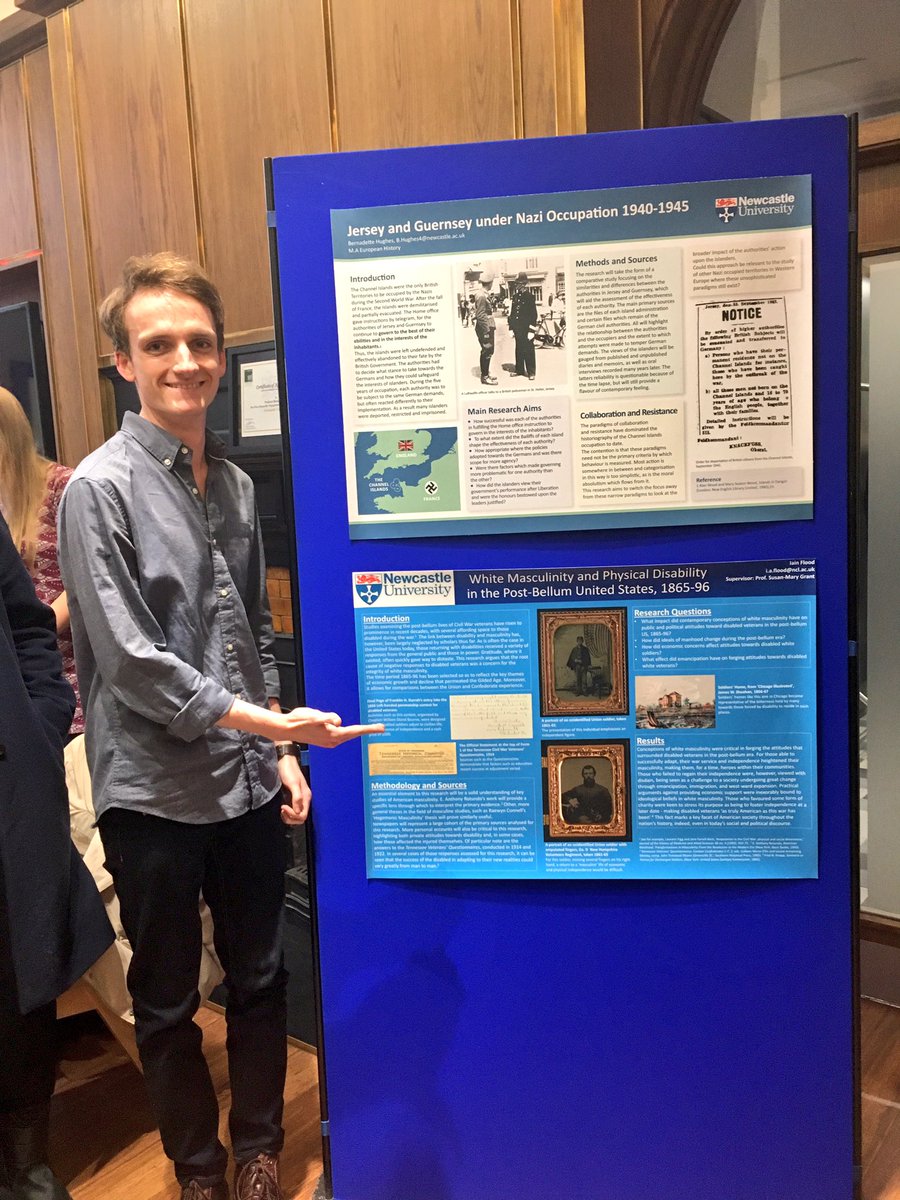
Best Poster: Iain Flood, Newcastle University

“White masculinity and physical disability in the post-bellum United States, 1865-96.”

daq6faexcaeqvnf

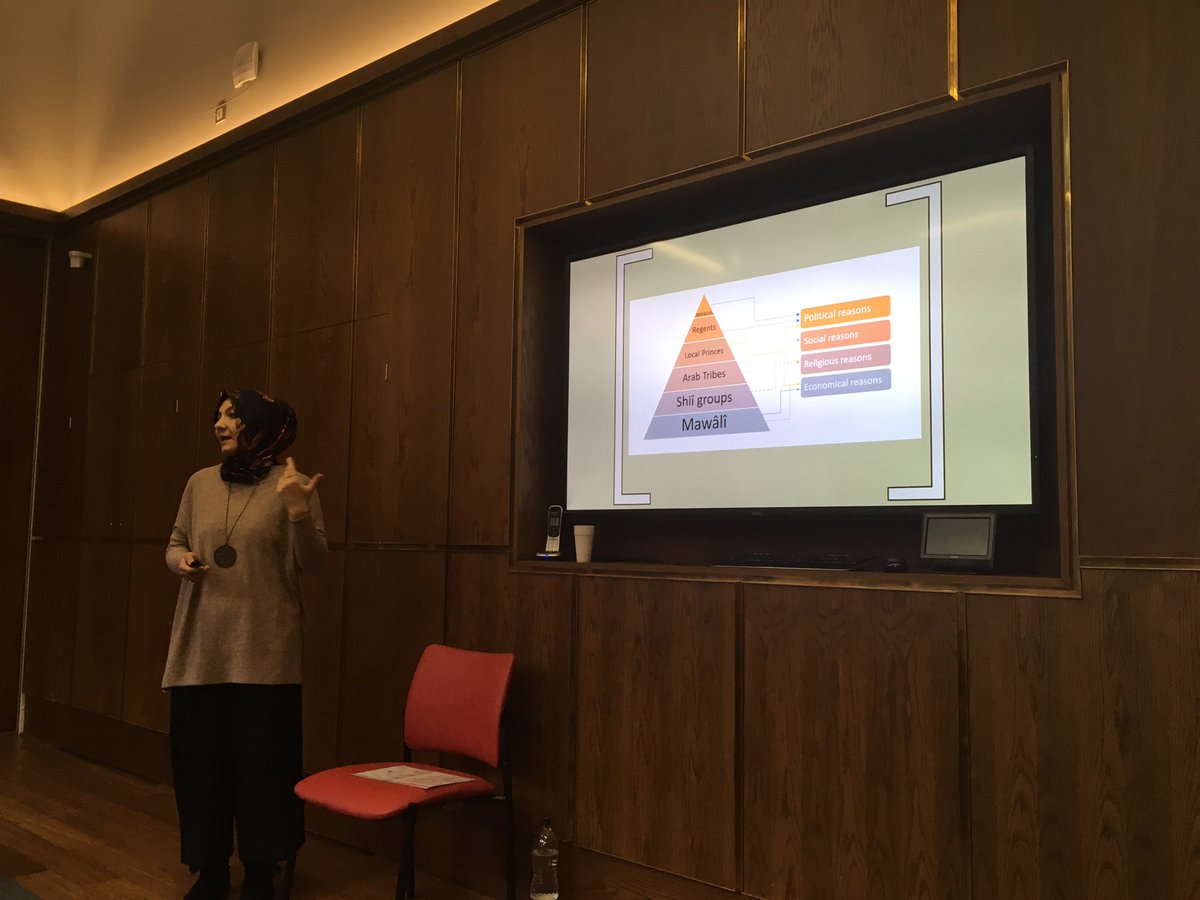
Best Paper Runner-up: Oznur Ozdemir, Leeds University

“Re‐evaluating an Early Islamic Mass Movement: Looking at the Abbasid Revolution from an Economic Perspective.”

damci2wuqaa5w2r

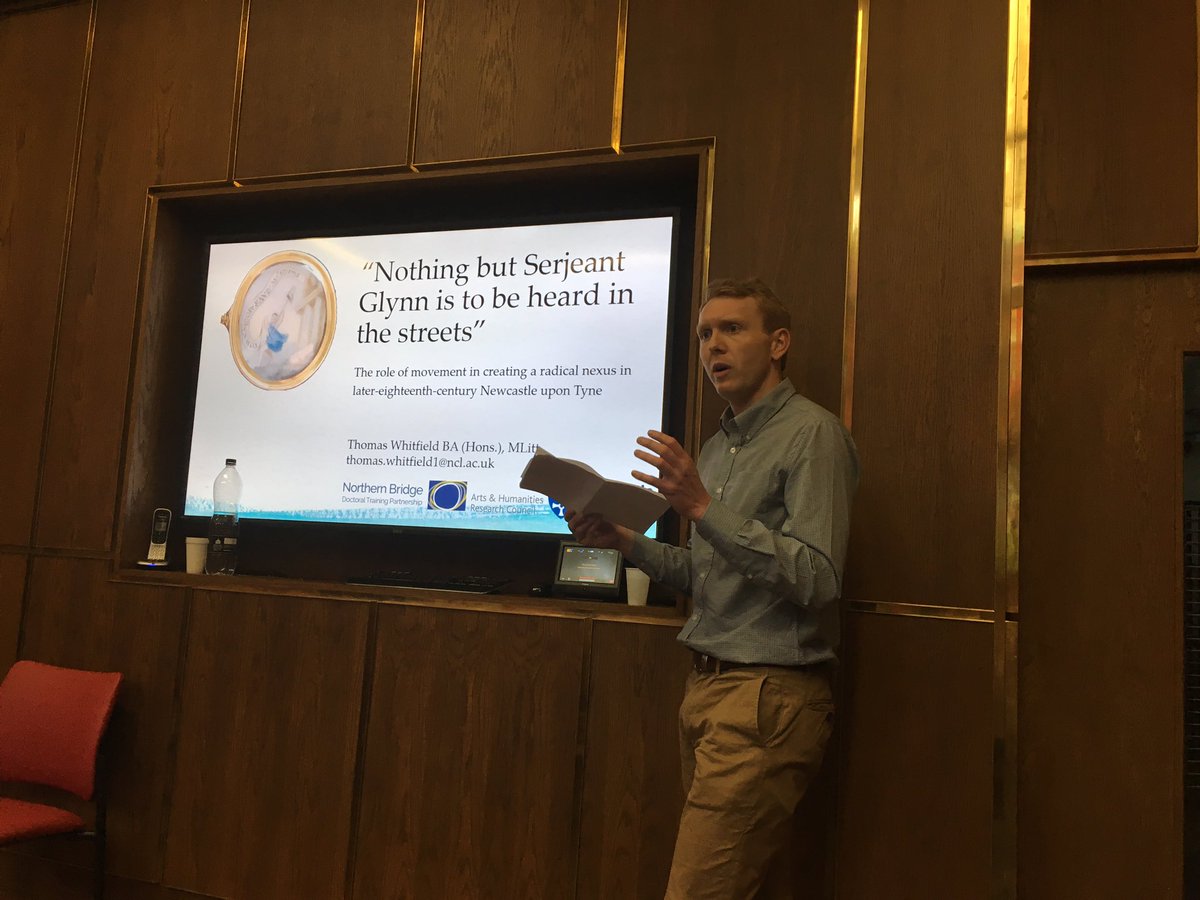
Best Paper: Thomas Whitfield, Newcastle University

“’Nothing but Serjeant Glynn is to be heard in the streets’– The role of movement in creating a radical nexus in later-eighteenth-century Newcastle upon Tyne.”

daq6rspw0ae4c2x

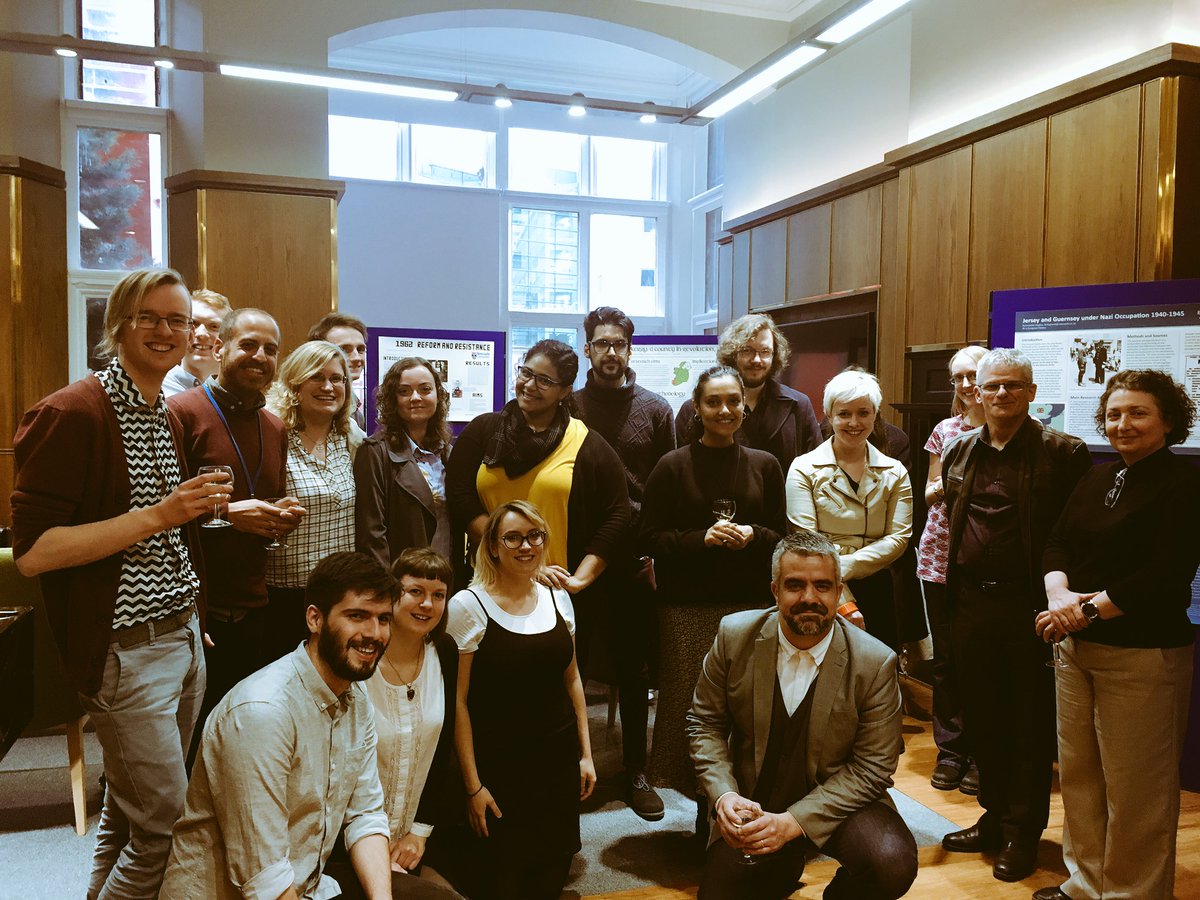
We would like to thank everyone who contributed and attended the conference. It was a huge success, we look forward to next year!

daq6lvuwaaeguhy

14th Annual Postgraduate Forum Conference Program

14th Annual Postgraduate Forum Conference

School of History, Classics and Archaeology

Newcastle University

19th May 2016

‘Movement’

Time Programme
9.00-9.50 Registration and coffee (Armstrong Reception Rooms)
9.50-10.00 Chair’s welcome (Armstrong Reception Rooms)
10.00-11.30 Panel I: Cultural movement (4 papers)

chair: tbc

(Armstrong Reception Rooms)

Fernando Sanchez (Trinity College, Dublin) “(Re)constructing cultural distinctiveness: cultural diplomacy or propaganda? The 1977-1979 touring exhibition, Treasures of Early Irish Art, 1500 B.C. to 1500 A.D.
Amber Roy (Newcastle University) “Identifying movement and use in ground and polished stone”
Lakshmi-Pearl Quigley (University of Edinburgh) “Movement and ‘In‐between‐ness’: Liminality in theories about difference in ‘race’ and gender history”
11.30-12.00 Tea/coffee I (Armstrong Reception Rooms)
12.00-13.30 Panel II: Movement and positioning (3 papers)

chair: tbc

(Armstrong Reception Rooms)

Lorena Zanin (University of Leeds) “Who comes, who goes and who stays: movements and interests in the North eastern corner of Italy straddling the foundation of Aquileia.”
Sara Borrello (Newcastle University) “Moving Matrons: The case of Servilia”
Kimberley Foy (Durham University) “’Keeping State’: Space, performance and languages of diplomacy at the Early Stuart Court, 1603-1642.”
13.30-14.30 Lunch (Armstrong Reception Rooms)
14.30-16.30 Panel III: Social movement (4 papers)

chair: tbc

Gorka Etxebarria (University of the Basque Country) “From the imminent breakup with Francoism to the Basque National Liberation Movement: the role of ETA armed organisation in a changing political environment (1974‐1983)”
Oznur Ozdemir (University of Leeds) “Re‐evaluating an Early Islamic Mass Movement: Looking at the Abbasid Revolution from an

Economic Perspective”

Emilio Zucchetti (Newcastle University) “Clashes and riots in ancient Rome: a postmodern perspective on Roman social struggles.”
Thomas Whitfield (Newcastle University) “’Nothing but Serjeant Glynn is to be heard in the streets’– The role of movement in creating a radical nexus in later-eighteenth-century Newcastle upon Tyne.”
16.30-17.00 Tea/coffee II (Armstrong Reception Rooms)
17.00-18.00 Keynote address (room G17)

chair: tbc

Graham Smith (Royal Holloway) “Movement in oral history: Revisiting Mrs Smereka remembering her Ostarbeiter journey”
18.00- Prize giving and wine reception (Armstrong Reception Rooms)
19.30- Dinner at Piccolino


Call for Papers – 14th Annual Postgraduate Forum Conference

Call for Papers

14th Annual Postgraduate Forum Conference

School of History, Classics and Archaeology

Newcastle University

19th May 2017


‘Movement’


This interdisciplinary one-day conference seeks to bring together Postgraduate students studying histories relating to the theme of Movement. How do we study the past, not as static, but as dynamic and changing? How does the movement from one context to another change how we interpret evidence? What are the effects of movement on societies, material, and intellectual cultures? How has the idea of movement, or a movement, been used for political, social, or artistic purposes? We welcome any papers exploring the movement of people, objects, and ideas.

We invite proposals for twenty-minute papers from all postgraduate historians, classicists, ancient historians, and archaeologists. Suggested topics include, but are not limited to:

  • Migration and population movements
  • Journeys and travel
  • Trade and connections
  • Social movements
  • Cultural, Literary or Philosophical movements
  • Scientific movements
  • Movement of/within the body
  • Movement of soul/emotions
  • Physical movement such as gesture or dance

We also invite poster submissions from postgraduate students. In order to offer the opportunity to present work in the earlier stages of research, poster submissions are not necessarily required to fit with the theme of the conference.

The PGF Committee is more than happy to announce that keynote this year will be presented by: Dr. Graham Smith (Royal Holloway, University of London), with a paper entitled “Movement in oral history: Revisiting Mrs Smereka remembering her Ostarbeiter journey”.

Please send abstracts of no more than 300 words nshspgf@ncl.ac.uk by 10th April 2016. If you have any ideas, questions or enquiries, please feel free to get in touch.

Tea/coffee and lunch will be provided, and the conference will be followed by a reception where there will be prizes for the best paper and poster. Afterwards, there will be an optional dinner, at extra charge.

Follow us at @NewcastlePGF

https://www.societies.ncl.ac.uk/pgfnewcastle/

History Lab 2017: Creating Dialogue.

histroy-lab


History Lab 2017: Creating Dialogue.

Teesside University, Wednesday 5 April 2017.

The Curve T1.01, 12:30 – 6:00pm


12:30 – 1pm: Registration

1:00 – 2pm: Welcome and Panel 1 – Thinking about Militarism and Peace (Chair: Sophie Roberts)

Rowan Thompson, (PhD, Northumbria University) ‘An essential institution in British aviation’: The Air League of the British Empire, Empire Air Day and the creation of ‘airmindedness’ in the 1930s

Jasmine Calver, (PhD, Northumbria University) The Comité Mondial des Femmes contre la Guerre et le Fascisme and the Comitern: French and Soviet women’s anti-fascist collaboration in the 1930s

2:00 – 2:20pm: Break

2:20 – 3:20pm: Panel 2 – Rediscovering History through Alternative Sources (Chair: Natasha Neary)

Laura Flannigan, (MA, York University) Edmund Dudley’s Tree of Commonwealth and discourses on royal morality in the early sixteenth century

Tracey Jones, (PhD, Teesside University) ‘Colliery Amazons and Venuses’: The ‘Picturesque’ Pit Brow Women of Wigan

3:20 – 3:30pm: Break

3:30 – 5:00pm: Panel 3 – Public History and Collaboration (Chair: Rebecca Saunders)

Judith Phillips, (PhD, Teesside University) National identity, gender, social class and cultural aspiration in mid-nineteenth century England and France: Josephine Bowes (1825-1874), collector and museum curator

Spencer Brown, (MA, York University) ‘What should York remember?’ A community history project

Harriet Beadnell, (PhD, York University) Organising Postgraduate Conferences – The pros and cons of planning student-led events and some tips on where to start

5:00 – 5:15pm: Break

5:15 – 6:00pm: Keynote – Dr Ben Roberts (Teesside University), Title TBC

6:30pm: Conference Dinner at Al Forno Restaurant, Southfield Road, Middlesbrough.


Please register via: https://www.eventbrite.co.uk/e/creating-dialogue-symposium-tickets-32689403887?aff=eac2    Registration closes on 24th March 2017.

NEWCASTLE CLASSICS AND ANCIENT HISTORY RESEARCH SEMINARS, SPRING 2017

Please find below the programme for the Classics and Ancient History Research Seminars taking place this semester at the School of History, Classics and Archaeology, Newcastle University. All seminars begin at 5.00 pm on the given day and, unless specified below, take place in Room 2.50 on the 2nd floor of the Armstrong Building. (A campus map may be foundhere.) Further details about the final session listed below, a commentary workshop on Hesiod’sTheogony led by Profs Jenny Strauss Clay and Athanassios Vergados, will be circulated in due course. I or Micaela Langellotti will be sending out a weekly notice in advance of each seminar, along with contact details about that week’s dinner arrangements. Any enquiries may be directed us at john.holton@newcastle.ac.uk and micaela.langellotti@newcastle.ac.uk.
 
All are very welcome to attend!
Wednesday 15th February
Young Research Panel (PhD candidates, Newcastle University)
Roberto Ciucciove: Lex Marcia Atinia: new strategies of communication and legislative productivity within the Romannobilitas at the beginning of the II century BC
Chris Mowat: An Intersex Manifesto: Naming the non-binary constructions of the ancient world
James Mullen: Beyond Persianization: the adoption of Near Eastern traditions by Alexander the Great
 
Wednesday 22nd February
Dr Rolf Strootman (Utrecht)
Global empire, local religion: Religious patronage and imperial integration in the Hellenistic Near East
 
Thursday 23rd February (Room TBC)
Dr Claudia Beltrao da Rosa (UNIRIO/Newcastle)
Images of the Gods in Cicero
 
Wednesday 1st March
Prof. Nicholas Purcell (Oxford)
Micro-global history puts the ancient Mediterranean in its place
 
Wednesday 8th March
Dr Jamie Wood (Lincoln)
From Cyprian to Priscillian: making and breaking bishops in late Roman Spain,ca. 250-ca. 400
 
Wednesday 15th March
Prof. Costas Panayotakis (Glasgow)
The collection of Latin moral maxims attributed to the playwright Publilius
 
Wednesday 22nd March
Dr Caroline Vout (Cambridge)
Classicism Meets Modernity: Greek and Roman Art in the Nineteenth Century
 
Wednesday 26th April
Dr Katherine McDonald (Exeter)
Writing women: understanding the goddess Reitia
 
Wednesday 3rd May
Dr David Lewis (Nottingham)
Occupational hazards: measuring the extent of the division of labour in the economy of classical Athens
 
Wednesday 10th May
Dr Oliver Passmore (Newcastle)
Deixis and Identity in the Odyssey
 
Wednesday 17th May
Dr Lisa Hau (Glasgow)
Pathos with a Point. Reevaluating ‘Tragic History’
 
Wednesday 24th May (Room 1.04, Armstrong Building)
Prof. Jenny Strauss Clay (Virginia) and Prof. Athanassios Vergados (Heidelberg/Newcastle)
Workshop: Commentary on Hesiod’s Theogony
 

Newcastle University Roman Archaeology Seminar Series, Semester 2 Winter/Spring 2017

All the following seminars are on Tuesdays at 18:00 hrs in Armstrong Building room 1.06

7 Feb 2017 – James Harland (York University)

‘The End of Roman Rule and the Adventus Saxonum: Rethinking Ethnicity in post-Roman Britain’


21 Feb – Simon Esmonde Cleary (Birmingham University)

‘The Mediterranean Mattered More: Imperial weakness and local responses either side of the Channel at the turn of the fourth and fifth centuries A.D.’


28 Feb – Indra Werthmann (Durham University)

‘The Image of the Past: Reassembling identities through Roman objects in early Anglo-Saxon society, 5th to 7th century AD’


7 Mar – Barbara Birley (Vindolanda Trust)

‘Recent work at Vindolanda, excavations and artefacts’


14 Mar – David Breeze (Edinburgh)

‘Bearsden: Life in a Roman fort’


21 Mar – Alexis Haslam (Pre-Construct Archaeology)

‘Industry and Magic: Quarrying and Selective Deposition in Ewell, Surrey’


25 Apr – TBA


2nd May – TBA

All welcome.  Colleagues wishing to join the speaker for dinner are asked to contact Tatiana Ivleva (Tatiana.ivleva@ncl.ac.uk) in advance


Newcastle University History Seminar Series, semester 2, 2016-7

All the following seminars are in Armstrong Building room 1.03.

Professor Richard Clay, Professor of Digital Humanities,

‘Vandalism and Terrorism during the Revolutionary France’,

Wednesday, 22 February. 3.30pm.

Dr Michael Pierse, Queens University Belfast,

‘Thinking Globally about Irish Working-Class Writing?’,

Wednesday 1 March, 5pm.

Professor Thomas Scharf, Professor of Social Gerontology,

‘Constructing home over the life course in rural Ireland: towards a model of at-oneness’,

Wednesday, 15 March, 5pm.

Dr Laurence Marley, National University of Ireland, Galway,

‘Empire, faith and class in a Belfast mill district: 1914-21’,

Wednesday, 22 March, 5pm.

Dr Brian Kelly, Reader in American History, Queen’s University Belfast

‘WEB Du Bois, Black Agency, and the “Slaves’ General Strike”: Problems in the Historiography of US Emancipation’,

Wednesday, 3 May, 5pm.

Dr Emma Cheatle, NUHRI Post-doctoral Research Fellow, Newcastle University,

‘Object, Landscape and Confinement in the Writing of Mary Wollstonecraft’, Wednesday, 10 May, 5pm.

Professor Neville Kirk, Manchester Metropolitan University,

‘Transnational Radicalism: The Case of Tom Mann and Robert Samuel Ross’,

Wednesday, 17 May, 5pm.

All welcome. We particularly welcome PG students. Refreshments provided

CALL FOR PAPERS – MOVEMENT: THE 14TH ANNUAL PGF CONFERENCE

Call for Papers

14th Annual Postgraduate Forum Conference

School of History, Classics and Archaeology

Newcastle University

19th May 2017

‘Movement’


This interdisciplinary one-day conference seeks to bring together Postgraduate students studying histories relating to the theme of Movement. How do we study the past, not as a static, but as dynamic and changing? How does the movement from one context to another change how we interpret evidence? What are the effects of movement on societies, material, and intellectual cultures? How has the idea of movement, or a movement, been used for political, social, or artistic purposes? We welcome any papers exploring the movement of people, objects and ideas.

We invite proposals for twenty-minute papers from all postgraduate historians, classicists, ancient historians, and archaeologists. Suggested topics include, but are not limited to:


  • Migration and population movements
  • Journeys and travel
  • Trade and connections
  • Social movements
  • Cultural, Literary or Philosophical movements
  • Scientific movements
  • Physical movement such as gesture or dance


We also invite poster submissions from postgraduate students. In order to offer the opportunity to present work in the earlier stages of research, poster submissions are not necessarily required to fit with the theme of the conference.

Please send abstracts of no more than 300 words to nshspgf@newcastle.ac.uk by 10th April 2017. If you have any ideas, questions or enquiries, please feel free to get in touch.

Follow us at @NewcastlePGF

https://www.societies.ncl.ac.uk/pgfnewcastle/

PGF EVENT NEWSLETTER

PGF Event Newsletter
Week ending on Sun 19 February 2017

Research Seminars
• 21 February, 6pm @ Armstrong Bldg. 1.06: The Mediterranean Mattered More: Imperial weakness and
local responses either side of the Channel at the turn of the fourth and fifth centuries A.D.
• 23 February, 5pm @ Armstrong Bldg. 2.16: ‘Mirrors for Men: New findings with respect to
Technology and Culture of Medieval Swords from Europe and Japan’ between medieval Europe and Japan
• 9 March, 5pm @ Armstrong Bldg. 2.16: Settlement and Social Power: Landscapes of Authority in
Early Medieval England
• 6-7 March, Time TBA @ Newcastle University: Ancient Conceptions of Music: An interdisciplinary
workshop

Newcastle Events
• 22 February, 3:30pm @ Armstrong Bldg. 1.03: ‘Vandalism and Terrorism during the Revolutionary
France’
• 1 March, 5pm @ Armstrong Bldg. 1.03: ‘Thinking Globally about Irish Working-Class Writing?’
PGF Seminar
This Wednesdays @ 1pm: Armstrong Bldg. 1.03

GO TO OUR FACEBOOK PAGE FOR MORE INFORMATION!
@NEWCASTLEPGF

***If you would like to promote your event, please email us! (A.S.Martinez-
Lopez2@newcastle.ac.uk) ***

REFLECTIONS ON JUDITH BUTLER AND KINSHIP TROUBLE by Chris Mowat

Reflections on Judith Butler and Kinship Trouble.

Last Wednesday I had the chance to travel to London for the 2017 Housman Lecture given by Professor Judith Butler, hosted by the Department of Greek and Latin, UCL.

For those not familiar with her work, Professor Butler is perhaps best known for her ground-breaking work in Gender and Queer Theory, and has published much on these topics over the past three decades, as well as on psychoanalysis, power structures and identity politics.

The lecture was called “Kinship Trouble in The Bacchae”, a discussion of what we mean by “kinship”, how we form/break kinship bonds and, to keep in theme with the lecture series, how we can see these bonds and roles played out in Greek tragedy.

The lecture is available to stream (https://www.youtube.com/watch?v=ixwrw0PMC8I), and it is well worth watching if you get the chance, so I won’t repeat the content here, but there are a couple of things that, I think, are worth reflecting on.

Firstly, though it does not relate to the lecture directly itself, it was important the way in which Butler began by pointing out the fact that the lecture had been scheduled to be in a room with no disability access. There is a particular irony here, given Professor Butler’s lifelong work on bodies and how they affect identity politics, and the fact that she is a major influence on Disability Studies as a discipline. The room situation was not originally the case, but the university moved the lecture on account of so many people booking tickets. ‘Room for more people’ doesn’t seem to me, however, a good enough reason to deliberately exclude others based on accessibility, contravening the Equality Act 2010. The room we were in looked quite newly built (or at least newly redesigned), so one wonders why the room was designed without access for everyone in mind? Universities and institutions will use the excuse of old buildings and old designs as the reason why they are restricted in how they can design their rooms, but, in all the constant building work and redesigns that happen on campuses (and I think of our own Armstrong Building, which has been a building site for as long as I have been here), this excuse seems somewhat lacking. Butler explained that though the room was out of her control, she had made opportunities to meet with those who had been unable to attend, over the following few days. But this is certainly something we should probably all be thinking more about in planning and attending academic events.

The lecture itself was then a tour de force of Butler’s usual style of questioning norms and structures we presuppose to be in place by showing that, often, they are only retroactively seen to have been there when they are broken, or at least pushed to extremes. Kinship is more than just a biological, familial bond, a fact particularly prevalent in structures of ‘queer kinship’, but how far does it go, and why is it always necessarily so fragile? At what point does one become ‘kin’, and what effect does that have on the way we treat others? The lessons that Butler brought from Greek tragedy, particularly Euripides’ Bacchae, was that they make it evident we need laws about and knowledge of kinship, and kinship boundaries, in order to not commit violent acts against kin. But this opens a whole new set of questions, not least leaving us wondering if that, then, means it is okay to commit violent acts against non-kin; similarly, when we look at the number of domestic abuse cases, and the statistics of crimes committed by family members and loved ones upon each other, does knowledge of kinship really stop violent acts?

The title of the lecture was obviously referencing to Butler’s seminal first monograph, Gender Trouble (1990), and indeed the concept of kinship got the level of treatment given to the concept of gender in that earlier work. But what I found particularly interesting was the way Professor Butler brought the conclusions of these two lines of questioning. Gender Trouble has a feeling of dissatisfaction of the social structures that pervade and restrict certain people through enforcing conformation, and the lingering question of whether we really need them; “Kinship Trouble in the Bacchae” has a feeling of dissatisfaction at different social structures, but left the lingering question of whether we have a responsibility to operate and utilise those structures, extending the boundaries of “kin” to protect and help others on an immediate but also a global scale.

Chris Mowat,