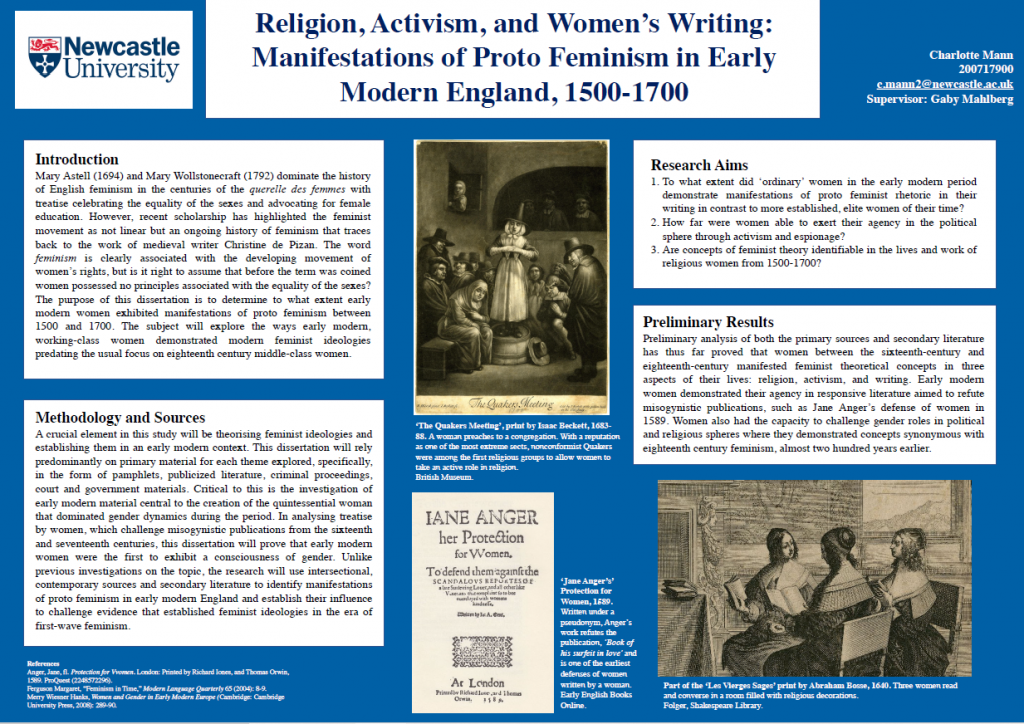

We are excited to invite you to our 19th Annual Postgraduate Conference, on the 19th May 2021.
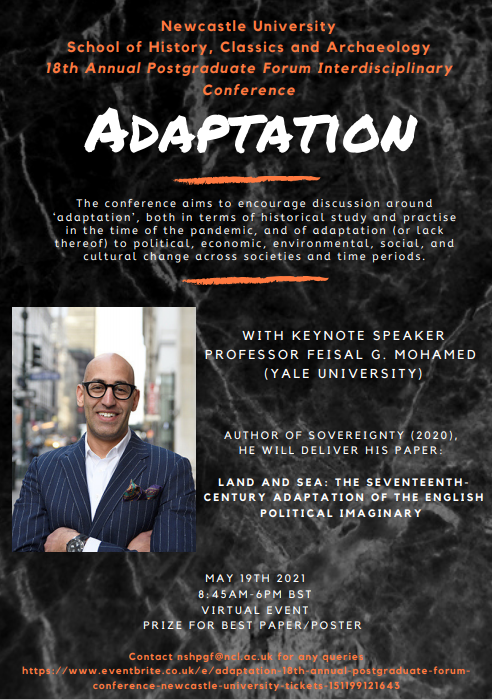
This virtual conference aims to encourage discussion around ‘adaptation’, both in terms of historical study and practise in the time of the pandemic, and of adaptation (or lack thereof) to political, economic, environmental, social, and cultural change across societies and time periods. Papers will be presented in cross-disciplinary thematic panels, and we will be hearing from postgraduate students from across the globe as well as a little closer to home in Newcastle!
We are delighted to be joined by Yale University’s Professor Feisal Mohamed as our keynote speaker, with his paper entitled Land and Sea: The Seventeenth-Century Adaptation of the English Political Imaginary
Everyone welcome – see the link below to register! https://eventbrite.co.uk/e/151199121643
Conference schedule (all times are BST)
8:45-9:00 – Welcome
STREAM A
Panel – Material Culture
Chaired by Eleanor Harrison
09:00- 9:20 – Liz Shaw (Newcastle University), ‘Adapting Roman motifs in regional brooch design.’
09:20 – 09:40 – Goran Durdevic (Capital Normal University), ‘Magic, illusion and adaption: reflection and mirrors in Qin – Han and Roman empires.’
09:40 – 10:00 – David Johnson (Newcastle University), ‘Adapting the British Home in the Empire.’
10:00 – 10:20 Q&A
Panel – Adaptation of Historical Practice and Media
Chaired by Rob Granger
10:30 – 10:50 – John Pearson (Newcastle University), ‘Camera, Lights, Action! A Personal Approach to using Existing Film and Video as an Ethnoarchaeological Source.’
10:50 – 11:10 – Hannah James Louwerse (Newcastle University), ‘Staying flexible: how to build an oral history archive.’
11:10 – 11:30 – Kieran Shackleton (University of Glasgow), ‘Adapting the Holocaust Memory Centre: Rethinking Memory Seventy-Six Years Later.’
11:30 – 11:50 – Rebecca Whiting (University of Glasgow), ‘Re-thinking rights to archives.’
11:50 – 12:10 – Q&A
Panel – Ideology & Belief
Chaired by Leanne Smith
13:10 – 13:30 – Olivia Kinsman (University of Bristol), ‘SEKHMET: An Ancient Goddess for Modern Times.’
13:30 – 13:50 – Daniel Sutton (St John’s College Oxford), ‘When Words Won’t Adapt: Language and Authority in Tacitus’ Annals.’
13:50 – 14:10 – Samantha Dobbie (University of Glasgow), ‘Adapting to Revolution: Women in Revolutionary Paris, October 1789.’
14:10 – 14:30 – Katharine McCrossan (University of Glasgow), ‘Co-operation, Competition, and Consumerism: The Scottish Co-operative Movement in the 1950s.’
14:30 – 14:50 Q&A
Panel – Mobility & Identity
Chaired by Rob Granger
14:50 – 15:10 – Giulio Leghissa (University of Toronto), ‘SB XIV 11979 and Women Mobility between North Africa and Egypt.’
15:10 – 15:30 – Neil McClelland (University of Glasgow), ‘Natives’ and Foreigners’ Mutual Adaptation in Late-Medieval Florence.’
15:30 – 15:50 – Anais Delcol (University of Glasgow), ‘Adaptation to a new culture as a way of reinventing female identity.’
15:50 – 16:10 – Daniel Riddell (Northumbria University), ‘Scandinavian and German Merchant Migrants to Newcastle in the 19th Century: British Businessmen?.’
16:10 – 16:30 Q&A
16:40 – 17:40 – Keynote speaker – Feisal Mohamed (Yale University), ‘Land and Sea: The Seventeenth-Century Adaptation of the English Political Imaginary’
17:40 – 18:00 -Prize giving & closing speeches
STREAM B
Panel – Landscapes and Their Challenges
Chaired by Jerome Ruddick
10:30 – 10:50 – Laura Stops (University of Exeter), ‘Politics, Passages and Peripheries: The adaptation of the Porta Esquilina for a new imperial age.’
10:50 – 11:10 – Katerina Gottardo (Durham University), ‘Adaptation to the environmental context: the substructures of caveae in Roman theatres in the northern-central Italy.’
11:10 – 11:30 – Huilin Yang (University of Glasgow), ‘Exploring the role of olive cultivation in the Mediterranean ecosystem using archaeological evidence and the Annales framework.’
11:30 – 11:50 – Mark Mather (University of Queensland), ‘Roman Supply Lines – How the Gallic Landscape Necessitated Adaptation.’
11:50 – 12:10 – Q&A
Panel – Religion & Society
Chaired by Harriet Palin
13:10 – 13:30 – Arnau Lario-Devesa (University of Barcelona), ‘Re-editing the past, or how to fabricate continuity: The case-study of the roman sanctuary of Can Modolell (Cabrera de Mar, Barcelona) and the neighbourhood of Saint John.’
13:30 – 13:50 – Öznur Özdemir (Sakarya University), ‘Muslims’ Fiscal Adaptation After the First Islamic Conquests.’
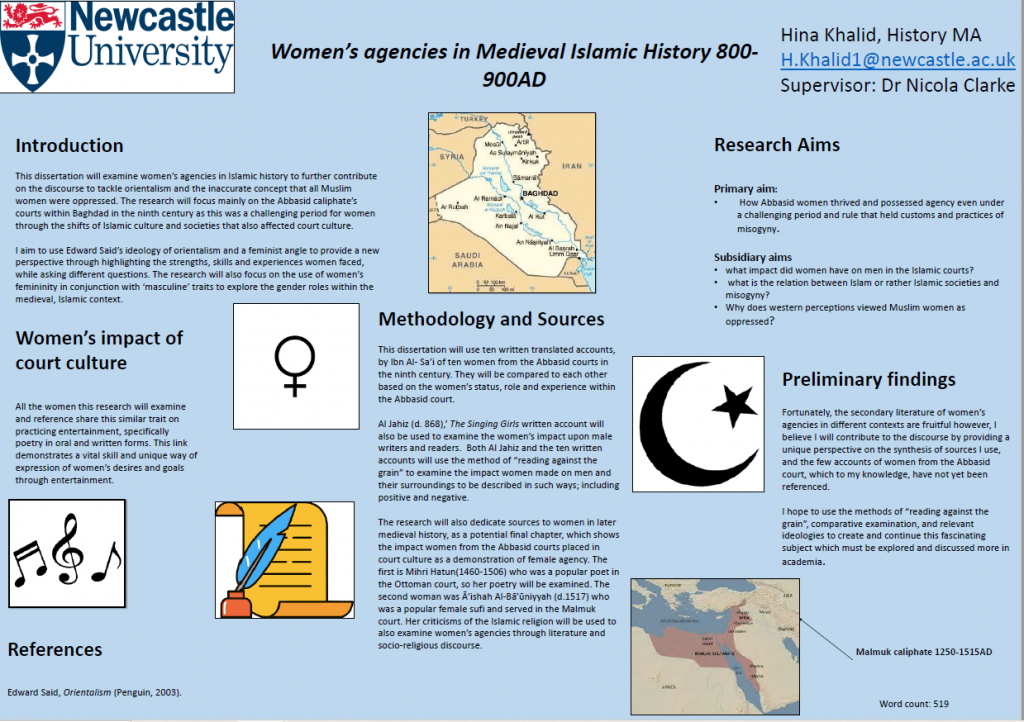
13:50 – 14:10 – Hina Khalid (Newcastle University), ‘How Abbasid women thrived and possessed agency even under a challenging period and rule that held customs and practices of misogyny.’
14:10 – 14:30 – Q&A
Panel -Reinterpreting & Reusing the Past
Chaired by Katherine Waugh
14:50 – 15:10 – Jessica Habib (University of Glasgow), ‘Debating the Colonial Identity of the Ottoman Empire: Caliphate and Colonizer?’
15:10 – 15:30 – Shelby Judge (University of Glasgow), ‘Madeline Miller’s Circe as the archetype of contemporary feminist adaptations of Greek myth’
15:30 – 15:50 – Elly Polignano (Newcastle University), Marc.Arg. AP 5.63: multiple levels of adaptation
15:50 – 16:10 – Berklee Baum (University of Oxford), ‘The Adaptability of Memorialization and Memory.’
16:10 – 16:30 Q&A
END STREAM
‘Individuals and Communities’
20th May 2016
Room 2.22, Research Beehive, Newcastle University
| 9.00 – 9.15 | Tea and Coffee |
| Panel 1
Chair: Lauren Emslie |
|
| 9.15 – 9:45 | George Scratcherd (University of Oxford)
The four horsemen of the AME Church: ‘Great Men’ and the challenges of black church historiography. |
| 9.45 – 10.15 | James Mullen (Newcastle University)
God, King, and the Land: The relationship between Neo-Assyrian Kings, their subjects and the God Aššur. |
| 10.15 – 10.45 | David Astbury (Newcastle University)
Can path creation theory restore the agency of individuals and communities in the past? |
| 10.45 – 11.15 | Tom Whitfield (Newcastle University)
“Wilkes and Liberty”—Punch bowls and the later-eighteenth-century Wilkite agitations. |
| 11.15 – 11.30 | Tea and Coffee |
| Panel 2
Chair: Amy Shields |
|
| 11.30 – 12.00 | Mareike Ahlers (Newcastle University)
All for One and One for All—Identifying heterarchial structures in Early Neolithic barrow building communities. |
| 12.00 – 12.30 | Henry Clarke (University of Leeds)
Negotiating individual identities within the community in Central Spain, 2nd century BC – 2nd century AD. |
| 12.30 – 1.00 | Kate Caraway (University of Liverpool)
Group size and community cohesion in Archaic Greece: Towards a methodology. |
| 1.00 – 2.00 | Lunch and poster session |
| Panel 3
Chair: Lucy Cummings |
|
| 2.00 – 2.30 | John Bowman (Newcastle University)
Derwentcote Forge Cottages: A steel making community in the Derwent Valley 1841-1891. |
| 2.30 – 3.00 | Lawrence Mills (University of Glasgow)
Building the Old College |
| 3.00 – 3.30 | Alberto Cafaro (University of Pisa)
Praefecti fabrum and Roman politics. |
| 3.30 – 4.00 | Andrew Marriott (Newcastle University)
Entrenched Views. Accessing the people of the First World War through Material Culture |
| 4.00 – 4.30 | Tea and Coffee |
| 4.30 – 5.30 | Keynote: Dr Valentina Arena (UCL)
‘The Individual and the Community in Republican Political Thought’ |
| 5.45 | Reception and prize giving (Student Common Room, Armstrong Building) |
It’s that time of year again: the sun is out, the birds are singing… and the PGF Conference is soon!
The theme for this year’s conference, if you didn’t know it yet, is Individuals and Communities. We have a great day lined up for you, some interesting papers from across the disciplines and across the country (and beyond!), so come along to the Research Beehive on campus on 20th May. There will also be posters on postgraduate research.
You can find the programme here.
UPDATE: The research beehive can be found at number 25 on the campus map.
You can follow us @NewcastlePGF for information and live tweeting. Use the hashtag #PGFConference to join the discussion.
By Mareike Ahlers (Archaeology PhD)
Graciously gliding across the water, swans have the uncanny ability to present a serene picture of themselves to the world above the water. Underneath the water, however, their feet are paddling frantically to keep them afloat. This sounds very much like organising a conference.
On the 20/21st November 2015, my colleague, Lucy Cummings, and I hosted the 2nd Neolithic and Early Bronze Age Research Student Symposium (NEBARSS). Full of new experiences, it was both our first go at organising a conference and our first time presenting an academic paper. You can imagine then, that this was a little daunting! Our conference was a great success. Everyone—guests, colleagues, and staff—was really pleased with how it went. Our effort and organisation certainly paid-off, but it was not without its difficulties.
Starting on Friday evening, Newcastle’s own Dr Chris Fowler gave the keynote on ontologies in Neolithic and Bronze Age Britain and Ireland, followed by a wine reception. This was a great start to the conference. The excellent keynote set the tone for the rest of the conference, and the wine reception provided the opportunity for everyone to meet. The occasion also gave the speakers the chance to loosen up and calm down any nerves with a glass of wine (or two!) … While we proceeded to stress about making dinner plans, double-checking that people had places to stay, and cleaning up and clearing everything away before rushing down to meet everyone for dinner. But the world seems much more relaxed after an amazing curry!
But the organisation does not stop there. On Saturday morning (the main day of the conference), Lucy and I met at the department well before 8am, doing more clearing and setting up coffee, biscuits and poster boards… These are wobbly A4 folding screen boards onto which we had to fit A1 posters. Just a little hiccup.
Trying to get your nerves under control throughout the morning is especially tricky if you know that your own, very first, paper is coming up in just a few minutes. While finally getting the chance to tell your audience about henges and long barrows, a little piece of paper telling you that only there are only 5 minutes remaining is vying for your attention. They seemed really off-putting! But, we are told that it happens even to the best.
After that it is finally time to relax… well, at least until lunch time. While everyone else was enjoying the delicious food platters and sandwiches, we were already starting to think about the next session: making sure that all the power point presentations are working, water is ready at the lectern to slake any sudden thirst, and the session leader has some information to use when introducing the speaker.
Finally, after the last session and when all thanks have been given, the first sip of your cold drink in the pub is the best feeling of the whole day. Everyone is happy, the conference is a success, no fatal mishaps, no wine or coffee on the carpets. You managed pass the whole day off like a swan. Time to breathe … and start thinking about the next one!
A number of our AHRC funded PhD students attended the Northern Bridge Autumn School, hosted by Queens University Belfast.
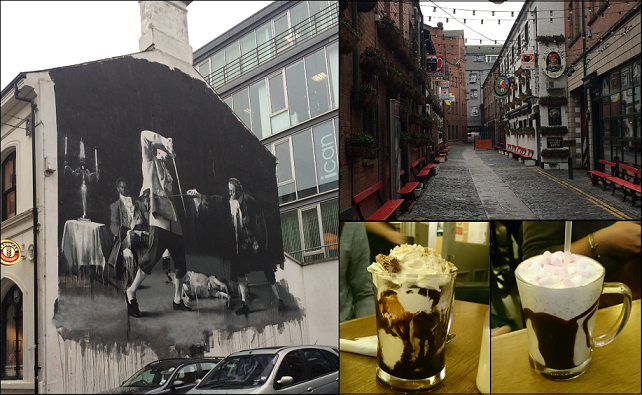
We set off from Newcastle Airport with the weather forecast to rain, rain, rain, with a little more rain scheduled for Belfast for the next few days. We were pleasantly surprised to land in a slightly grey but DRY Belfast. We had time to wander around the city of Belfast, to see some of the street art, the infamous ’Big Fish’, the Ulster Museum and we even squeezed in a visit to Maggie May’s Café, which was as nice as people had reported, and so we pass on the recommendation (see photo below)!
The main aim of the Wednesday timetable was to give this year’s newly funded students a chance to talk and get to know each other, and to hear about their research topics; whilst for the 2014/2015 group it was a chance to catch up with each other’s progress and adventures since the Newcastle event in June 2015.
While the new starters were perfecting their ‘elevator pitch’ (ie. Sell yourself to a prospective boss in the time it takes you to climb 7 floors in a lift!), we spent time reflecting on the advantages of being part of the Northern Bridge partnership. We also highlighted areas in which more could have been made as a new starter, and this was the spark for the afternoon session, which we were to run for the new cohort. This ‘Peer Feedback’ session also included a pitching session for possible training events to be run and organised through Northern Bridge by us, the students. The focus of the afternoon was careers and employability; we heard from a Northern Bridge student who had undertaken a placement that had benefitted her research and provided a possible career path post-PhD. It certainly gave us some food for thought!
The day was concluded with a drinks reception in the wonderful Great Hall of Queen’s University followed by a meal at an Italian restaurant (also followed by a visit to the nearby pubs and bars for some!).
Thursday’s sessions included thematic-based interdisciplinary group networking, followed by a Keynote lecture by Professor Richard Clay (Newcastle University) titled “from coins to Internet in 45 minutes(ish)”. Professor Clay outlined some interesting ideas about the use of marks, graffiti and prints to change perception and re-code public space using examples through history—from early coinage to modern-day street art.
The closing session focussed on ways of disseminating research via the media, discussing ‘being Mary Beard’ – an academic who regularly presents her research interest to the public through documentaries, radio programmes, and her blog, alongside her academic publications. This session also brought up very current issues regarding gender and the representation of academics (women academics, in particular) within the media. It was a short but thought provoking session which raised questions about women in academia and in the media, and how we can move to change these stereotypes. This is obviously an issue which is currently being scrutinised and addressed by academia and the wider public alike.
The autumn conference was a great introduction for the new starters, and provided some food for thought for those of us in stage 2 of our PhD projects – How will we disseminate our work? What road will be taken, an academic or non-academic path? What makes my CV stand out from all the others?
Time to start planning!
-Lucy
2nd Neolithic and Early Bronze Age Research Student Symposium
November 2015
We are holding a postgraduate research student conference here at Newcastle University focusing on the Neolithic and Early Bronze Age archaeology of Britain and Ireland. The conference will be preceded by a keynote speaker (tbc.) and a wine reception, which will provide delegates with a relaxed and friendly environment to discuss their research interests with other PG students and Newcastle staff members, as well as external archaeologists and interested parties.
The conference does not have a theme in order to allow researchers to present aspects of their research projects as they so wish. We are now accepting abstracts for both papers and posters from postgraduate researchers, early careers researchers or independent archaeologists. Click here to download our abstract submission form.
We would also encourage poster abstracts from Masters students who wish to present the results of their dissertations, or new PhD students wanting to present their key research interests and research questions.
If you are interested in attending but not giving a paper or creating a poster we will be opening registration in July , so keep an eye out for further information or email us to be put on our email list.
email: l.b.cummings@ncl.ac.uk or nebarss2015@gmail.com
View our Call for Papers poster for more information.
We hope to hear from you soon!
Last Friday (22nd May 2015) saw Newcastle University’s 12th Annual Postgraduate Forum Conference go off with a bang. A really fantastic range of papers and posters were presented from Newcastle and beyond, displaying some really varied research.
The theme of the conference was “Disruptions”, which had taken root from marketing and commercial theory, as chair Amy Shields explained in her introduction. I think it is fair to say that each paper developed and worked with this theme in really varied and fruitful directions.
The first panel comprised of Skylar Arbuthnot, Samuel Pearson and Victoria Hughes. Arbuthnot gave us some interesting food for thought in local archaeology by suggesting that the understood disruption of Roman settlement could be rethought if we looked for forts in different places. Pearson followed this with an interesting discussion of Lollards and Lollardy heretics in Elizabethan England, and the evidence for and against familial conversion. Finally Hughes looked at some of the Christian responses to a Pagan emperor in the Roman world, and the disruption they felt it caused to their religion.
This was followed by a quick break and a discussion from our keynote speaker, Harry Dickinson (Edinburgh University) who showed a fantastic range of caricature imagery from Britain during the French Revolution and the comedic responses that disruption caused in this country. He almost caused a disruption of his own when he revealed in a denouement that he is, although local, a Sunderland supporter!
After that was a very posh spread for lunch!
Our second panel was Stephanie Moat, Andrew Marriot and myself, Chris Mowat. Moat took the idea of non-classical art styles being regarded as “inferior” in classical archaeologist scholarship and disrupted it herself with the theory of mimetic practice. Marriott then took us to one of the world’s biggest disruptions, the First World War, and looked at how trench art can actually provide new ways of thinking about the historical, military and social developments and outcomes of the war. Thirdly my own paper looked at dreams in the Roman Republic as not simply a disruption of sleep but also a message of potential disruption to the future, and how gender reinforced structures of importance, even in sleep.
The third panel had John Burke and Anthony Stewart. Burke provided stimulating discussion regarding the ongoing disruption of the island of Cyprus by looking at the ‘ghost-town’ of Famagusta, and Stewart took us into Haiti with a look at the local religion of Vodou and the island’s cultural understanding and treatment of mental illnesses.
The poster session showed off, in particular, some of the varied work being done by Masters students.
The final panel of the day was Steven Server and Ben Morton. Server took us through the political climate of the US in the ‘6os and ‘70s through the lens of risk theory, and the disruptions to society and politics during the period. Finally, Morton brought us back to thinking about the theme as a whole and the way we as historians, classicists and archaeologists look at static movement and disruption.
At the wine reception, the Keith Wrightson and Norman McCall prizes were presented. The runner up prize was presented to Andrew Moat, and the winner for the best paper was Stephanie Moat; for posters, Victoria Bell won the runner up prize, with Stacey Astill being the winner.
I, on behalf of the PGF, would like to give a big thank you to Keith Wrightson and Norman McCall for, as always, supporting our event and taking a keen interest in our postgraduate research community – Thank You.
As well, we would like to thank the speakers and audience through the day for the stimulating presentations and fascinating discussion. The whole day was a great success and a lot of good fun. We would all also like to thank Shields for organising and chairing a fantastic conference – thank you!
Chris Mowat
PGF Committee Member
Updated conference programme. We look forward to seeing you all on Friday!
Disruptions!
12th Annual Postgraduate Forum Conference 2015
22nd May 2015
Research Beehive, Old Library Building
9.00 Tea/Coffee Reception
9.20 Introduction
Panel 1 – Chair: Sam Petty
9.30 Skylar Arbuthnot (Newcastle, PhD) The End of Extramural Settlements in the Hadrian’s Wall Frontier Zone
10.00 Samuel Pearson (Durham, MA) Hereditary Heretics: The Experience of Conversion in Lollard Communities, c. 1500-1550
10.30 Victoria Hughes (Newcastle, PhD) “What an evil the Roman world is breeding!” Responses to the Emperor Julian’s Reign
Break
11.15 Keynote Speaker – Harry Dickinson (Edinburgh) British Caricatures and the French Revolution.
Lunch
Panel 2 – Chair: Lauren Emslie
1.00 Stephanie Moat (Newcastle, PhD) Mimetic Practice in Religious Iconography: A Case Study of Roman Britain
1.30 Andrew Marriot (Newcastle, PhD) Disruptive Influences and a Lack of Discipline? World War 1 Trench Art
2.00 Chris Mowat (Newcastle PhD) Calpurnia and the Disruption of the Roman State
Break
Panel 3 – Chair: Amy Shields
2.45 John Burke (Newcastle, PhD) A Lost City in the Sand: The Memorial Legacy of Conflict through the Greek Cypriot ‘ghost-town’ of Famagusta
3.15 Antony Stewart (Newcastle, PhD) The Disruption of Leonce Joachim, 1934: How the anthropologist’s informant became the subject of an international debate on Haitian psychology, Vodou and mental health
Break and Poster Session
Panel 4 – Chair: David Lowther
4.30 Steven Server (Oxford, MSc) Extralaw and Disorder: Disruptions in Political Culture Surrounding State Risk Management, 1964-1976
5.00 Ben Morton (Newcastle, PhD) Disruptions, Scales and the Medieval Village: Questioning the Nucleated-Dispersed Paradigm
5.30 – Conclusion and Thanks
6.00 – Wine Reception – Student Common Room