Newsletter, week 15.02.16

The return of the weekly newsletter!  If you would like to promote an event, please get in touch
(m.ahlers1@ncl.ac.uk).

Research Seminars

Archaeology:
Archaeology Seminar Series
Thursday 18th February, 4-5 pm, Armstrong Building, Room 2.16
Andy Jones (Cornwall Archaeological Unit): ‘The Whitehorse cist

Classics and Ancient History:
Wednesday 17th February, 5pm, Armstrong Building, Room 2.50 Ruth Morello (Manchester): ‘Making Fabricius take the cash: traditional exempla andhte problem of modernity’.

Further School Events

The Extraordinary Gertrude Bell Exhibition
30th January 2016 – 3rd May 2016, Great North Museum

Newcastle University Public Lectures

16th February, 5:30-7pm, Curtis Auditorium, Herschel Building
The British Academy Debates: ‘does religion do more harm than good? ‘ If you would like to attend please register at www.britishacademy.ac.uk/faith

Live Music

18th February, 1:10-2pm, Brunswick Methodist Church, Newcastle
Rose Consort of Viols (Ibi Aziz, John Bryan, Alison Curm, Andrew Kerr, Roy Marks)
‘Flights of Fancy: fantasias, In nomines and dance music from Tudor and Stuart part-books, including music by Tallis, Byrd, Ferrabosco, and Holborne’
Free admission

18th February, 4:30-5:30pm, Spaces 4 and 5, Culture Lab, King’s Walk
Student Performances
Including Dan Lewis (drums), Sarah Berry (violin), Dario Lozana-Thortnon (guitar), Rosie Brownhill (piano accordion)
Free admission, limited capacity
Just a minute with… Chris Mowat

ChrisChris Mowat is a second year Classics and Ancient History PhD student, and our current IT and Social Media person. His research is on gender construction and divination in the Roman world. He is also organising AMPAH 2016. He is on twitter @chrismologos

Though currently away on research in Germany, we still managed to get him to answer a few questions…


  1. If you could time-travel back to any moment in the past where and when would it be?

Gosh, there are so many options… and I would probably just waste it on going to see the original production of a Shakespeare…

  1. What book are you currently reading?

Romanitas by Sophia McDougall. Alternate history modern-day Roman Empire, or, as my best friend described it, “Latin Steampunk”.

  1. What did you want to be as a child?

So many things, including a best-selling novelist and a window cleaner! True story!

  1. Can you describe your research in three words?

Roman Sex and Magic.

Okay – that is not exactly accurate, but close enough, and it is great to say!

  1. What are your three most overused/cliché words or phrases?

“Hi Hungry, I’m Chris!”

“True story.”

“On a scale of 1 to [word]…”

  1. What’s the worst Classics-related joke that you’re heard and/or are guilty of telling?

I have a Classics hoodie that says “my life is in ruins”. Works for archaeologists, too!

  1. Have you got any hidden talents?

Yes.

But if I told you, they wouldn’t be hidden!

  1. If given complete freedom to start over, what profession would you like to do and why?

Professional panda hugger. It is a real job, which people are paid real money to do.

  1. What is your favourite movie quote?

“How am I not myself?” (from I Huckabees).


Thanks, Chris! See you in March, when you are back from Germany!

Individuals and Communities: the 13th Annual PGF conference

20th May, 2016

Humans are often considered ‘social animals’, existing only within larger groups, though still maintaining a unique identity. This interdisciplinary one-day conference seeks reflect on the shifting relationship between individuals and communities across history. Defining the relationship between the individual and a (or several) social group(s) is difficult task. A community and an individual often construct carefully curated identities, which are either mutual or distinct. Humans have constantly created communities, approaches to the study of which are wide-ranging and indeed interdisciplinary. Equally, throughout our history individuals have emerged and their eminency has endured the test of time. Prominent and conspicuous these great individuals stand as role-models and exempla. Yet others, individuals who are not famous (either in their own, or our time) often prove to be just as important. What role can we, as historians and archaeologists, play in reviving and bringing back the individual from a historical period, ancient or more modern? Can we restore their agency? How important is the individual experience in society? How are communities organised?
 
We invite proposals for twenty-minute papers from postgraduate historians, classicists, ancient historians, and archaeologists. Suggested topics include, but are not limited to:
 
·        Individuals in communities
·        Individuals outside communities
·        Outsiders and exile
·        Individuals in history
·        Agency
·        ‘Great-Man’ theory
·        Public and private religion
·        Organisation(s) and landscape
·        Social roles
·        International relations
·        Social communication
·        Family
·        Gender and sexuality
·        Creating society
·        Class and race
 
We also invite poster submissions from postgraduate students. In order to offer the opportunity to present work which is in the earlier stages of research, poster submissions are not necessarily required to fit with the theme of the conference.
 
Please send abstracts of no more than 300 words to l.emslie@ncl.ac.uk by Friday 1st April 2016. If you have any ideas, questions or enquiries, please feel free to get in touch.

PGF Lunchtime Seminar

The next lunchtime seminar is Wednesday 20th, at 1pm, in Armstrong 1.04.

John Bagnall (History) will be talking to us about :

The New Official History: Charles Moore, Margaret Thatcher and the Falklands Crisis

‘Earlier this year, Charles Moore released the second of his three volume official biography of Margaret Thatcher. Moore was given unrivalled access to, not only Thatcher herself, but her wealth of private papers concerning her time as British Prime Minister. His first volume, published in 2013, ended with the Falklands Affair of 1982 and the second volume, picks up from this point and continues until the end of her time in office. The Falklands Affair was a dispute between the United Kingdom and Argentina over the sovereignty of the Falkland Islands. The dispute garnered international tension when a nine week conflict was fought between the two nations in 1982. Moore’s work uses Thatcher’s own papers and memory of the affair to give a new account of the conflict. As this work was undertaken before the source material was released for public research purposes, it is at the forefront of study of 1980s British Political history.

This paper aims to examine what Moore adds to the existing knowledge of the Falklands Affair in the context of Lawrence Freedman’s two volume Official History of the Falklands Campaign published in 2005. Freedman too was given access to source material from government departments before it was released to the public and produced, at the time, the most comprehensive study of the Falklands Campaign that had been done. This paper compares the work done by Moore to the work of Freedman to highlight what new insights Moore has offered on the Falklands Affair. This paper scrutinises the source material used by each author as well as their methodologies and conclusion to produce an analysis of how much has been added by Moore to our understanding of one of the most crucial aspects of Thatcher’s Britain, the Falklands Affair.’

Come along for discussion, tea, coffee and biscuits!

Just a minute with… Amy Shields

amyAmy Shields a third year history PhD student, and current editor of our postgraduate journal, Pons Aelius. Her research focuses on seventeenth century republicanism in England, Venice, and the Dutch Republic. She is on twitter @ahshields90

  1. What did you want to be as a child?

An Olympic swimmer, an author, and a vet. I think I may have been a bit over ambitious.

  1. What advice would you have for current UG or early stage PG students?

Get involved in as many things as you can! Not only is a great way to meet new people, but you gain new skills and your CV will look great.

  1. What is the most important life skill you learnt whilst being a PGR student?

How to blag confidence and ignore that gnawing feeling of panic that I’m out of my depth. Imposter syndrome is all too common in academia, but if you act like you know what you’re doing and just go for it, you’ll surprise yourself with what you can achieve.

  1. What has been the most significant/memorable moment of your academic career so far?

When I got accepted to give a paper at Berkeley in California. I’d written the abstract just a few days before the deadline, and didn’t really expect to be accepted. I’d also never been to the US before, so that was a really great experience.

  1. If given complete freedom to start over, what profession would you like to do and why?

When I was little, I really wanted to be a vet because I absolutely love animals. I gave up on that dream because I found sciences much more challenging than humanities at school, and also because I’d get upset far too easily! But if I went back now, I wouldn’t let myself give up so easily.

  1. What book are you currently reading?

One Hundred Years of Solitude is sitting on my bedside table right now, but I’m only a few pages in. I have a habit of getting too distracted by a good book – I won’t notice that hours have passed because I’m so hooked! Last week I read the Hunger Games trilogy in four days….and my supervisor wonders why I miss deadlines… (sorry Rachel!)

  1. What has been the highlight of your week?

It was great to see the finished version of the newly renamed E-Journal, Pons Aelius, going live this week. Linda and I spend a lot of hours working on it, so we were really pleased to see it finally published. It also helped that we could celebrate with a few glasses of wine at the PGF party!

  1. Do you have favourite hidden gems of Newcastle?

It’s not hidden as such, but I love going to Intermezzo at the Tyneside Cinema. It’s a great place to while always the afternoon over a glass of wine and a good book.

Thanks, Amy! Hope you have a wonderful holiday period, and we will see you all in the New Year!

Newsletter, week 14.12.2015

It is the last week of term before Christmas, just a couple of things are happening this week, then we are all free! Happy holidays everyone!

PGF

Lunchtime Seminar
Thursday 17th December, 1-2pm, Armstrong Building, Room 3.41
Amber Roy and Andrew Marriott (both archaeology)

Research Seminars

Archaeology:
Roman Archaeology Seminar Series

Tuesday 15th December, 6-7:30 pm, Armstrong Building, Room 1.06
Tatiana Ivleva (Newcastle University): ‘Global adornments: glass banlges in Late Iron Age Roman period Europe and Britain’

History:

Wednesday, 16th December, 5-7pm Armstrong Building, Room 1.04
Mark Knights (Warkwick University): ‘Corruption and anti-corruption in seventeenth and eighteenth century Britain’


Newsletter, week 7.12.15

There is a lot going on this week, so here is this week’s events newsletter.  If you would like to promote an event, please get in touch
(m.ahlers1@ncl.ac.uk).

PGF

The Importance of being ‘Visible’
Tuesday 8th December, 6:30pm, Armstrong Building, Room 3.38 Question and answer session on academic life and career perspectives
Ask your own questions beforehand on twitter and facebook #AskThePGF

PGF Christmas party
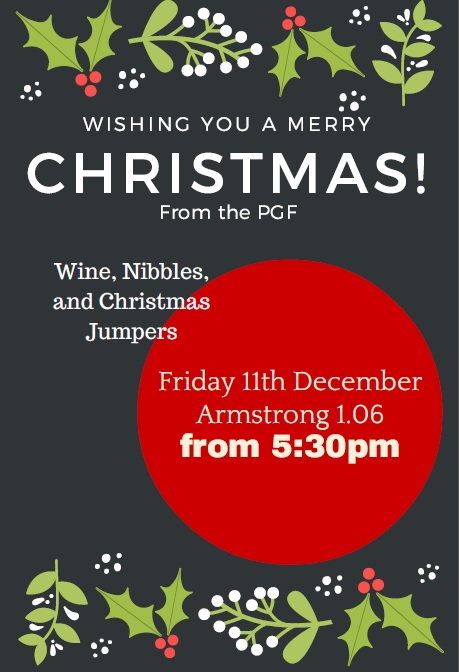
Friday 11th December, 5.30pm, Armstrong Building, Room 1.09 Everyone is welcome

Research Seminars

Archaeology:
Roman Archaeology Seminar Series
Tuesday 8th December, 6-7:30 pm, Armstrong Building, Room 1.06 David Mason (Durham County Council): ‘Research excavation at Binchester Roman fort and extra-mural settlement’

Classics and Ancient History:
Monday, 7th December, 5-7pm Armstrong Building, Room 2.50 Hector Williams (UBC): ‘Goddesses, Whores, Vampyres and Archaeologists: Excavating Ancient Mytilene’


Further School Events

Archaeology Careers Fair
Wednesday 9th December, 4pm, Armstrong Building, Room 1.06
Archaeology drinks
Wednesday 9th December, 5:30pm, Armstrong Building, Room 1.06

Newcastle University Public Lectures

9th December, 5:30-6:45pm, Curtis Auditorium, Herschel Building
Baroness Altmann (Minister of State for Pensions) ‘Pensions and ageing society’


Just A Minute With… Dr. Rob Dale

rob daleDr Rob Dale is Lecturer in Russian History, specialising in twentieth-century Russian and Soviet history, especially the late Stalinist period (1945-1953). He studied for a BA in History at York, an MA in History at the School of Slavonic and East European Studies and a PhD in Russian History at QMUL. Find him on twitter @DrRobDale

  1. Which famous historian would you most like to meet for a drink, and why?

I’ve been lucky enough to meet many of my historiographical heroes for a drink. I’d most like a drink with Elena Zubkova, the historian who almost singlehandedly put the study of late Stalinism back on the map.

  1. What advice would you have for current UG or early stage PG students?

Never ever go anywhere without a book. You never know when your bus breaks down, the person you are meeting will be late, and ten minutes appear when you could read something interesting.

  1. What book are you currently reading?

I’m reading several. Owen Hatherley’s Landscapes of Communism, which is introducing me to the architecture of parts of the Communist world I’ve never visited, and Sheila Fitzpatrick’s new book On Stalin’s Team: The Years of Living Dangerously in Soviet Politics, which is written with her usual wit, precision and deep understanding.

  1. What is the most important life skill you learnt whilst being a PGR student?

The ability to root out the cheapest flights, rail tickets and hotel rooms, and live off a diet of buckwheat, salted cucumbers, and kefir.

  1. What do you enjoy the most about being part of the history, classics and archaeology department at Newcastle?

Interaction with our students. Having taught in a number of institutions, I think the make-up of our student body generates really fascinating discussions. I love working in the Armstrong building too.

  1. What would your perfect day away from work be?

I’d probably still be reading and working, but in the Russian National Library in Saint-Petersburg. I’d spend the day reading different materials in the different reading rooms, but spend lots of time in the tea room and buffet talking to Russian colleagues.

  1. What’s the question you’d most like to have been asked (and why)?

Are you available to keep wicket for England next week? I’m a huge cricket fan, and love keeping wicket.

  1. If given complete freedom to start over, what profession would you like to do and why?

I’d probably want to do something where I could spend more time in the open-air. I like idea of working for the forestry commission in some capacity.

  1. What is your favourite movie quote?

“With great power comes great responsibility.” (Peter Parker, Spiderman)

  1. What’s next for Rob?

I’m about to start working on an article about the upkeep of soldiers’ graves in the late Stalinist period. The material is really exciting, and I think it tells us something important about Soviet War Memory.

Best of luck with the research, Rob. Until next time…!