We are in the process of updating and cleaning up the website! This means some past issues of Pons Aelius now have new URLs.
Pons Aelius’ Senior Editor is contacting previous contributors where possible to let them know their work has moved. If your work isn’t where it used to be, it will be on one of our new Pons Aelius issue pages, under the Pons heading on the left side of the page.
The Committee page will be updated to include the 2025-’26 team soon.
Upcoming events:
The team are working hard behind the scenes to put together the 2026 Conference and Seminar Series – stay tuned!
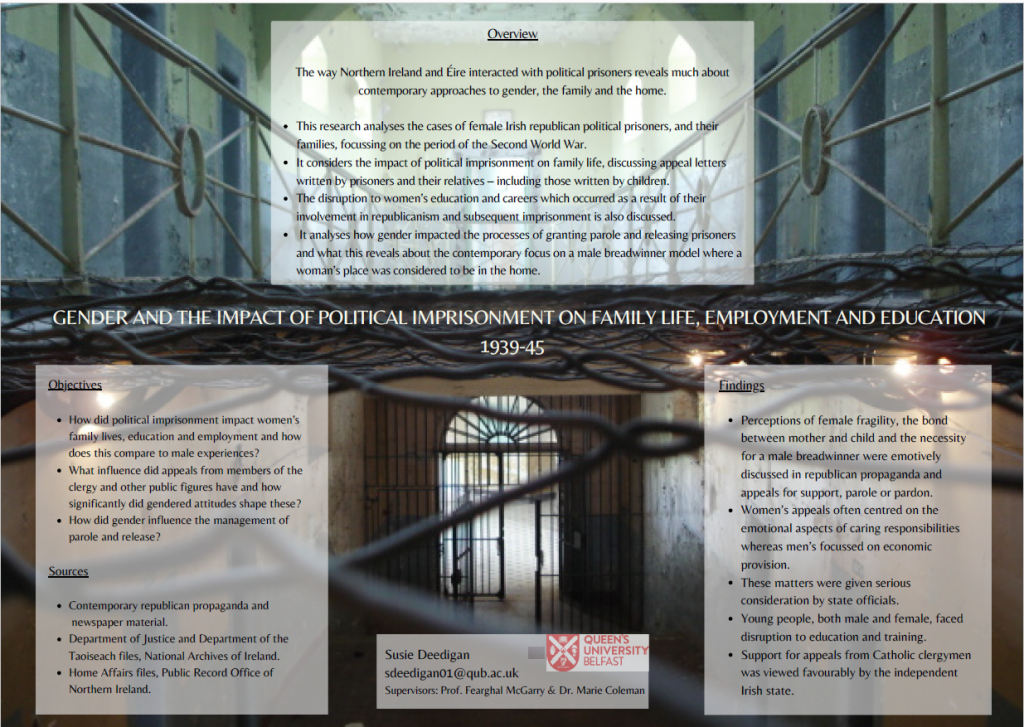
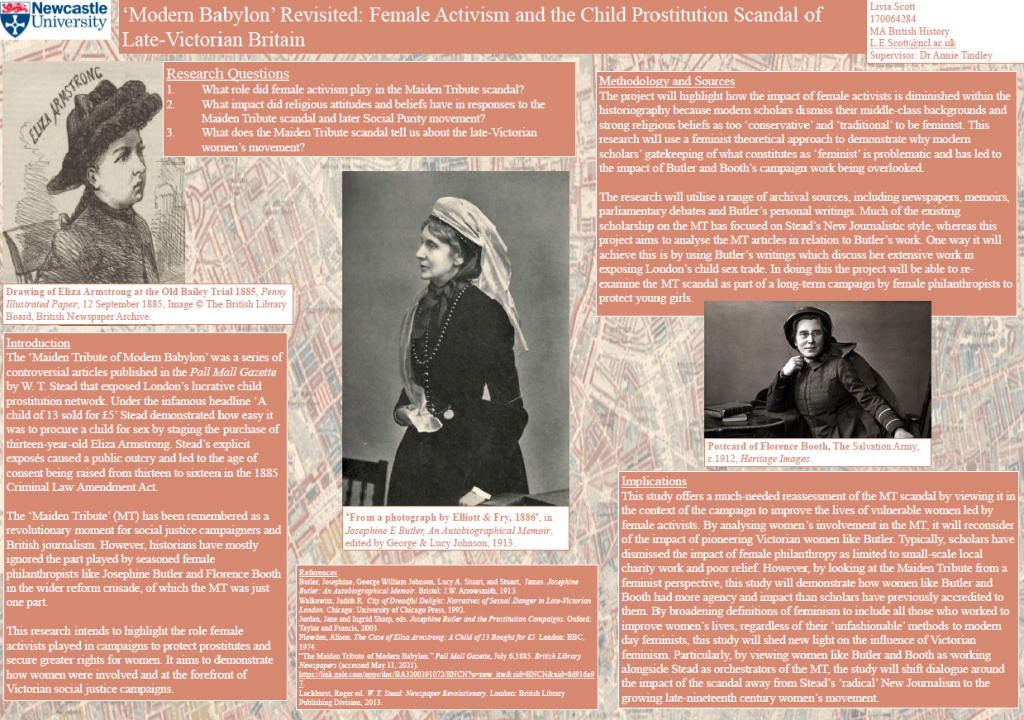
T.N. Gibson, “All in the name of progress… and for a few lousy bob”: Brassed Off, Rebellion and Deindustrialisation.
t.gibson6@newcastle.ac.uk
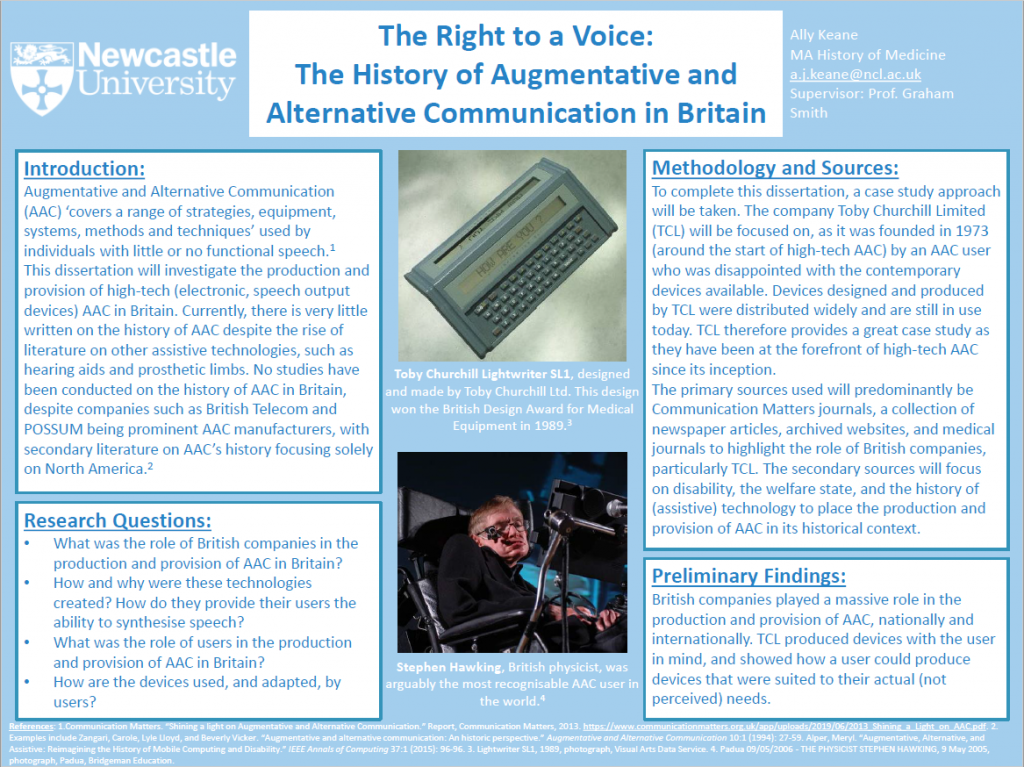
Ally Keane, ‘It became a symbol of my incapacity and I hated it’: Resistance to High-Technology Augmentative and Alternative Communication, c. 1980-2020.
a.j.keane@newcastle.ac.uk
Bernardo Carvalho De Mello, Global South Narratives of Rebellion in International Human Rights Law.
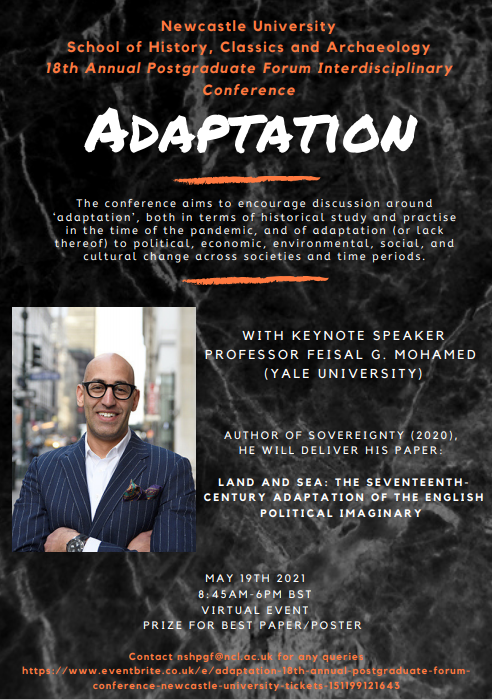
We are excited to invite you to our 19th Annual Postgraduate Conference, on the 19th May 2021.
This virtual conference aims to encourage discussion around ‘adaptation’, both in terms of historical study and practise in the time of the pandemic, and of adaptation (or lack thereof) to political, economic, environmental, social, and cultural change across societies and time periods. Papers will be presented in cross-disciplinary thematic panels, and we will be hearing from postgraduate students from across the globe as well as a little closer to home in Newcastle!
We are delighted to be joined by Yale University’s Professor Feisal Mohamed as our keynote speaker, with his paper entitled Land and Sea: The Seventeenth-Century Adaptation of the English Political Imaginary
09:00- 9:20 –Liz Shaw (Newcastle University), ‘Adapting Roman motifs in regional brooch design.’
09:20 – 09:40 – Goran Durdevic (Capital Normal University), ‘Magic, illusion and adaption: reflection and mirrors in Qin – Han and Roman empires.’
09:40 – 10:00 – David Johnson (Newcastle University), ‘Adapting the British Home in the Empire.’
10:00 – 10:20 Q&A
Panel – Adaptation of Historical Practice and Media
Chaired by Rob Granger
10:30 – 10:50 – John Pearson (Newcastle University), ‘Camera, Lights, Action! A Personal Approach to using Existing Film and Video as an Ethnoarchaeological Source.’
10:50 – 11:10 – Hannah James Louwerse (Newcastle University), ‘Staying flexible: how to build an oral history archive.’
11:10 – 11:30 – Kieran Shackleton (University of Glasgow), ‘Adapting the Holocaust Memory Centre: Rethinking Memory Seventy-Six Years Later.’
11:30 – 11:50 – Rebecca Whiting (University of Glasgow), ‘Re-thinking rights to archives.’
11:50 – 12:10 – Q&A
Panel – Ideology & Belief
Chaired by Leanne Smith
13:10 – 13:30 – Olivia Kinsman (University of Bristol), ‘SEKHMET: An Ancient Goddess for Modern Times.’
13:30 – 13:50 – Daniel Sutton (St John’s College Oxford), ‘When Words Won’t Adapt: Language and Authority in Tacitus’ Annals.’
13:50 – 14:10 – Samantha Dobbie (University of Glasgow), ‘Adapting to Revolution: Women in Revolutionary Paris, October 1789.’
14:10 – 14:30 – Katharine McCrossan (University of Glasgow), ‘Co-operation, Competition, and Consumerism: The Scottish Co-operative Movement in the 1950s.’
14:30 – 14:50 Q&A
Panel – Mobility & Identity
Chaired by Rob Granger
14:50 – 15:10 – Giulio Leghissa (University of Toronto), ‘SB XIV 11979 and Women Mobility between North Africa and Egypt.’
15:10 – 15:30 – Neil McClelland (University of Glasgow), ‘Natives’ and Foreigners’ Mutual Adaptation in Late-Medieval Florence.’
15:30 – 15:50 – Anais Delcol (University of Glasgow), ‘Adaptation to a new culture as a way of reinventing female identity.’
15:50 – 16:10 – Daniel Riddell (Northumbria University), ‘Scandinavian and German Merchant Migrants to Newcastle in the 19th Century: British Businessmen?.’
16:10 – 16:30 Q&A
16:40 – 17:40 – Keynote speaker – Feisal Mohamed (Yale University), ‘Land and Sea: The Seventeenth-Century Adaptation of the English Political Imaginary’
17:40 – 18:00 -Prize giving & closing speeches
STREAM B
Panel – Landscapes and Their Challenges
Chaired by Jerome Ruddick
10:30 – 10:50 – Laura Stops (University of Exeter), ‘Politics, Passages and Peripheries: The adaptation of the Porta Esquilina for a new imperial age.’
10:50 – 11:10 – Katerina Gottardo (Durham University), ‘Adaptation to the environmental context: the substructures of caveae in Roman theatres in the northern-central Italy.’
11:10 – 11:30 – Huilin Yang (University of Glasgow), ‘Exploring the role of olive cultivation in the Mediterranean ecosystem using archaeological evidence and the Annales framework.’
11:30 – 11:50 – Mark Mather (University of Queensland), ‘Roman Supply Lines – How the Gallic Landscape Necessitated Adaptation.’
11:50 – 12:10 – Q&A
Panel – Religion & Society
Chaired by Harriet Palin
13:10 – 13:30 – Arnau Lario-Devesa (University of Barcelona), ‘Re-editing the past, or how to fabricate continuity: The case-study of the roman sanctuary of Can Modolell (Cabrera de Mar, Barcelona) and the neighbourhood of Saint John.’
13:30 – 13:50 – Öznur Özdemir (Sakarya University), ‘Muslims’ Fiscal Adaptation After the First Islamic Conquests.’
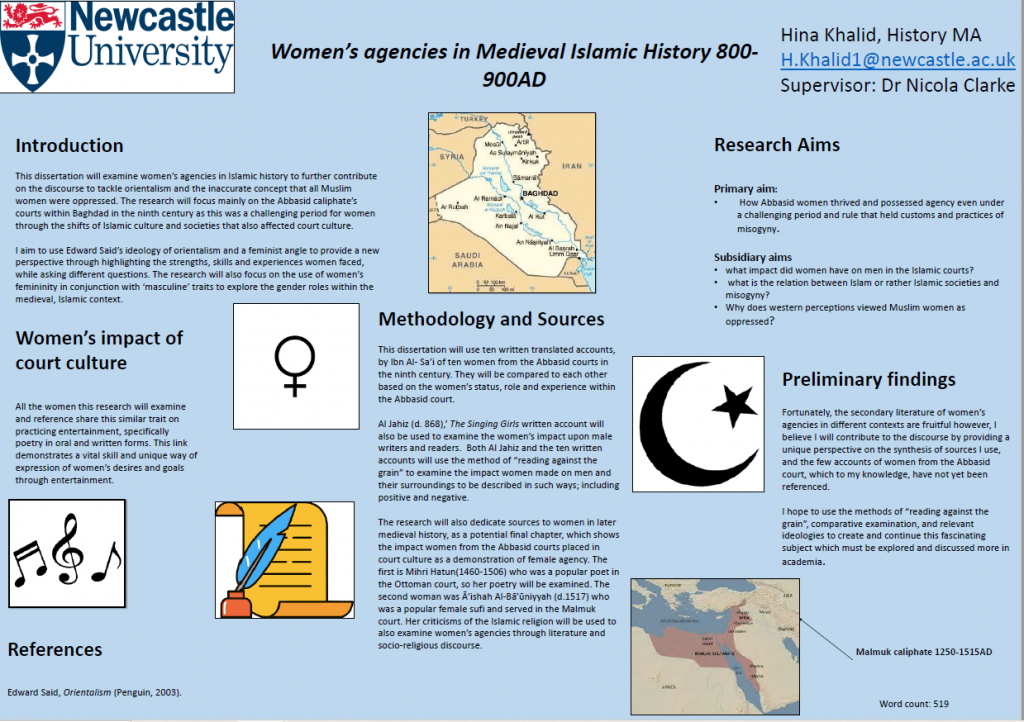
13:50 – 14:10 – Hina Khalid (Newcastle University), ‘How Abbasid women thrived and possessed agency even under a challenging period and rule that held customs and practices of misogyny.’
14:10 – 14:30 – Q&A
Panel -Reinterpreting & Reusing the Past
Chaired by Katherine Waugh
14:50 – 15:10 – Jessica Habib (University of Glasgow), ‘Debating the Colonial Identity of the Ottoman Empire: Caliphate and Colonizer?’
15:10 – 15:30 – Shelby Judge (University of Glasgow), ‘Madeline Miller’s Circe as the archetype of contemporary feminist adaptations of Greek myth’
15:30 – 15:50 – Elly Polignano (Newcastle University), Marc.Arg. AP 5.63: multiple levels of adaptation
15:50 – 16:10 – Berklee Baum (University of Oxford), ‘The Adaptability of Memorialization and Memory.’
*Everyone is welcome – email Leanne at l.smith28@newcastle.ac.uk for Zoom details.
· 3rd February – Rob Granger (Newcastle University), “Nightmares and Miracles: Franco’s Madrid, 1939 – 1975”
· 10th February – Clare Tonks (University of Edinburgh), “Material Culture of Battlefield Tourism at Waterloo”
· 17th February – Henry Brown (University of Oxford), “Anarchists in Uniform: The Militarisation of Anarchist Culture during the Spanish Civil War (1936 – 1939)”
· 24th February – Claire Heseltine (University of Oxford), “‘And her loveliness’: the wounding and death of Penthesilea in Roman art”
· 3rd March – Oded Haim (Ben-Gurion University of the Negev), “From Defeat to Victory: Why did Rome Win the Second Punic War?”
· 10th March – Jamie Gemmell (University of Edinburgh), “Projects of Racialisation: Oroonoko and African Identity in the Seventeenth-Century Atlantic World”
· 17th March – Indigo Reeve (University of Edinburgh), “A Stressful Life: Childhood Health in South-East Scotland”
· 24th March – Meena Menon (University of Leeds), “Social Movements and Local Sovereignty in the Age of Transnational Capital and Ecological Devastation in Postcolonial India”
· 5th May – Cathy Bishop (Swansea University), “Practicalities of incense in New Kingdom Egypt”
· 12th May – Yolanda Panou (University of Edinburgh), “Becoming a victim of μανία: Representations of child killing on the Athenian stage”
· 2nd June – Kathryn Watts (University of Edinburgh), TBC · 9th June – Mihai Hotea (University of Nottingham), “Should democratic leaders engage in bilateral summits with dictators? A case-study of the US, UK and communist
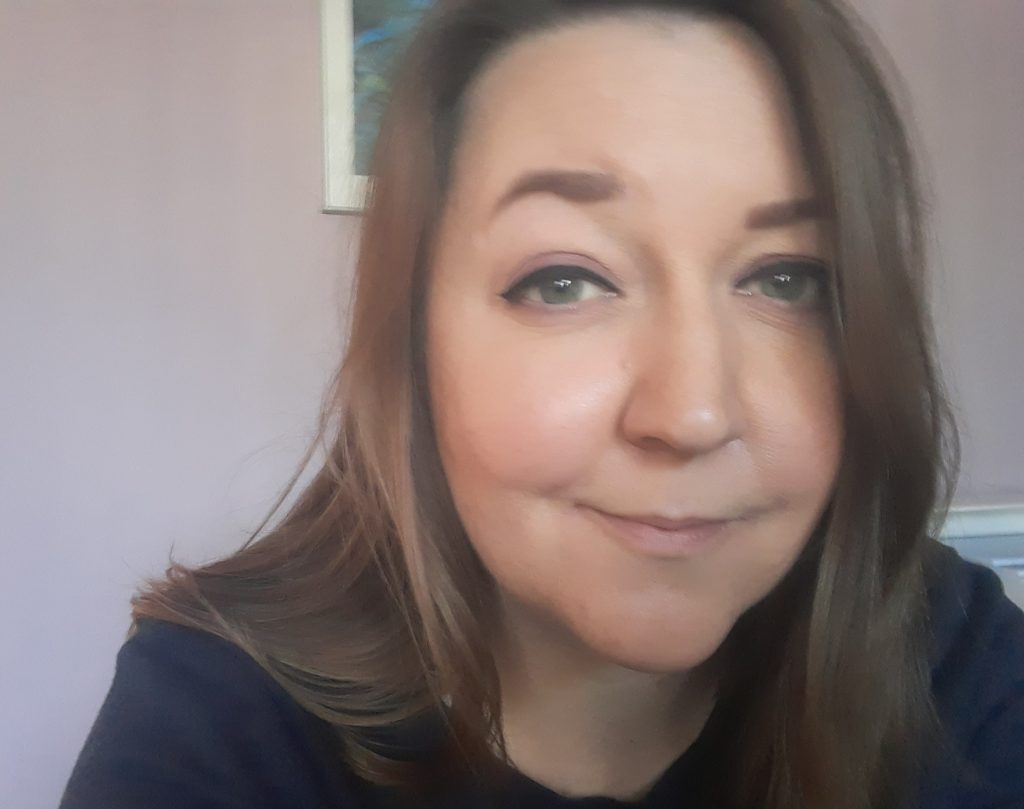
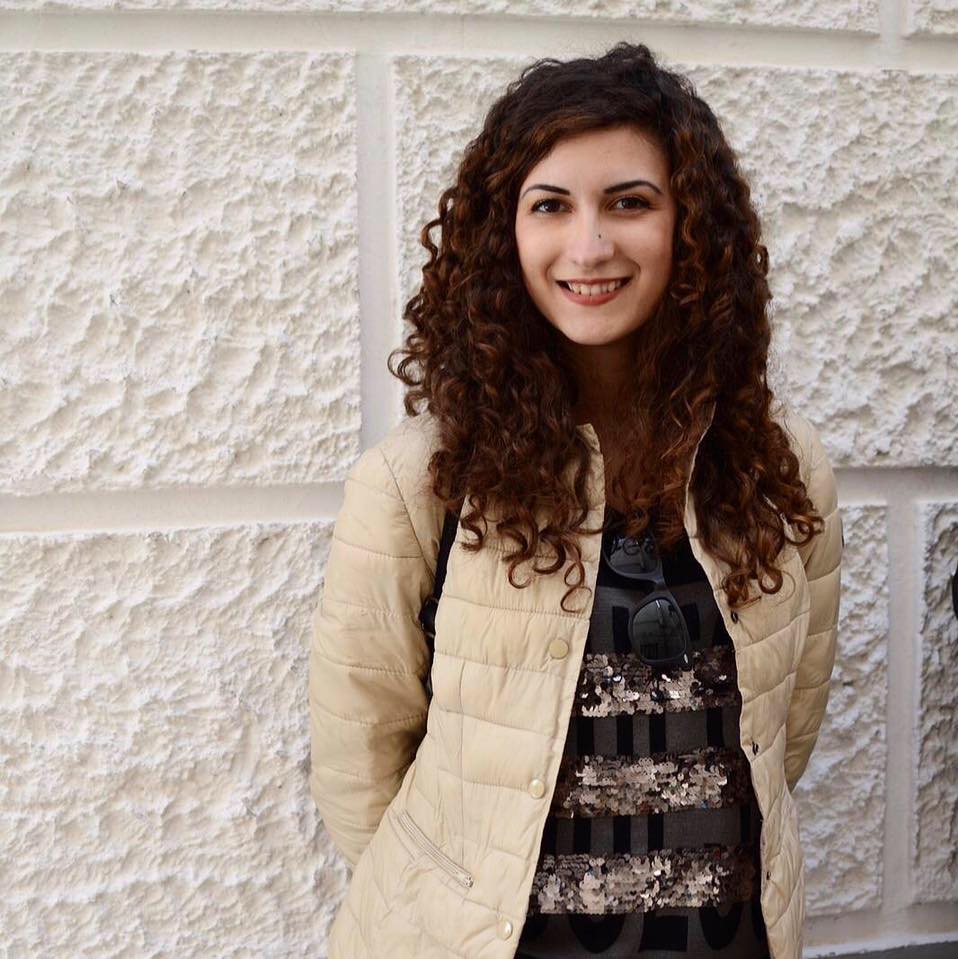
I live with my son Isaac (11) and my cat Arabella (Bella). Isaac is my absolute world. He’s the reason I decided to go to university as I want to inspire him to follow his dreams. I absolutely love watching documentaries, my favourite was about ordinance survey maps! I also have a slight obsession with James Blunt.
Tell us a little bit about your research
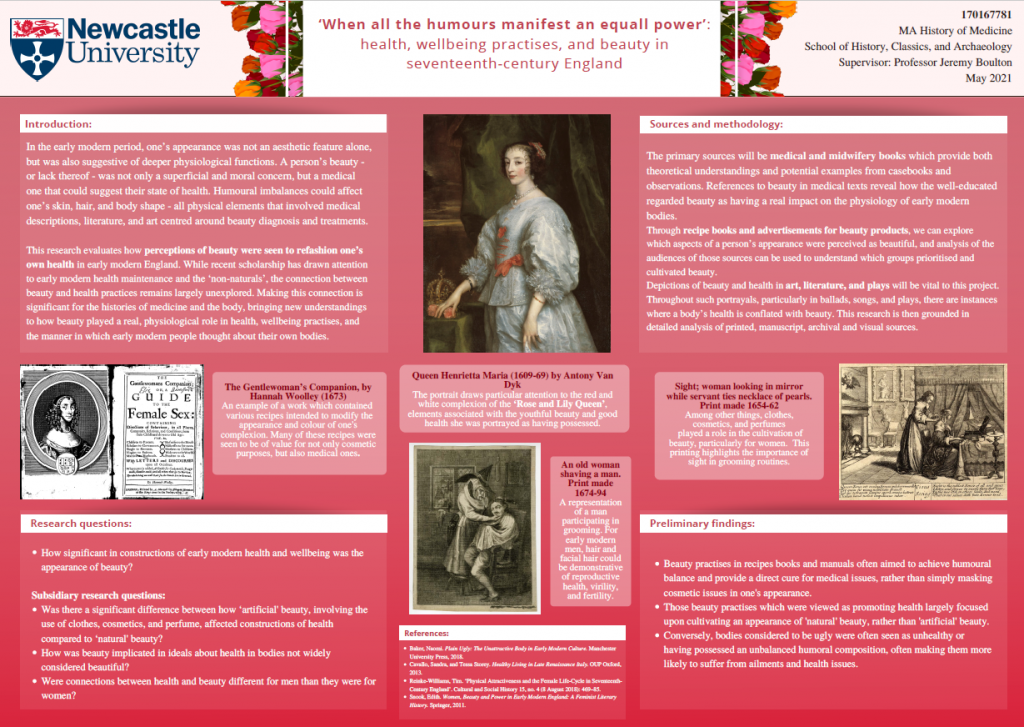
My research is focused on the political & religious thought of the Fifth Monarchy Men in England during the seventeenth century. They were a millenarian sect that believed it was their purpose to reform society ready for the second coming of Christ. The current historiography of the group has tended to concentrate on their religious ideas and has dismissed their engagement with political ideologies, such as republicanism.
What was it that got you interested in your current research topic?
I was researching for an essay during the first year of my BA and stumbled across the Fifth Monarchists. I found it strange that it was written during the time that they were ‘never to be forgotten sect’ and yet they have largely been forgotten. They have been overshadowed by other seventeenth century radical groups that have been considered by some historians to engage with political concepts that we are certainly more familiar with in modern society. The religious beliefs of the Fifth Monarchy Men do not fit comfortably within this secular narrative.
What has been the best/most enjoyable part of your PhD so far?
I recently delivered my first paper. This was originally due to take place in my first year but was delayed due to Covid-19 but thankfully I was able to present this online. I was extremely nervous and practically lost my voice practising my talk, but it was really enjoyable. I also got some really good feedback and advice on other avenues to pursue.
And what has been the most challenging?
Dealing with my guilt as a parent. There are often times when I will work over the weekend or during school holidays and I feel like a terrible Mam.
Has Coronavirus impacted your research?
Thankfully, most of my sources are available online but the first lockdown really impacted as the schools were closed and I had to take time to help Isaac with his schoolwork. The pandemic has also impacted my mental health much more than I thought it had. I think being away from my friends and away from the university I just felt like I wasn’t part of anything anymore. That’s why I am loving my role as series seminar co-ordinator I now feel like I am part of a community!
What would be your most important advice for someone just starting their PhD?
Be kind to yourself and DO NOT compare your PhD journey with anyone else’s
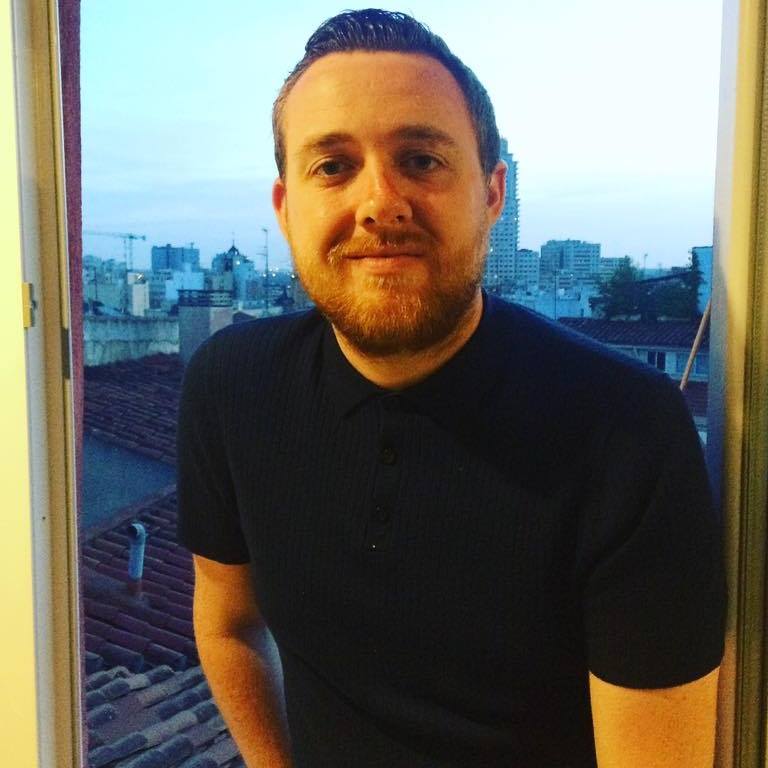
Hi, I’m Rob and I’m a second year PhD student in history and currently the Chair of our Postgraduate Forum at Newcastle. After two years in Madrid trying (and mostly failing) to speak Spanish with a Yorkshire accent, and being torn between missing my dog back in the UK, and being able to go to rooftop bars in November, I’ve ended up back in Newcastle – where I completed my BA and MA degrees – to continue an academic path that started out with a second year essay on the Franco dictatorship.
My thesis will explore the later (c.1964 – 1975) Franco regime’s attempts to generate social and political consent during a period of growing unrest that has traditionally been seen as an era of terminal decline for the dictatorship. For obvious reasons, I haven’t been able to get to Spain, so progress has been difficult, but this experience has taught me that there are always more people in the same boat as you as you might think.
A piece of advice I’d definitely give is to use Twitter as an academic networking tool, which I’ve only started to do relatively recently, but has already led to both productive working relationships and personal connections with other PhD students researching modern Spanish history, who are going through many of the same challenges and frustrations at the minute as me, particularly in terms of travel and access to archives etc. If all goes according to plan, the goal post-PhD would be to try and find someone who’s willing to pay me to continue to think, read and write about modern Spanish history!
We will be hearing from Elly Polignano a first year PhD candidate within our school. Her research focuses on the wide-spread literary form of the epigram and her thesis will offer the first critical edition and commentary of Marcus Argentarius’s thirty- seven epigrams. Elly will deliver her paper “P.Oxy. 3723: limits and ambiguity on the elegiac genre“.
For more information please contact Leanne – l.smith28@newcastle.ac.uk