We are in the process of updating and cleaning up the website! This means some past issues of Pons Aelius now have new URLs.
Pons Aelius’ Senior Editor is contacting previous contributors where possible to let them know their work has moved. If your work isn’t where it used to be, it will be on one of our new Pons Aelius issue pages, under the Pons heading on the left side of the page.
The Committee page will be updated to include the 2025-’26 team soon.
Upcoming events:
The team are working hard behind the scenes to put together the 2026 Conference and Seminar Series – stay tuned!
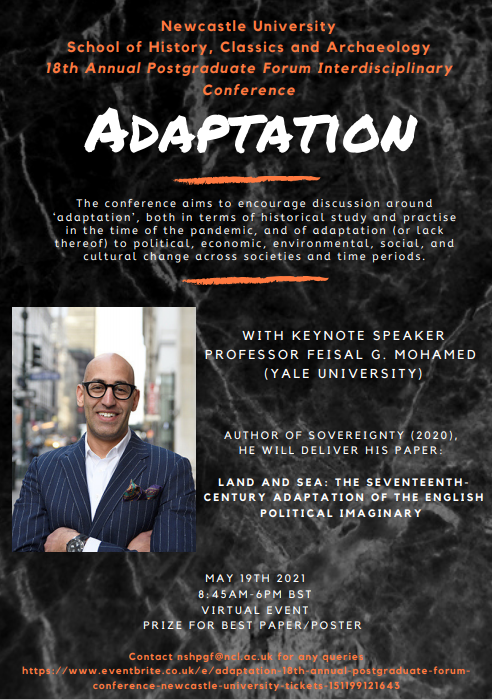
We are excited to invite you to our 19th Annual Postgraduate Conference, on the 19th May 2021.
This virtual conference aims to encourage discussion around ‘adaptation’, both in terms of historical study and practise in the time of the pandemic, and of adaptation (or lack thereof) to political, economic, environmental, social, and cultural change across societies and time periods. Papers will be presented in cross-disciplinary thematic panels, and we will be hearing from postgraduate students from across the globe as well as a little closer to home in Newcastle!
We are delighted to be joined by Yale University’s Professor Feisal Mohamed as our keynote speaker, with his paper entitled Land and Sea: The Seventeenth-Century Adaptation of the English Political Imaginary
09:00- 9:20 –Liz Shaw (Newcastle University), ‘Adapting Roman motifs in regional brooch design.’
09:20 – 09:40 – Goran Durdevic (Capital Normal University), ‘Magic, illusion and adaption: reflection and mirrors in Qin – Han and Roman empires.’
09:40 – 10:00 – David Johnson (Newcastle University), ‘Adapting the British Home in the Empire.’
10:00 – 10:20 Q&A
Panel – Adaptation of Historical Practice and Media
Chaired by Rob Granger
10:30 – 10:50 – John Pearson (Newcastle University), ‘Camera, Lights, Action! A Personal Approach to using Existing Film and Video as an Ethnoarchaeological Source.’
10:50 – 11:10 – Hannah James Louwerse (Newcastle University), ‘Staying flexible: how to build an oral history archive.’
11:10 – 11:30 – Kieran Shackleton (University of Glasgow), ‘Adapting the Holocaust Memory Centre: Rethinking Memory Seventy-Six Years Later.’
11:30 – 11:50 – Rebecca Whiting (University of Glasgow), ‘Re-thinking rights to archives.’
11:50 – 12:10 – Q&A
Panel – Ideology & Belief
Chaired by Leanne Smith
13:10 – 13:30 – Olivia Kinsman (University of Bristol), ‘SEKHMET: An Ancient Goddess for Modern Times.’
13:30 – 13:50 – Daniel Sutton (St John’s College Oxford), ‘When Words Won’t Adapt: Language and Authority in Tacitus’ Annals.’
13:50 – 14:10 – Samantha Dobbie (University of Glasgow), ‘Adapting to Revolution: Women in Revolutionary Paris, October 1789.’
14:10 – 14:30 – Katharine McCrossan (University of Glasgow), ‘Co-operation, Competition, and Consumerism: The Scottish Co-operative Movement in the 1950s.’
14:30 – 14:50 Q&A
Panel – Mobility & Identity
Chaired by Rob Granger
14:50 – 15:10 – Giulio Leghissa (University of Toronto), ‘SB XIV 11979 and Women Mobility between North Africa and Egypt.’
15:10 – 15:30 – Neil McClelland (University of Glasgow), ‘Natives’ and Foreigners’ Mutual Adaptation in Late-Medieval Florence.’
15:30 – 15:50 – Anais Delcol (University of Glasgow), ‘Adaptation to a new culture as a way of reinventing female identity.’
15:50 – 16:10 – Daniel Riddell (Northumbria University), ‘Scandinavian and German Merchant Migrants to Newcastle in the 19th Century: British Businessmen?.’
16:10 – 16:30 Q&A
16:40 – 17:40 – Keynote speaker – Feisal Mohamed (Yale University), ‘Land and Sea: The Seventeenth-Century Adaptation of the English Political Imaginary’
17:40 – 18:00 -Prize giving & closing speeches
STREAM B
Panel – Landscapes and Their Challenges
Chaired by Jerome Ruddick
10:30 – 10:50 – Laura Stops (University of Exeter), ‘Politics, Passages and Peripheries: The adaptation of the Porta Esquilina for a new imperial age.’
10:50 – 11:10 – Katerina Gottardo (Durham University), ‘Adaptation to the environmental context: the substructures of caveae in Roman theatres in the northern-central Italy.’
11:10 – 11:30 – Huilin Yang (University of Glasgow), ‘Exploring the role of olive cultivation in the Mediterranean ecosystem using archaeological evidence and the Annales framework.’
11:30 – 11:50 – Mark Mather (University of Queensland), ‘Roman Supply Lines – How the Gallic Landscape Necessitated Adaptation.’
11:50 – 12:10 – Q&A
Panel – Religion & Society
Chaired by Harriet Palin
13:10 – 13:30 – Arnau Lario-Devesa (University of Barcelona), ‘Re-editing the past, or how to fabricate continuity: The case-study of the roman sanctuary of Can Modolell (Cabrera de Mar, Barcelona) and the neighbourhood of Saint John.’
13:30 – 13:50 – Öznur Özdemir (Sakarya University), ‘Muslims’ Fiscal Adaptation After the First Islamic Conquests.’
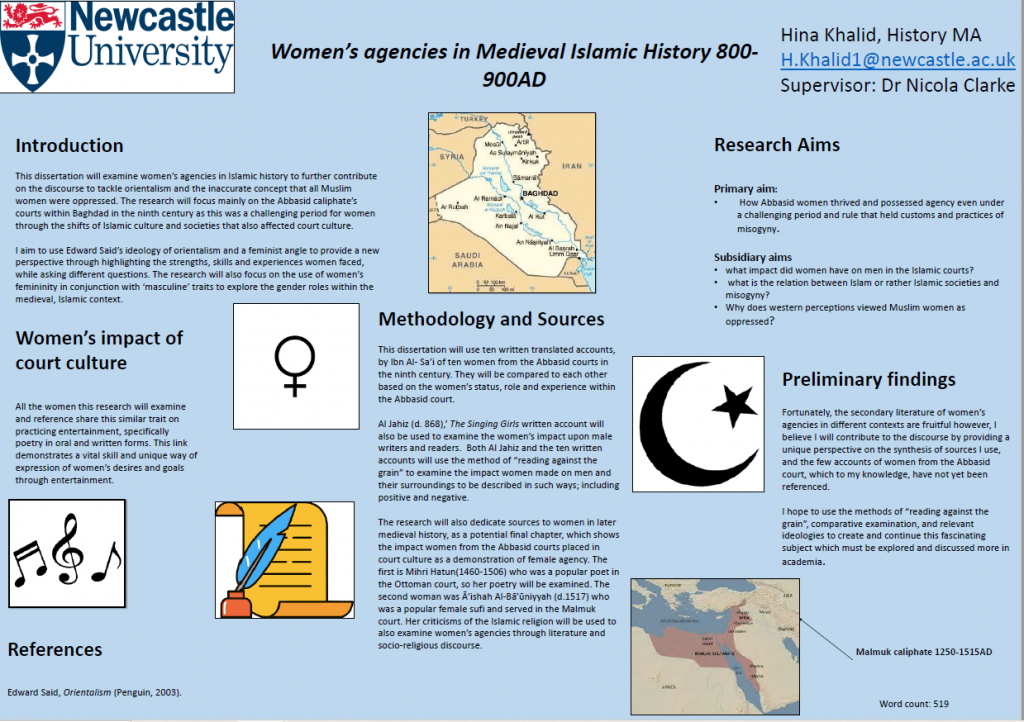
13:50 – 14:10 – Hina Khalid (Newcastle University), ‘How Abbasid women thrived and possessed agency even under a challenging period and rule that held customs and practices of misogyny.’
14:10 – 14:30 – Q&A
Panel -Reinterpreting & Reusing the Past
Chaired by Katherine Waugh
14:50 – 15:10 – Jessica Habib (University of Glasgow), ‘Debating the Colonial Identity of the Ottoman Empire: Caliphate and Colonizer?’
15:10 – 15:30 – Shelby Judge (University of Glasgow), ‘Madeline Miller’s Circe as the archetype of contemporary feminist adaptations of Greek myth’
15:30 – 15:50 – Elly Polignano (Newcastle University), Marc.Arg. AP 5.63: multiple levels of adaptation
15:50 – 16:10 – Berklee Baum (University of Oxford), ‘The Adaptability of Memorialization and Memory.’
*Everyone is welcome – email Leanne at l.smith28@newcastle.ac.uk for Zoom details.
· 3rd February – Rob Granger (Newcastle University), “Nightmares and Miracles: Franco’s Madrid, 1939 – 1975”
· 10th February – Clare Tonks (University of Edinburgh), “Material Culture of Battlefield Tourism at Waterloo”
· 17th February – Henry Brown (University of Oxford), “Anarchists in Uniform: The Militarisation of Anarchist Culture during the Spanish Civil War (1936 – 1939)”
· 24th February – Claire Heseltine (University of Oxford), “‘And her loveliness’: the wounding and death of Penthesilea in Roman art”
· 3rd March – Oded Haim (Ben-Gurion University of the Negev), “From Defeat to Victory: Why did Rome Win the Second Punic War?”
· 10th March – Jamie Gemmell (University of Edinburgh), “Projects of Racialisation: Oroonoko and African Identity in the Seventeenth-Century Atlantic World”
· 17th March – Indigo Reeve (University of Edinburgh), “A Stressful Life: Childhood Health in South-East Scotland”
· 24th March – Meena Menon (University of Leeds), “Social Movements and Local Sovereignty in the Age of Transnational Capital and Ecological Devastation in Postcolonial India”
· 5th May – Cathy Bishop (Swansea University), “Practicalities of incense in New Kingdom Egypt”
· 12th May – Yolanda Panou (University of Edinburgh), “Becoming a victim of μανία: Representations of child killing on the Athenian stage”
· 2nd June – Kathryn Watts (University of Edinburgh), TBC · 9th June – Mihai Hotea (University of Nottingham), “Should democratic leaders engage in bilateral summits with dictators? A case-study of the US, UK and communist
We will be hearing from Elly Polignano a first year PhD candidate within our school. Her research focuses on the wide-spread literary form of the epigram and her thesis will offer the first critical edition and commentary of Marcus Argentarius’s thirty- seven epigrams. Elly will deliver her paper “P.Oxy. 3723: limits and ambiguity on the elegiac genre“.
For more information please contact Leanne – l.smith28@newcastle.ac.uk
We will be hearing from Adrian Pole a current PhD candidate at University of Edinburgh. His research focuses on cross-cultural interactions between international volunteers in the Spanish Civil War and the people, places, and politics of 1930s Spain. Adrian will deliver his paper “No exit today – It’s a Revolution!’ Britons in Revolutionary Catalonia, 1936”.
For more information please contact Leanne – l.smith28@newcastle.ac.uk
We have a full schedule for our first semester covering a broad range of fantastic subjects.
All the seminars for semester 1 will take place online and details of the Zoom meeting will be sent in the week prior to the seminar.
Grab a cuppa and join us on Wednesday’s 1-2pm.
11th November – Adrian Pole (University of Edinburgh), “‘No exit today – It’s a Revolution!’ Britons in Revolutionary Catalonia, 1936”
18th November – Elly Polignano (Newcastle University), “P.Oxy.3723: limits and ambiguity on the elegiac genre”
25th November – Harry Lewis (University of Edinburgh), “Jacobite Rebellions in the Caribbean”
2nd December – Katherine Waugh (Newcastle University), “The Industrial Past in the Deindustrialised Present: Exploring cross-generational experiences of County Durham’s pit closures”
9th December – Alice Robinson (Newcastle University), “Mapping Ancient Rome in Percy Shelley’s Writing”
16th December – Marcela Delia (University of Edinburgh), “Justices in that pairt: revisiting the Aberdeen witchcraft trials in light of a recent discovery (c. 1597)”
13th January – Leanne Smith (Newcastle University), “Politics of the Apocalypse: William Aspinwall’s godly republicanism”
20th January – Thomas Little (Newcastle University), “My Secret Life—the erotic adventures of a Victorian gentleman”
27th January – Jerome Ruddick (Newcastle University), “The Festival of Despoina: Creating mythological narratives through material culture”
Due to the fact that there was no PGF Seminar last week, we are pleased to announce that we have not one, not three, but two(!) seminars for you to enjoy this Wednesday! We hope to see you there, or at one of the other seminars being given this week!
‘BACKWATER ECONOMIES? A FOODWAY FRAMEWORK FOR EXAMINING WETLAND WORLDVIEWS IN THE PREHISTORIC PAST‘ BY PHD CANDIDATE FLOOR HUISMAN (DURHAM UNIVERSITY)
One of the major problems we face when trying to study past worldviews is the way in which our own, modern western worldview influences our research, from the questions we ask, to our final interpretations. Within the sub-discipline of wetland archaeology, for instance, we often ask why past communities chose to live in such marginal landscapes. We assume that wetlands were ‘special’ in some way, either as ‘ritual’ or ‘sacred’ places, or as resource rich environments. We assume a particular worldview amongst the wetland communities living there, one focussed on ‘the wild’, which sets them apart from contemporary, ‘domestic’ ‘dryland’ communities. Yet rather than assuming the presence of such opposing worldviews, we should assess to what extent the landscape or environment in which people lived truly affected their worldview and the formation of particular community identities. This paper will explore how we may be able to do this by considering prehistoric communities’ (inter)relation with the environment through a study of past foodways and environmental change. It will present the preliminary results of my PhD research which examines the use of domestic and wild plant and animals in relation to a changing environment in and around the later prehistoric East Anglian Fens (c. 4000 BC-40 AD). It asks if and when a wetland worldview and accompanying identities came into being as the East Anglian Fens changed from a dryland basin into Britain’s largest wetland. Thus, this paper explores a new approach to understanding past worldviews, by integrating archaeological with environmental data. It is hoped this will allow us to move beyond our modern worldviews and gain a better understanding of past worldviews and the way these shaped communities.
AND
‘A CONTROVERSIAL TRIBUNICIAN STATUTE: THE PLEBISCITUM CLAUDIANUM AT THE BEGINNING OF THE SECOND PUNIC WAR (218 BC)’ BY PHD CANDIDATE ROBERTO CIUCCIOVE (NEWCASTLE UNIVERSITY)
The Plebiscitum Claudianum was controversial tribunician bill, which dealt with very significant economic matters especially related to sea-trade, involving also, at its very core, the political relations between the senatorial elite and the emerging equestrian order. The year 218 BC represented a crucial moment in the history of Rome and the whole Mediterranean world. We are at the very beginning of the Second Punic War, a conflict that will reshape the politicalmilitary order for many decades to come. In the same year a lex Claudia was proposed and passed. As usual, there will be refreshments in the form of tea, coffee and biscuits will be provided.
HISTORY SEMINAR: ‘THE SACRED AND THE SATIATED: HISTORY, ARCHAEOLOGY, AND THE LIMINAL SPACE OF BLACK RESISTANCE’ BY PEGGY BRUNACHE (UNIVERSITY OF DUNDEE)
Traditional scholarship of the Black diaspora has predominantly focused on the examination of primary and secondary historical documents. Moreover, the historiography of slavery of the French Antilles, for example, has been weaker than other regions, especially when compared to British and American counterparts. More recent historical studies have shifted to critically engage larger questions as to how enslaved and free black communities actively participated in strategies to either escape or circumvent gendered and racialized systems of oppression. Since the late 1980s, historical archaeology has risen to the challenge to provide a unique contribution to further our understanding of past lifeways of the Black Atlantic via engendered methodological frameworks for studying artefact patterning and examining the nature of material culture. This presentation hopes to progress critical dialogue on Black agency and choices by engaging place, material culture, and space, through an alternative understanding of conceptual sites of conflict and resistance. I will consider two geographically disparate 19th century archaeological sites, one in the French Caribbean and the other in North America, associated with the slave economy to consider new transformative theories on Black resistance as liminal space for identity formation and societal transformation. This production of knowledge serves as an exploration for re-historicising the past through an intersectionality of structurally hierarchical categories of difference in the archaeological study of enslaved Africans and their descendants. http://www.ncl.ac.uk/hca/seminars/item/thesacredandthesatiated.html
CLASSICS AND ANCIENT HISTORY RESEARCH SEMINAR: ‘PHILOLOGICAL NETWORKS: EDITING THE CLASSICAL TEXT IN EIGHTEENTH-CENTURY CAMBRIDGE’ BY DR KATHERINE EAST (NEWCASTLE)
EVENT: ‘MARTIN LUTHER KING, JR. AND THE POOR PEOPLE’S CAMPAIGN AT FIFTY’ BY DR KERRY TAYLOR (ASSOCIATE PROFESSOR OF HISTORY, THE CITADEL, CHARLESTON, SOUTH CAROLINA, USA)
Date/Time: Tuesday 21 November 2017, 18:00. Venue: Room G.33, Barbara Strang Teaching Centre.
A specialist in twentieth-century US, labour, African American and oral history, Dr Kerry Taylor came to the Citadel after serving as the Associate Director of the Southern Oral History Program in Chapel Hill. He co-edited volume 4 and volume 5 of the Papers of Martin Luther King, Jr. (University of California Press, 2000 and 2005) and American Labor and the Cold War (Rutgers University Press, 2004). In addition to directing The Citadel Oral History Program, Taylor has been extensively involved in grassroots organising in Charleston and across the South, particularly in the “Fight for 15” movement to organise fast food workers for a $15-an-hour minimum wage and union recognition. http://www.ncl.ac.uk/hca/events/item/martinlutherkingjrandthepoorpeoplescampaignatfifty.html
EXHIBITION: ‘PATHS ACROSS WATER: LOST STORIES OF TYNESIDE AND THE CARIBBEAN’
Until 26 November. Venue: Old Low Light in North Shields
Come for the history, the poetry table, the oral stories, a video artwork reacting to shifts in the wind outside, a story-telling booth that will create both an oral archive and a digitally mixed soundscape exploring people’s responses to the sea and to the paths of migration connecting the North East with not only the Caribbean but also the rest of the world. And so much more.
MUSEUM EXHIBITION: ‘FRONTIER FASHION: GLASS BANGLES OF THE ROMAN NORTH’
Until 3 January 2018. Venue: Great North Museum
A mini exhibition Frontier Fashion: Glass Bangles of the Roman North that focuses on Newcastle University archaeologist Dr Tatiana Ivleva’s research on Roman glass bangles in Britain. Tatiana is particularly interested in the popularity of glass bangles in Northern Britain, on both sides of Hadrian’s Wall. A small number of fascinating artefacts are on show in the display which is taking place in the new temporary exhibition space, formerly the Mithraeum. Further details can be found here.