We are in the process of updating and cleaning up the website! This means some past issues of Pons Aelius now have new URLs.
Pons Aelius’ Senior Editor is contacting previous contributors where possible to let them know their work has moved. If your work isn’t where it used to be, it will be on one of our new Pons Aelius issue pages, under the Pons heading on the left side of the page.
The Committee page will be updated to include the 2025-’26 team soon.
Upcoming events:
The team are working hard behind the scenes to put together the 2026 Conference and Seminar Series – stay tuned!
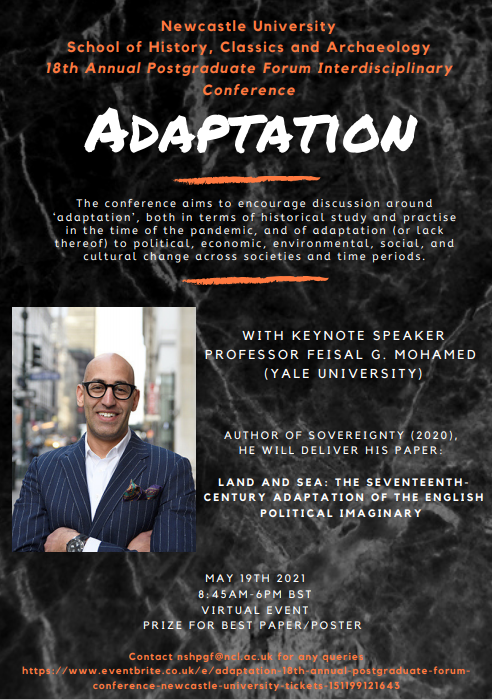
We are excited to invite you to our 19th Annual Postgraduate Conference, on the 19th May 2021.
This virtual conference aims to encourage discussion around ‘adaptation’, both in terms of historical study and practise in the time of the pandemic, and of adaptation (or lack thereof) to political, economic, environmental, social, and cultural change across societies and time periods. Papers will be presented in cross-disciplinary thematic panels, and we will be hearing from postgraduate students from across the globe as well as a little closer to home in Newcastle!
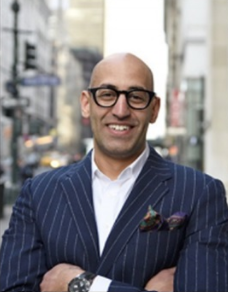
We are delighted to be joined by Yale University’s Professor Feisal Mohamed as our keynote speaker, with his paper entitled Land and Sea: The Seventeenth-Century Adaptation of the English Political Imaginary
09:00- 9:20 –Liz Shaw (Newcastle University), ‘Adapting Roman motifs in regional brooch design.’
09:20 – 09:40 – Goran Durdevic (Capital Normal University), ‘Magic, illusion and adaption: reflection and mirrors in Qin – Han and Roman empires.’
09:40 – 10:00 – David Johnson (Newcastle University), ‘Adapting the British Home in the Empire.’
10:00 – 10:20 Q&A
Panel – Adaptation of Historical Practice and Media
Chaired by Rob Granger
10:30 – 10:50 – John Pearson (Newcastle University), ‘Camera, Lights, Action! A Personal Approach to using Existing Film and Video as an Ethnoarchaeological Source.’
10:50 – 11:10 – Hannah James Louwerse (Newcastle University), ‘Staying flexible: how to build an oral history archive.’
11:10 – 11:30 – Kieran Shackleton (University of Glasgow), ‘Adapting the Holocaust Memory Centre: Rethinking Memory Seventy-Six Years Later.’
11:30 – 11:50 – Rebecca Whiting (University of Glasgow), ‘Re-thinking rights to archives.’
11:50 – 12:10 – Q&A
Panel – Ideology & Belief
Chaired by Leanne Smith
13:10 – 13:30 – Olivia Kinsman (University of Bristol), ‘SEKHMET: An Ancient Goddess for Modern Times.’
13:30 – 13:50 – Daniel Sutton (St John’s College Oxford), ‘When Words Won’t Adapt: Language and Authority in Tacitus’ Annals.’
13:50 – 14:10 – Samantha Dobbie (University of Glasgow), ‘Adapting to Revolution: Women in Revolutionary Paris, October 1789.’
14:10 – 14:30 – Katharine McCrossan (University of Glasgow), ‘Co-operation, Competition, and Consumerism: The Scottish Co-operative Movement in the 1950s.’
14:30 – 14:50 Q&A
Panel – Mobility & Identity
Chaired by Rob Granger
14:50 – 15:10 – Giulio Leghissa (University of Toronto), ‘SB XIV 11979 and Women Mobility between North Africa and Egypt.’
15:10 – 15:30 – Neil McClelland (University of Glasgow), ‘Natives’ and Foreigners’ Mutual Adaptation in Late-Medieval Florence.’
15:30 – 15:50 – Anais Delcol (University of Glasgow), ‘Adaptation to a new culture as a way of reinventing female identity.’
15:50 – 16:10 – Daniel Riddell (Northumbria University), ‘Scandinavian and German Merchant Migrants to Newcastle in the 19th Century: British Businessmen?.’
16:10 – 16:30 Q&A
16:40 – 17:40 – Keynote speaker – Feisal Mohamed (Yale University), ‘Land and Sea: The Seventeenth-Century Adaptation of the English Political Imaginary’
17:40 – 18:00 -Prize giving & closing speeches
STREAM B
Panel – Landscapes and Their Challenges
Chaired by Jerome Ruddick
10:30 – 10:50 – Laura Stops (University of Exeter), ‘Politics, Passages and Peripheries: The adaptation of the Porta Esquilina for a new imperial age.’
10:50 – 11:10 – Katerina Gottardo (Durham University), ‘Adaptation to the environmental context: the substructures of caveae in Roman theatres in the northern-central Italy.’
11:10 – 11:30 – Huilin Yang (University of Glasgow), ‘Exploring the role of olive cultivation in the Mediterranean ecosystem using archaeological evidence and the Annales framework.’
11:30 – 11:50 – Mark Mather (University of Queensland), ‘Roman Supply Lines – How the Gallic Landscape Necessitated Adaptation.’
11:50 – 12:10 – Q&A
Panel – Religion & Society
Chaired by Harriet Palin
13:10 – 13:30 – Arnau Lario-Devesa (University of Barcelona), ‘Re-editing the past, or how to fabricate continuity: The case-study of the roman sanctuary of Can Modolell (Cabrera de Mar, Barcelona) and the neighbourhood of Saint John.’
13:30 – 13:50 – Öznur Özdemir (Sakarya University), ‘Muslims’ Fiscal Adaptation After the First Islamic Conquests.’
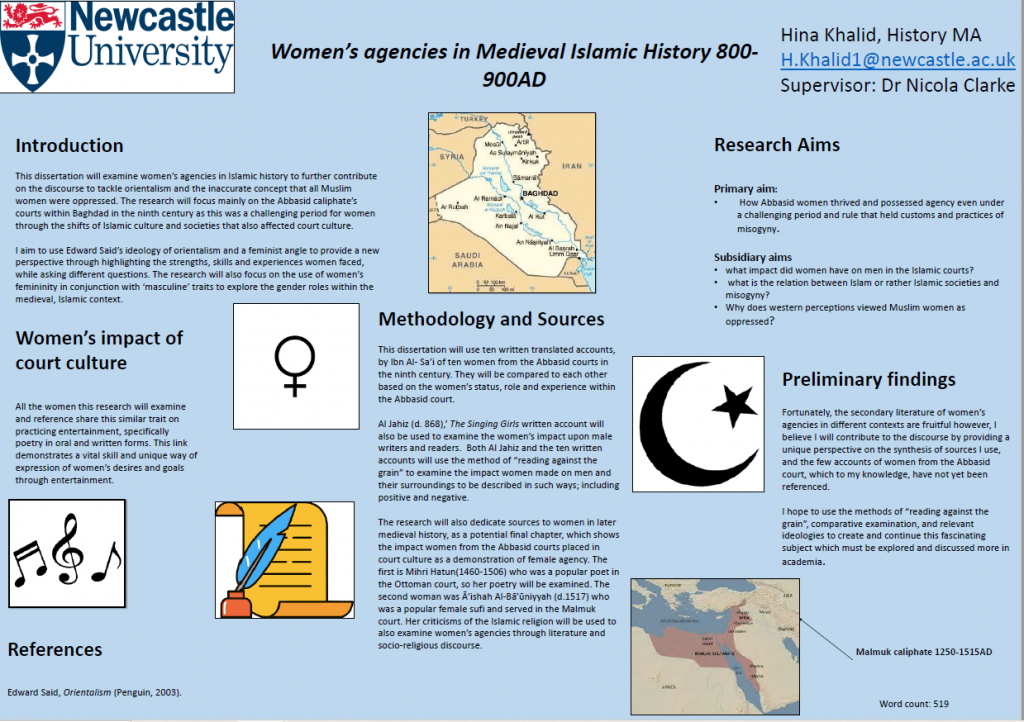
13:50 – 14:10 – Hina Khalid (Newcastle University), ‘How Abbasid women thrived and possessed agency even under a challenging period and rule that held customs and practices of misogyny.’
14:10 – 14:30 – Q&A
Panel -Reinterpreting & Reusing the Past
Chaired by Katherine Waugh
14:50 – 15:10 – Jessica Habib (University of Glasgow), ‘Debating the Colonial Identity of the Ottoman Empire: Caliphate and Colonizer?’
15:10 – 15:30 – Shelby Judge (University of Glasgow), ‘Madeline Miller’s Circe as the archetype of contemporary feminist adaptations of Greek myth’
15:30 – 15:50 – Elly Polignano (Newcastle University), Marc.Arg. AP 5.63: multiple levels of adaptation
15:50 – 16:10 – Berklee Baum (University of Oxford), ‘The Adaptability of Memorialization and Memory.’
It’s that time of year again: the sun is out, the birds are singing… and the PGF Conference is soon!
The theme for this year’s conference, if you didn’t know it yet, is Individuals and Communities. We have a great day lined up for you, some interesting papers from across the disciplines and across the country (and beyond!), so come along to the Research Beehive on campus on 20th May. There will also be posters on postgraduate research.
Humans are often considered ‘social animals’, existing only within larger groups, though still maintaining a unique identity. This interdisciplinary one-day conference seeks reflect on the shifting relationship between individuals and communities across history. Defining the relationship between the individual and a (or several) social group(s) is difficult task. A community and an individual often construct carefully curated identities, which are either mutual or distinct. Humans have constantly created communities, approaches to the study of which are wide-ranging and indeed interdisciplinary. Equally, throughout our history individuals have emerged and their eminency has endured the test of time. Prominent and conspicuous these great individuals stand as role-models and exempla. Yet others, individuals who are not famous (either in their own, or our time) often prove to be just as important. What role can we, as historians and archaeologists, play in reviving and bringing back the individual from a historical period, ancient or more modern? Can we restore their agency? How important is the individual experience in society? How are communities organised?
We invite proposals for twenty-minute papers from postgraduate historians, classicists, ancient historians, and archaeologists. Suggested topics include, but are not limited to:
·Individuals in communities
·Individuals outside communities
·Outsiders and exile
·Individuals in history
·Agency
·‘Great-Man’ theory
·Public and private religion
·Organisation(s) and landscape
·Social roles
·International relations
·Social communication
·Family
·Gender and sexuality
·Creating society
·Class and race
We also invite poster submissions from postgraduate students. In order to offer the opportunity to present work which is in the earlier stages of research, poster submissions are not necessarily required to fit with the theme of the conference.
Please send abstracts of no more than 300 words to l.emslie@ncl.ac.uk by Friday 1st April 2016. If you have any ideas, questions or enquiries, please feel free to get in touch.
The next lunchtime seminar is Wednesday 20th, at 1pm, in Armstrong 1.04.
John Bagnall (History) will be talking to us about :
The New Official History: Charles Moore, Margaret Thatcher and the Falklands Crisis
‘Earlier this year, Charles Moore released the second of his three volume official biography of Margaret Thatcher. Moore was given unrivalled access to, not only Thatcher herself, but her wealth of private papers concerning her time as British Prime Minister. His first volume, published in 2013, ended with the Falklands Affair of 1982 and the second volume, picks up from this point and continues until the end of her time in office. The Falklands Affair was a dispute between the United Kingdom and Argentina over the sovereignty of the Falkland Islands. The dispute garnered international tension when a nine week conflict was fought between the two nations in 1982. Moore’s work uses Thatcher’s own papers and memory of the affair to give a new account of the conflict. As this work was undertaken before the source material was released for public research purposes, it is at the forefront of study of 1980s British Political history.
This paper aims to examine what Moore adds to the existing knowledge of the Falklands Affair in the context of Lawrence Freedman’s two volume Official History of the Falklands Campaign published in 2005. Freedman too was given access to source material from government departments before it was released to the public and produced, at the time, the most comprehensive study of the Falklands Campaign that had been done. This paper compares the work done by Moore to the work of Freedman to highlight what new insights Moore has offered on the Falklands Affair. This paper scrutinises the source material used by each author as well as their methodologies and conclusion to produce an analysis of how much has been added by Moore to our understanding of one of the most crucial aspects of Thatcher’s Britain, the Falklands Affair.’
Come along for discussion, tea, coffee and biscuits!
School of History, Classics and Archaeology, Newcastle University
Disruptions
The theme of this year’s issue of the PGF E-Journal seeks to reflect on the way in which “disruptions” have shaped historical disciplines and processes.
Studies of history are littered with the disruptions of peoples and places, politics and religion, memory and belief, but the term itself is rarely used. Does the concept of disruption offer any new perspective, and how do we recognise and define these disruptions? Does the term disruption have any genuine utility? Can we look at disruptions on a macro and micro scale? How do we deal with disruptions to scholarly narratives when new theories, interpretations, and material are discovered?
We are seeking abstracts for papers of 4000 words. Suggested topics include, but are not limited to:
Historiographical Disruptions
Material Disruptions
Disruptions of Landscape
Political Disruptions
Social Disruptions
Economic Disruptions
Ideological/Philosophical Disruptions
Religious Disruptions
Medical Disruptions
Urban or Rural Disruptions
Disruption of Memory
Natural or Environmental Disruption
Textual Disruptions
Narrative Disruptions
Please send abstracts of 250-300 words along with a CV to Amy Shields (amy.shields@ncl.ac.uk) by 28th August. If your paper is selected, the deadline for the final paper will the 2nd October.