Programme
Speech by the Vice-Chancellor
Newspaper Report on Speech by Sir George Thompson
A 1960 Upgrade
===============================================================
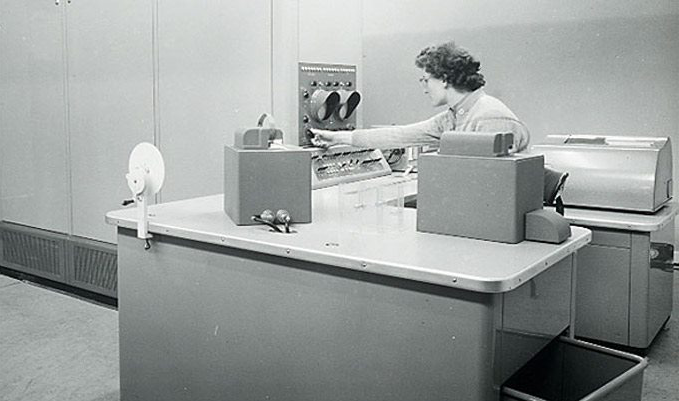
Elizabeth Barraclough at the Pegasus
OFFICIAL OPENING OF THE UNIVERSITY COMPUTING LABORATORY.
21st January, 1958.
PROGRAMME.
11.30 a.m.
Official Opening in the Lecture Room on the first floor.
Welcoming Address by the Vice-Chancellor.
Opening by Sir George Thompson, LL.D., Sc.D., F.R.S.
Vote of thanks.
12.00 noon approx.
Naming the Computer.
12.15 p.m.
Demonstration to luncheon guests.
12.30 p.m.
Sherry in the University Office.
Lunch.
. . . . . . . .
AFTERNOON VISITORS
3.0 p.m.
Miss Barraclough and two engineers on duty in the Computer Rooom.
Dr. Page, Dr. Scoins, Dr. Samet and Dr. Eve on reception and ready to form groups in the tape-editing . . . examine invitation card and conduct to the cloakroom and then direct to the Lecture room for commencement of opening ceremony.
Miss Smith on duty outside Lecture room. Dr. Scoins and Dr. Samet to receive guests in Lecture room.
N.B. Mr. B. Z. de Ferranti and Professor Edwards to be seated in the front row.
Lecture Room
Stacking chairs will be placed in position for seating guests.
One ‘Gold seal’ table and five desk chairs at the top of the room for V.I.P’s.
Following Vote of Thanks.
Rector to make short announcement about naming ceremony.
Dr. Page will conduct V.I.P’s., Ferranti representatives and Professor Edwards for the naming ceremony in the Computer Room. Dr. Eve, Miss Barraclough and two engineers will attend also.
Dr. Scoins and Dr. Samet will take remaining visitors to the Library and Tape-editing rooms during the naming ceremony.
Mrs. Barrett will take care of the press, who will be allowed into the computer room for photographs after naming.
Dr. Scoins and Dr. Samet will take their respective parties to the computer room and then conduct them to the University Office Committee room for sherry by 12.30 p.m.
Dr. Page will show V.I.P’s, round remainder of laboratory.
N.B. Any guests still in the laboratory at 12.30 p.m., must be ushered into the University Office.
AFTERNOON VISITORS
3.0 p.m. Miss Barraclough and two engineers on duty in the Computer Room.
Dr. Page, Dr. Scoins, Dr. Samet and Dr. Eve on reception and ready to form groups in the tape-editing room and conduct their own groups to the computer room and then to refreshments in the Lecture room. Each member of staff will be responsible for his own group.
===================================================================
OFFICIAL OPENING OF COMPUTING LABORATORY ON
21st January, 1958
Speech by Vice-Chancellor, Sir James Duff
Welcome to those present who have faced the weather and got to the ceremony this morning. The number of guest limited by the size of the room, but a wider circle of persons interested have been invited to visit the Laboratory this afternoon between 3.0 and 5.30 p.m.
To give a very brief history of the Computing Laboratory – the University is in two divisions, Newcastle and Durham. Both divisions of the University had been considering the idea of acquiring, or somehow getting access to, a computer when, in October, 1955, the U.G.C. wrote to a number of Universities to say that they were considering the possibility of making grants to help Universities to acquire such machines. There followed a thorough reassessment of the probably use that would be made of such a machine by the departments in the two divisions and by industry in the region. It became clear that in both divisions the departments of mathematics and of the Physical Sciences would be regular users of such a machine, and that in the N/C. Division there were possibilities of extending use by the many Applied Science Departments. Enquiries also showed that a number of leading engineering firms in the region and especially those most concerned with nuclear power plants, were very much in favour of the acquisition of such a machine by the University and would do all in their power to help. The Senate of the University therefore decided that it was important that a computer should be acquired and that the best plan would be to establish a U.C.L. to serve both divisions instead of placing the computer in a single department in either Division of the University. I think we were worldly wise enough to realise that if each University asked for a computer neither might get it – greatly increased likelihood for one of us. It was also found possible to put at the disposal of the Computing Laboratory the house No.1 Kensington Terrace, which adjoins The University Office in Newcastle. In December 1955 the U.G.C. were informed that the University definitely wished to apply for a grant to pay for the greater proportion of the cost of a Ferranti Pegasus Computer and the arrangements for the proposed Computer Laboratory were explained to us by the U.G.C.
In April, 1956, we received the welcome news from the U.G.C. that the University of Durham was one of the five to which it was proposed to make grants for the acquisition of such a machine, and with the least possible delay action was taken so that a machine was ordered on behalf of the University in May, 1956. The machine was actually delivered by Ferranti on 1st November 1957, the first day of the month in which they had promised delivery. We are very grateful for their promptitude and glad to have a representative of the firm, and indeed of the family, here today. The machine was accepted on the 25th November, after passing tests. During the period following the ordering of the machine arrangements were made for the staffing of the Laboratory. The bi-divisional character of the Laboratory is shown by the fact that while it is located in N/C, its Director Dr. Page, was appointed from the staff of the Durham Division, a lecturer in statistics. He had previously had experience in Cambridge in the use of the Computer in that University. Members of Senate mainly responsible for the shaping of policy know that Dr. Page is the person most responsible for turning a paper plan into an effective working organisation. He has been joined by two other experienced members of staff, Dr Scoins and Dr. Samet and by Miss E. D. Barraclough, as Computer Operator.
Just as the organisation of the Laboratory has been the work of a team, so too, has the work of the building and the construction of the Computer room been carried out so quickly due to the cooperation of the University Registrar, the Bursar of King’s College, Edwards & Partners, the Architects, Messrs. Harry Kindred, Ltd., the builders, Mr. E. A. Livingston, our Electrical Consultant, and of course Messrs. Ferranti Ltd.
It is now necessary to say something about finance. When making their enquiry to Universities regarding the possibility of assistance in the acquisition of a computer, the University Grants Committee made it clear that they would expect Universities to find some proportion of the cost from other sources than a treasury grant. As this University is poorly endowed we have had to rely on friends from industry, we are deeply grateful to those good friends who have so far contributed to the capital cost. Messrs. Parsons have contributed £2,500, Messrs. Reyroll and Merz & McLellan £100 [sic] each. But the principal part of the cost has been provided by the U.G.C.
Sir George Thompson, the Master of Corpus Christi College, Cambridge has made his very personal contribution to the launching, of this Laboratory by making the long journey to be here to open the the Laboratory, and name the machine. It is particularly appropriate that he should do this, as one of the most distinguished of living British scientists who started his life by obtaining Firsts in both Parts of the Mathematical Tripos and in the Second Part of the Natural Science Tripos at Cambridge, and has given 40 years’ service to research especially in matters relating to Aeronautics and Atomic Energy and to teaching in Universities as far apart as Aberdeen and London. His career was crowned by the Nobel Prize in Physics in 1937 and the Royal Medal of the Royal Society in 1949. It is appropriate also that he comes to us from Cambridge, because that is the University that, more than any other, has given a lead to British Universities in the use of electronic computers; and finally, it is especially appropriate because Sir George Thompson is a member of the U.G.C. who were our principal source for this machine. I now invite Sir George Thompson to address us on the occasion of the opening of the Laboratory and afterwards to proceed to the machine room and there to christen the machine by an appropriate name.
It is a Personal pleasure to me to welcome Sir George, known him for as many years as I have known anybody inspite of appearances he is older and I have looked up to him in both senses of the word.
==================================================================
[Newspaper account of Sir George Thompson’s Speech]
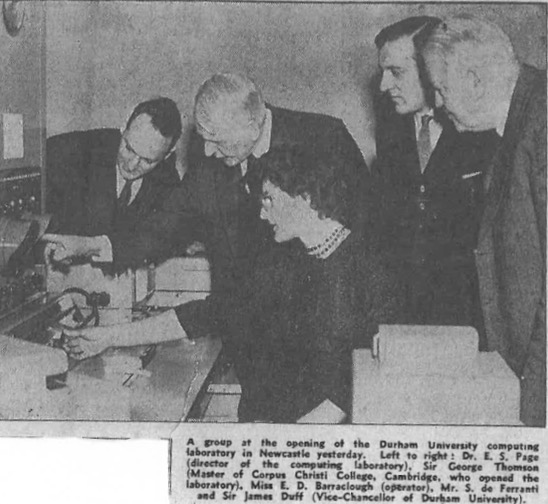
Electronic Computer can even aid study of literary style
DURHAM UNIVERSITY’S £50,000 “BRAIN” OPENED
How the electronic computer can help in the study of the humanities, notably in the study of literary style, was described by Sir George Thompson, the distinguished physicist, who yesterday performed the opening ceremony of Durham University’s £50,000 computer, Ferdinand, in Newcastle.
Sir George, a former Nobel Prize winner for physics, is Master of Corpus Christi College, Cambridge, and a member of the University Grants Committee. He said that of all the inventions of the present age, none had a wider range of possibilities than the electronic computer.
“Nuclear energy may affect our economy more closely and deeply and sputniks hold our imagination. But energy is the same, however made. One can only have more; there is no change in quality.
Unlimited future
The foreseeable possibilities of space travel are limited by our solar system with its nine planets, one of which we know already. But the computer’s future seems only limited by one’s imagination, and by its own imagination, for I am sure it will soon possess one.
“Inventions which really improve the machinery of thought are few. Speech, of course, is still far the most important, thought not quite so important as some people would have us believe. Next in time sequence is writing, arithmetic, geometry, perhaps the abacus, certainly the Arabic numerals, analysis represented by the calculus, printing and that’s about the lot. All help man to think better, more clearly, or in new fields.”
“Perhaps the analogy with printing is the closest. There is nothing that an electronic computer does that a bank clerk cannot do given time and docility.
“There are few books now printed really better produced than a 14th century manuscript. Printing has made a difference partly because it allows quite ordinary people to own more books than were in substantial libraries of the past, partly because the demand creates the supply and books get written and readers can buy them at reasonable prices.
Can learn by experience
“One simple use of computers is to do heavy and long calculations which would have to be done anyhow. In this respect it is just a labour saving device. It has a quick memory and a slow memory. These contain not only the particular figures with which it is dealing, or will shortly need, but instructions, as to how do deal with them.
“The machine can be guided by facts not known, or not known in advance to the man who is running it. It can in a sense learn from experience.”
Sir George indicated the many uses of the computer and indicated that the machine could give information not otherwise available. It replaces a guess at the best arrangement, by knowledge, and this is a qualitative change.
Immense possibilities
“Finally, I would like to suggest a use which is just coming in and seems to have immense possibilities, namely the study of literary style.
“In paintings one can do much by studying brushwork to distinguish between artists of the same date and school. There is nothing quite similar in literature.
“The sort of thing I mean has been done in a very simple way by counting, for example, the number of words of different lengths in various authors. The ratio of long and short words is fairly characteristic of an author, but this, of course, is very crude. More subtle and elaborate tests are possible.
“How oten do two adjectives qualify one noun? Are rare nouns usually qualified by a particular adjective? What is the frequency distribution of sentences in length? Is a long sentence normally followed by a short one, or would two short ones be more common? What is the proportion of relative clauses?
“One can think of hundreds of such questions, most of which could be dealt with by machine. One would take two or three admitted works by an author and see how consistent they were. Then one that was in doubt, and so on.
“This has been seriously suggested to compare Shakespeare and Marlowe.
Settling questions of fact
“Though this is, perhaps, the most promising case, I feel that these machines have something to offer the humanities and that where questions of fact, such as authorship are concerned, the methods of science may prove very powerful to the literary man.”
Sir James Duff, Vice-Chancellor of Durham University, who presided, thanked the University Grants Committee for the provision of the computer, and for substantial financial contributions by three Tyneside firms. Prof. J. L. Burchnall, Professor of Mathematics at Durham University, proposed a vote of thanks to Sir George Thompson.