The IBM System 360/67 Computer
UNIVERSITY OF NEWCASTLE UPON TYNE
PRESS RELEASE
G. ASHLEY
Assistant Registrar
Newcastle: 28511 – Extension 622
6 February 1967
None of the material contained in the following release may be published or broadcast before 0001 hrs. on Wednesday, 8 February 1967.
ADVANCED UNIVERSITY COMPUTER SYSTEM FOR THE NORTH EAST
Unique University Development
The Universities of Newcastle upon Tyne and Durham are to join forces in installing one of the most advanced computer systems in the world for their joint use. Due for installation towards the end of 1967 it will make the Universities the most advanced University Computing Centre in the United Kingdom. Both Durham and Newcastle have expanded their computing activities enormously in recent years. An indication of the rapid growth of the subject is shown by the fact that the 1967 installation will be several hundred times more powerful and many times more useful than was the first computer installed in Newcastle in 1957.
This is the first time that two Universities in the United Kingdom have established a joint computing complex of this particular kind. Most of the finance is being provided by the government through the Computer Board but both Universities are contributing substantial sums from their own resources.
Maximum Use of Expensive Equipment
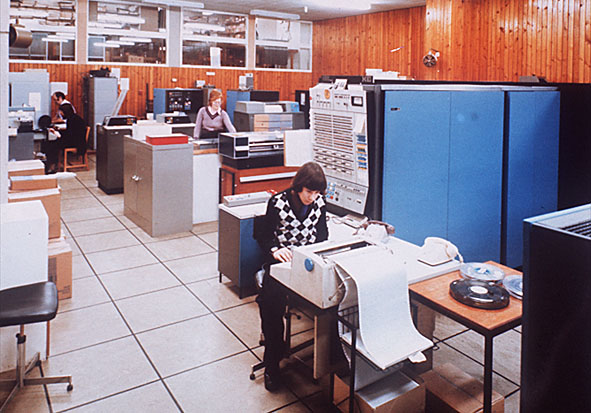
The system, which will have a total value of over £750,000 will be similar to those recently installed at the Lincoln Laboratory of the Massachusetts Institute of Technology and the University of Michigan. It will be based on an I.B.M. System 360 Model 67 Computer. This machine can operate both as a powerful “conventional” computer and as a time-sharing system of advanced design. In its conventional role, there will be available a wide range of high-level programming languages and a comprehensive operating system for users in both Newcastle and Durham, the latter making communication with the central machine by a small computer within the Computer Unit at Durham linked to Newcastle by private telephone line.
The time-sharing technique is a new development in data processing which will put the power of a single central computer at the fingertips of a number of distant users simultaneously by means of remote typewriter terminals. Each user will be able to feel that he has the whole machine to himself and is able to take part in a conversational interaction with it at his own speed. Both Universities will undertake experimental use and evaluation of this system. In addition, a less sophisticated system of computer use at multiple consoles, which is already operational, will be available as soon as the machine is installed.
Professor E.S. Page, Head of the Computing Laboratory at Newcastle University, states: “We are eager to experiment with the use of a ‘time-sharing’ computer and also to have available for large computations in both Universities a processing system as powerful as any in Britain today. Because the experimental aspects of this machine are so exciting, which will be at our disposal”. it is easy to overlook the sheer computing power
Installed at Newcastle
The central computer will be installed in the Computing Laboratory at the University of Newcastle and initially the system will include a small satellite computer in Durham and seven terminals which will be located at various points throughout the two Universities. These will be typewriter terminals and there is the possibility not only of increasing their number but of attaching high speed display terminals of the kind that provide, simply at the press of a button, visual presentation of information stored in the system as well as a keyboard for input of programmes and data.
Both Universities have active research and teaching programmes in Computing Science in addition to many research workers in other fields to whom the computer is an essential tool. Newcastle awards an Honours degree in Computing Science and teaches the subject in a General degree with Honours course while, Durham offers Computing as a subsidiary subject for students in Arts as well as in Science. Postgraduate studies can be pursued in both laboratories.
Newcastle has been awarded grants for research into computer typesetting, information retrieval and various operational research applications; work is also being undertaken into the applications of computers in libraries and documentation and into numerical analysis. Durham’s interests are primarily in operational research, particularly in libraries and hospitals, and in developing easier ways for non-specialists to use computers.
The Computing Laboratory in Newcastle is to be housed in four floors of the Claremont Tower, a 14-storey building which is moving rapidly towards completion and which will be the tallest on the University precinct. It is intended to retain the present Newcastle computer, an English Electric KDF.9 of 1964 and it will continue to make a valuable contribution to the University’s needs.
(Further information may be obtained from:-
either
Professor E.S. Page,
Computing Laboratory,
University of Newcastle upon Tyne. Tel: NEWCASTLE 22457/27668
or
Dr. J. Hawgood,
Computing Laboratory,
University of Durham. Tel: DURHAM 3541-8)