Programme
List of Invitations
Planned Operation of the 360/67
Demonstration Programme: Machine Scheduling
THE UNIVERSITY OF NEWCASTLE UPON TYNE
REGISTRAR: E.M. BETTENSON
6 KENSINGTON TERRACE
NEWCASTLE UPON TYNE NE1 7RU
(STD code ONE2.28511)
INAUGURATION OF NUMAC
(Northumbrian Universities Multiple Access Computer)
IN THE CLAREMONT TOWER, UNIVERSITY OF NEWCASTLE UPON TYNE
Monday, 18 March 1968
Programme for the Inaugural Ceremony
The Ceremony will take place at 11 a.m. in Lecture Room 120, which is situated at First Floor level in the Lecture Theatre Bridge connected to Claremont Tower. (please see point 32 on the enclosed map).
Professor B.H. Flowers, F.R.S. Chairman of the Computer Board and Chairman of the Science Research Council, has very kindly agreed to give the Inaugural Address. Sir Edward Collingwood, Chairman of Council, University of Durham, will propose a vote of thanks to Professor Flowers and the Rt. Hon. E.W. Short, P.C., Postmaster General, is to give a brief address.
Professor E.S. Page, Head of the Computing Laboratory, University of Newcastle upon Tyne, will then invite guests to visit the viewing area for the 360/67 in Room SB.10, the Data Preparation Room (Room SB.3), the 1130 Room (SB.6) and the Consoles (B.46 and SB.3). Guests wishing to take part in a demonstration of an industrial machine scheduling application should make their way to a terminal.
Computing Laboratory
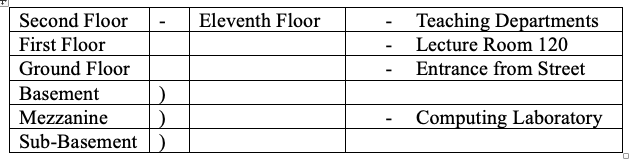
The Computing Laboratory occupies the bottom three floors of the Claremont Tower. Guests will enter the building at Ground Floor level and will find Lecture Theatre 120 at the next floor above. When the ceremony is over, guests will be asked to walk down the stairs to the Computing Laboratory.
The vertical layout of Claremont Tower is as follows:
Car Parking
The University has reserved accommodation for guests in the car park adjoining point 29 on the map. University Police will be on duty at the junction of King’s Road and Claremont Road to direct traffic. It will be helpful if guests will inform the Police that they are attending the NUMAC Inauguration in the Claremont Tower.
Sherry
Sherry and sandwiches will be provided in the Sub-Basement of the Computing Laboratory, Room SB.4.
Academic Dress
It is not intended that academic dress should be worn.
===============================================================
INAUGURATION CEREMONY – 18th March, 1968.
LIST OF INVITATIONS. DURHAM.
County and City People.
Lord Lieutenant.
Bishop.
Dean.
Mayor.
Chairman of the County Council.
County .
Treasurer and County Clerk.
Chief Constable.
University Dignitaries.
Chancellor.
Chairman of Council.
Dr. Reid.
Vice-Chancellor.
Two Pro-Vice-Chancellors.
Dean of Faculty of Arts.
– Faculty of Science.
– Faculty of Social Science.
Director of the Business School.
Director of Extra-Mural studies.
Director of Institute of Education.
Assistant Director of Business School.
Librarian.
Deputy Librarian.
Treasurer.
Finance Officer.
Science Site Manager.
N.U.M.A.C. Committee.
Durham Computer Unit Committee.
Computer Users.
Dr. Shearer.
Dr. Holland.
Dr. Collinge.
Dr. May.
Dr. Parris.
Mr. Morris
Chief Inspector Taylor.
Representatives of Five Outside Users.
Dorman Long.
Applied Research and Engineering.
Darlington Chemicals.
I.C.I.
Regional Hospital Board.
Dr. Thomas (Edinburgh Regional Centre).
M. Read (Sunderland Technical College)
Mr. Greig (Constantine Technical College)
Research Assistants
Mr. Johnson (Chemical Physics.)
Mr. Jeavons. (Applied Physics.)
Mr. Lloyd (Mathematics.)
Staff:
7 Academic and 14 Non-Academic.
Category 1.
Graduate Staff of Newcastle.
Miss E. D. Barraclough.
Dr. H. I. Scoins.
Dr. J. Eve.
Mr. M. J. Elphick.
Mr. J. S. Clowes.
Dr. K. Wright.
Mr. L. B. Wilson.
Mr. B. Shaw.
Mr. N. S. M. Shaw.
Mr. J. C. Joyce.
Mr. W. S. Gray.
Mr. R. E. Vine.
Mr. M. G. Berry.
Mr. J. P. G. Roper.
Dr. D. R. Armstrong.
Mr. T. Betteridge.
Mr. R. E. Broughton.
Mr. B. Jones.
Mrs. N. Newman.
Mr. D. M. Russell.
Mr. E. Watson.
Mr. I. Mitrani.
Mr. I. Nicholson.
Mr. J. G. Givens.
Miss M. King.
Miss R. S. Davies.
Mr. M. W. Grose.
Mr. R. E. Berry.
Mr. R. Snow.
Dr. F. Sorrentino.
Mr. R. C. Saunders.
Dr. P. Sipala.
Dr. A. Wood.
Category 2.
Non-graduate Full-time Staff.
Mr. R. W. Walker.
Mr. C. Ramsden.
Mr. D. Greensill.
Mrs. E. Barrett.
Miss A. Laybourn.
Miss M. Marshall.
Miss J. Younger.
Miss A. Cawthorn.
Miss S. M. Cawood.
Miss. E. Beeckmanns.
Mr. J. M. Case.
Mrs. M. Ashworth.
[Missing page]
Category 6.
Deans of Faculties.
Newcastle.
Faculty of Medicine.
Faculty of Arts.
Faculty of Science.
Faculty of Applied Science.
Faculty of Economic & Social Studies.
Faculty of Law.
Faculty of Education.
Faculty of Agriculture.
Durham.
Faculty of Divinity.
Faculty of Arts.
Faculty of Science.
Faculty of Music.
Faculty of Education.
Category 7.
Senior PRESS representatives.
Category 8.
PLATFORM.
Professor B. H. Flowers, F.R.S.
Professor Lord Wynne-Jones.
Lord Halsbury.
Vice-Chancellor & Warden of Durham University.
Mr. L. F. Rutterford, Computer Board.
Two Representatives from IBM United Kingdom Ltd.
Newcastle Vice-Chancellor Elect, Dr. H. G. Miller.
Professor E. S. Page.
Dr. J. Hawgood.
Category 9.
Other Principal Guests.
Mr. Dan Smith.
Director of the North of England Development Council.
Wellbar House Gauleiter.
Principal of Rutherford College.
Sir Edward Collingwood, C.B.E. (Chairman of Durham Council)
Mr. J. O. M. Alexander, D.S.O., M.C. (Chairman of Newcastle Council)
Mr. Norleigh Booth, (Vice-Chairman of Newcastle Council).
Category 10.
Directors of Computing Laboratories.
Aberdeen: – Dr. A. M. Murray.
Aston in Birmigham: – Prof. N. Mullineux.
Bath: – Prof. D. E. Bailey.
Belfast: – Prof. J. C. Browne.
Birmingham:
Bradford: – Dr. R. J. Ord-Smith.
Bristol: – Prof. M. H. Rogers.
Brunel: – Prof. M. L. V. Pitteway.
Cambridge: – Mr. E. N. Mutch.
City: – Mr. L. T. G. Clarke.
Dundee: – Dr. J. M. Rushworth.
East Anglia: – Mr. P. M. Stocker.
Edinburgh: – Prof. S. Michaelson.
Essex: – Prof. R. A. Brooker.
Exeter: – Mr. D. J. Stone.
Glasgow: – Prof. D. C. Gilles.
Heriot-Watt: – Mr. A. Balfour.
Hull: – Mr. D. W. Beard.
Keele: – Dr. H. H. Greenwood.
Kent: – Dr. E. B. Spratt.
Lancaster: – Mr. A. J. T. Colin.
Leeds: – Prof. G. B. Cook.
Leicester: – Dr. J. R. Thompson.
Liverpool: – Mr. A. Kirk.
London:
Imperial College: – Prof. S. Gill.
Inst. of Comp. Sc. – Prof. R. A. Buckingham.
University Coll. – Dr. P. A. Samet.
Loughborough. – Mr. D. C. Hogg.
Manchester: – Prof. F. H. Sumner.
Nottingham: – Mr. E. Foxley.
Oxford: – Prof. L. Fox.
Reading: – Dr. L. A. G. Dresel.
St. Andrews: – Dr. A. J. Cole.
Salford: – Mr. A. Wragg.
Sheffield: – Prof. D. J. Evans.
Southampton: – Mr. J. R. Reeves.
Stirling: – Prof. W. D. Munn.
Strathclyde: – Mr. J. G. Fraser.
Surrey: – Mr. T. F. Goodwin.
Sussex: – Dr. A. H. Craven.
Wales:
Aberystwyth: – Mr. P. J. H. King.
Bangor: – Mr. J. S. Hornsby.
Cardiff: – Dr. D. H. McLain.
Swansea: – Mr. H. J. Goodwin.
Welsh C.A.T. – Mr. E. Stuart.
Warwick: – Mr. H. S. P. Jones.
York: – Mr. D. G. Burnett-Hall.
Edinburgh Regional Centre: – Dr. G. E. Thomas.
National Computing Centre: – Prof. G. Black.
London:
Queen Mary Coll: – Mr. I. M. Khabaza.
Chelsea: – Mr. R. F. Shepherd.
PLANNED OPERATION OF THE 360/67
[Missing page]
When the Model 67 is operated in time-sharing mode, several users in Newcastle and Durham will be working simultaneously at typewriter terminals under the experimental time-sharing system TSS/360. The users will be able to employ a conversational approach, entering modifications to programs or data through the keyboard and receiving information from the typed output. They will be able to call upon their own programs and data previously stored on the multiple disc unit and upon common information also available there. Initially, six terminals in the Newcastle laboratory and two in Durham will be connected, followed shortly by five more at different places in the Newcastle campus and others at Durham. Other programs will be processed as a background task, depending on the activity at the terminals.
The arrangements for running the system are aimed to ensure that, after initial agreement on the general principles of operation, each University is free to adopt its own policy for the allocation of time and facilities among its members within its share (70% for Newcastle and 30% for Durham). The design of the 360, model 67 and the programming systems to be employed permit this independent control of its use. The running costs are being provided by an annual grant from the Computer Board for early years of the system’s operation. Systems programming, advisory and operating staff have been appointed in both Universities and will work with the programming and engineering staff from IBM (United Kingdom) Limited to provide the services that the users require.
The majority of the demand on the computing system will arise from research workers in science, engineering and medicine, although other workers, especially in the bibliographic and social science fields, will make substantial demands. Although the needs for computer time for each student example are slight, the numbers involved produce an appreciable demand from this source also.
UNIVERSITY OF NEWCASTLE UPON TYNE
N.U.M.A.C. INAUGURATION
Demonstration Program: Machine Scheduling.
You are invited to try your hand at deciding which order a number of jobs should be tackled with the object of having them all completed in as short a time as possible.
There are twelve jobs and each job must be processed for given times, first on Machine 1, then on Machine 2 and finally on Machine 3. Naturally no job can proceed to the next machine it needs until that machine is free having completed the jobs that reached it earlier. There can thus be jobs queuing before the second and third machines and similarly machines lying idle with nothing they can do.
The times needed by the various jobs are shown in the table below. The program, operating under the Time Sharing System (TSS/360) will prompt you to supply your nane and the letters A, B, – – – – L in the sequence you decide.
The program will print the completion time for your sequence of jobs and an indication whether you are among the best so far. You may have a second attempt if you wish. Visitors to the Laboratory are eligible for a prize of a bottle of whisky for the best schedule offered.
| Machines | |||
| Job | 1 | 2 | 3 |
| A | 25 | 7 | 4 |
| B | 17 | 21 | 13 |
| C | 3 | 11 | 23 |
| D | 26 | 10 | 18 |
| E | 1 | 2 | 4 |
| F | 17 | 23 | 24 |
| G | 28 | 21 | 12 |
| H | 29 | 26 | 10 |
| I | 17 | 22 | 20 |
| J | 13 | 2 | 6 |
| K | 10 | 16 | 16 |
| L | 16 | 18 | 29 |
Notes:
This demonstration program just gives the result of
scheduling the jobs in a specified manner.
It is one of a suite of programs which allows a variety of kinds
of manipulation of the order of the jobs so that the
best order can be sought.
INSTRUCTIONS FOR RUNNING DEMONSTRATION PROGRAM
The program necessitates two kinds of runs, an ‘A-run’ and a ‘B-run’.
Initially we will start with an A-run and if the situation arises (we expect
this not to occur) the runs must be alternated between A-runs and B-runs.
Procedure for running
A-RUN B-RUN
LOGON
ERASE AAA ERASE BBB
CDD PACKA CDD PACKB
RUN WTERM RUN WTERM
Program message
‘Enter information about run, e.g. today’s date’
Enter some characters ≤ 24
Program Message
‘Enter number of attempts allowed per person’
Enter 2
DEMONSTRATION
To terminate demonstration, when program message “Do you wish to have another attempt?’ comes up on terminal, answer 9999.
At finish of Program
Enter
PR AAA. INFOUT PR BBB. INFIN
LOGOFF
If the system breaks down then the data-sets for the demonstration may have to be reset from scratch. To do this we issue the following commands
ERASE AAA
ERASE BBB
DD BT, VS, DSNAME = bbb.infin
DD B2, VS, DSNAME = bbb. bestin
DO B3, VS, DSAME = bbb. badin
DD B4, VS, DSNAME = newtimes
CDS HOURS, NEWTIMES
CDS GOOD, BBB. BESTIN
CDS NOGOOD, B3B. BADIN
CDS TODATE, BBB. INFIN
Then begin with an
A-run