Executive Summary
Accountability Report
Staff Organisation
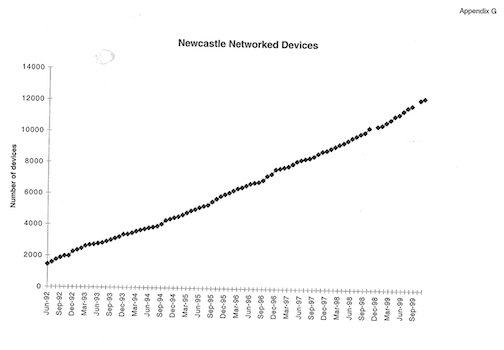
Networked Devices (Graph)
MITS Responsibilities
[Extracts from]
University of Newcastle
2000/01 Planning Statement for the University Computing Service
Executive Summary
3rd December 1999
• The most serious challenge facing the UCS remains mismatch between University expectations and UCS resourcing. The MIDS student management developments, a number of other management projects with significant IT requirements, and the process of implementation of the Institutional Plan with its implications for student numbers and teaching and learning delivery, are all sources of additional requirements on UCS services. A process of resource prioritisation needs to be established between UCS/ASSA and the sponsors of these projects.
• UCS has considered and documented some proposals for achieving greater cost-effectiveness and these are included in Appendix B to this document.
• Communications & Information Technology (C&IT) is now established as a core infrastructure throughout Higher Education. A high quality, resilient and dependable infrastructure with its associated services is prerequisite to the successful HE Institution now and in the future.
• UCS will continue to develop the University network to provide the high-speed resilient services that the University’s academic and business activities demand, and will recable buildings as rapidly as funding permits.
• The University’s desire to widen participation and increase student numbers will have potential resource implications if the target 7:1 student:computer ratio is to be retained and achieved. However, we do need to keep under review how best to provide student computing into the future, and this may require a change from the present fixed desktop model to a new one, perhaps involving networking facilities for student-owned computing platforms.
• UCS will strive to maintain its highly successful record in keeping JANET charges as low as possible.
• During 99/00 UCS intends stabilising the Windows NT4 PC cluster desktop, and redirecting effort to investigation of issues involved in migrating to Windows 2000 and towards upgrading the filestore from Novell 3.12.
• While use of UCS Unix desktop machines is diminishing, we do expect to need Unix for some years to come, both for provision of reliable, scalable infrastructure services, and for certain types of application needed by some postgraduates and staff.
• UCS manages the main University web service, together with other associated services such as the cache. The importance of web developments needs to be recognised by making appropriate stafting and/or management changes in this team.
• Following the successful bid to HEFCE, the second phase of NorMAN development, the improving of its resilience, is expected to be complete by early 2001.
• UCS is developing the institutional IT security policy.
• UCS requests assistance for administration associated with software licensing across campus, so that ALC staff resource can be released. Infringement of software licences
Accountability Report 1998/99
UCS is pleased to provide this report on the highlights of our 1998/99 activities. As in previous years, this summary document covers only major achievements, changes and developments.
Once again, despite a very successful year, demands on UCS have been such that the staff resource available for some activities has been overstretched because of a number of major simultaneous demands on time. ASSA is also asked to note a high level of resource input to activities which were deemed essential but not part of UCS’ formal Planning Statement for 1998/99, for example, the full impact of deployment of MAIS across campus and working towards introduction of Smartcards during a very short implementation period.
Workloads and stress levels continue to be high among senior and other key staff.
1. UCS/MITS Merger
Council formally approved merger of MITS with UCS from January 1999, with Dr P R Philips appointed Deputy Director from 1st October 1998, assuming particular responsibility for Management Information Systems. A number of staff structural changes ensued to reflect these changes.
• The Administrative Systems Technical Unit (ASTU) and Applications Development Unit (ADU) were established and staffed to provide support for SAP, MAC and other systems. A manager was appointed for each unit.
• A completely new Help Desk, initially to support SAP users, was put in place between January and April. Following appointment of a manager, this service was staffed by three operators who were appointed and trained within a very short period. By July, the service was providing support for over 500 users and had grown in expertise enabling it to answer 50% of queries without further referrral.
• PC Support and Network staff from the former MITS were integrated with the existing UCS management structure.
2. Support for Management Information Systems
UCS put enormous effort into developing the infrastructure support necessary for the successful deployment of the MAIS SAP-based applications.
• New Sun server hardware arrived in August 1998 and the AST leam successfully ported the SAP databases to Suns from the original, development platforms.
• The next major task was that of building the landscape to support the SAP production system. The high availability Sun cluster based on five servers in two machine rooms in separate buildings was completed almost on schedule by Christmas. Although the planned timetable was disrupted by hardware problems early in 1999, the team managed to set up and test the system in time to meet the April go-live deadline.
• From April all HR/Payroll and financial transactions of the University went live on the SAP system. Further waves of users went live in June, July and August.
• A new SAP User agreement was drawn up and by the end of July some 600 users had been signed up to use the system. An even larger task involved the installation of SAP authorisation profiles for Users. This work was done in conjunction with MAIS build teams, but created a large workload for the ASTU team.
• In early 1999 two experienced members of staff left the ASTU team and by May 1999 a further four new members of staff were in post, leaving the ASTU manager as the only original team member.
• During the same period the PC team was responsible for placing the SAP graphical User Interface (GUI) on the machines of over 300 Users throughout Administrative Departments. In addition, a new NT4 Administrative Desk top incorporating SAP, Microsoft Office and Secude security software was rolled out with some 200 new PCs and associated printers to Academic Departments across campus.
• In the early part of the year, four appointments were made to the ADU in order to provide an in-house SAP/ABAP programming resource. By the end of June virtually all the staff within this Unit had been trained began to replace the consultant programmers who were phased out between April and July.
• For the second consecutive year four members of MITS staff remained seconded for 80% of their time to the SAP Configuration teams.
Alongside SAP work, other activities continued.
• The major work on MAC systems, besides keeping systems operational, was to upgrade the software to afford millennium compliance. As soon as the Finance and HR functions had been transferred to the new SAP systems the SBS systems were upgraded to the millennium compliant D19 version, also required to cope with data transfer from UCCAS from October 1999.
• For the fifth consecutive year the distributed on-line Registration system stood up to the task of registering some 12000 students in one week. The HP hardware was however no longer maintainable beyond the end of 1998 and a decision was made to run the 1999 system on PCs using the Linux operating system. This new operating environment was tested, albeit under light load, using a modified version of the on-line Registration software in order to perform Module Re-selection in February 1999.
• Other members of staff continued to provide support for a growing number of database Applications written by the department. During the year the group assumed the responsibility for providing software support for the Accommodation Office. This project is due to deliver new software early in 2000.
• Early in 1999 the PC team was strengthened by two additional members of staff, and gained the additional responsibilities of looking after servers associated with the Help Desk, Syllabus+, the new Smartcard system, the Accommodation system as well as management of the SAP GUI across campus.
3. Network
• During 98/99, using funding for one year of the multi-year campus recabling project, UCS completed implementation of the first major recabling of buildings with the introduction of structured cabling throughout Kensington and Park Terraces. Extra fibre for use by the SAP systems was also installed, and the Cassie Building recabled, following its refurbishment by Estates.
• Campus building backbone capacity was increased by the installation of 19 switches. However, for departments to enjoy the full performance benefit of switching, recabling, as in Kensington Terrace, is a prerequisite.
• Core network capacity was increased by deploying additional switching equipment.
• Across campus, UCS connected approximately 1,800 new computers and printers to the network, and recabled clusters in Building Science, Claremont Tower, and Stephenson buildings.
• As part of the HEFCE-funded NorMAN project, UCS completed connection of the Universities of Durham, Sunderland, and Teesside, the University of Northumbria Coach Lane campus, and the University of Durham Stockton campus. All north-east universities now receive their SuperJANET III service via Newcastle, which is funded as the NorMAN network operator. UCS also hosts the JANET Point of Presence for UKERNA.
• Fibre connections were completed to Newcastle General and Freeman Hospitals, and to Castle Leazes and Henderson Halls. All are now in active use.
• In August 1998 JISC introduced charges for incoming transatlantic network traffic, and UCS has successfully introduced measures to minimise these charges. As a result we have been able to almost halve the originally predicted expenditure.
4. PC Services
• Central file servers for user file-space were replaced and upgraded as part of the ongoing replacement cycle. Resilience and capacity were both increased with the addition of RAID5 disk systems and the start of a new backup sub-system.
• New and replacement seats were provided in Cookson Building (26 new, 58 replacement) and Castle Leazes Halls (10 new – limited by lack of air conditioning). In the Herschel clusters, 18 seats were replaced. Installation of Claremont Tower clusters from previous year was completed.
• The redeployed machines allowed continuation of migration from Windows 3.1 to Windows NT4, and was well on target to for 100% by the end of summer 1999.
• Funding for departmental cluster replacement continued during 98/99. In consultation with CSC, the machines and network infrastructure in Geography (expanded from 40 to 65) and Law (24) were replaced The displaced machines, together with some UCS machines, were redeployed to other departmental clusters, extending NT4 to the English (10) and Civil Engineering (60) clusters. Installation of Mathematics cluster from previous year completed.
• UCS assisted in the implementation and integration with the main UCS NT service of PC clusters in Education (12) and Computing Science (62).
• A new release of the NT4 desktop was developed and deployed to over 1000 cluster machines with new versions of systems and application software.
• The ASSA funded Staff Common Desktop project delivered major results with the installation of four servers and deployment of the Common Administrative Desktop on over 200 PCs and 120 printers for departmental MAIS users. This work was a sine qua non for the successful delivery of MAIS applications. Implementation and evaluation of a “Thin Client” Desktop continues in collaboration with three departments.
• NT Servers for Helpdesk, Time-tabling, Smart Card and Accommodation were installed and Netware servers replaced. An updated Windows 95 desktop (including SAP and SECUDE where appropriate) was deployed throughout Central Administration.
• The University PC/Mac framework agreement required by EC public purchasing directives was completed in time for the beginning of the 1999/2000 academic year.
• A review of the Microcomputer Maintenance Scheme (MMS) was completed and, after consultation with CSC, outside contracts were put in place for all hardware maintenance, thereby leaving UCS technicians better able to deal with software and grey area faults. ASSA is shortly to receive final recommendations for approval of funding.
• Early in 1999 the PC team was strengthened by two additional members of staff, and also gained the additional responsibilities of looking after servers associated with Help Desk, Syllabus+, the new Smartcard system, the Accommodation system as well as management of the SAP GUI across campus.
In all, over 1000 machines had new software installed, approximately 500 machines were moved and over 100 network points and attendant infrastructure were replaced. It should be noted that the scale of the above work, together with the loss of two key members of staff has had a significant negative impact on:
• Applications software installation (e.g. AutoCad 2000)
• Upgrade of departmental clusters
• Departmental support for NT.
• Implementation of maintenance and management tools (e.g. SMS)
• Investigation of new technologies (e.g. Exchange server)
5. Unix Services
• The second phase of HP workstation withdrawal took place with all remaining HP machines being withdrawn. A small number of Sun machines were bought to provide further Unix stations (five each in OLUA, Herschel, Merz Court) plus five machines providing a batch only service. Some remaining gaps were filled with PCs and email stations (see PC Services section
• Timesharing services remained stable, but plans were made for replacing the 1993 machine, Aidan, and a price advantageous early purchase was made in summer 1999 with ASSA approval.
• Upgrades, including improvements to resilience, were made to servers supporting WWW, mail and directory services.
• UCS collaborated with a consortium of academic departments in the preparation of an (unfortunately unsuccessful) JIF bid for high performance computing facilities.
• The oldest fileservers and their disks were replaced.
6. Printing and Reprographics
• Additional printers (11, located in five clusters) were added to the charged printing service. The central colour printers were replaced, as were colour printers in two clusters. Plans were made for the further expansion of colour printers into clusters. The total number of monochrome pages printed in the year increased by 27% from 1.8 million to 2.3 million.
• The Reprographics service completed the tender process for replacement equipment which was installed at Easter and had printed over 1 million pages before the end of the financial year
7. WWW infrastructure support
• The infrastructure team was highly effective in ensuring that our web and caching configuration not only provided robust service but also did so highly cost-efficiently, thus minimising the University’s network costs in the new transatlantic charging regime.
8. Year 2000
• The UCS Director continued to chair the University’s Year 2000 Steering Group and was assisted by the Year 2000 Officer.
• A campus Action Plan was agreed and support provided to departments for the preparation of prioritised inventories and actions required. A number of bids against contingency funds were considered and recommendations made to the Vice Chancellor. Preparation of a Business Continuity Plan for the year end period is well underway.
9. User Services
This report would be very incomplete without reference to UCS User Services who have responsibilities in the areas of applications support and advice, information, user education and cluster support. Although this document tends to focus on major projects and milestones, it would be impossible without the ongoing effort of User Services to bring technological changes and developments into reliable, professionally delivered services easily accessible to students, academic, administrative and other staff.
10. Data Preparation Service
In April 1999, the UCS DPS chose not to bid directly for provision of data entry services to Durham University’s Education department due to unreasonable contractual demands and continuing logistical problems. However, following a successful bid from a local printing company, UCS, with ASSA approval, is now sub-contracting all of the same work. This has solved not only our logistics problems but put the DPS on a firmer business footing with guaranteed profitable work until at least July 2001.
11. Mailbase
• National usage of Mailbase continued to grow. In July 1999 there were 165,000 individual users of over 2,400 lists.
• Significant technical developments during 1998-1999 include provision of an enhanced interface for list administration, web pages for closed lists and subscription via the web. The planned move from in-house software to LISTSERV, a standard, commercially supported package, is on hold pending the tender process (see below).
• As anticipated in the UCS Plan 98/99, Mailbase has started to offer mailing lists for a fee to the broader educational community. Income from such fees in 98/99 was £11,500.
• Following the submission to ASSA, in November 1998, of a business plan and a subsequent review by JISC, the HE mailing list service was put out to tender during summer of 1999. The University has recently bid to supply this service.
Newcastle has the highest number of Mailbase list-owners at any university. Currently, 162 lists are owned by our staff, representing over 6% of the national total. We also have the highest number of members. It is unlikely that this level of involvement and visibility would have been achieved if the service had been sited elsewhere.
Statistics show that some 50% of all HE staff are members of our lists, and that the service is in use at all HEIs and by a wide spectrum of disciplines. The success and penetration of the service has helped to enhance the reputation of UCS and the University of Newcastle.
12. Netskills
• Following the end of its eLib funded phase, the Netskills project has managed to achieve (and in some cases exceed) its Business Plan targets. The Business Plan (submitted to ASSA in late 1997) required Netskills to increasingly cover costs by income generation from workshops and sales of training materials licenses. This is going well and continues to grow as new workshops and training materials come on stream and are marketed.
• Over 3000 people were trained at over 180 workshops around the UK. Four new workshops were developed.
• The training modules were updated and a number of new modules created. 25 modules are now available via the web along with a licence agreement and payment mechanism. Approximately £40k was raised from training materials licence fees.
• A large number of Newcastle staff have been trained over the past year including workshops run through Staff Development, AQEU and individual departments. These include Using the Internet for Learning and Teaching modules as part of the HE Lecturer Certificate, faculty Internet workshops and Intranet sessions for the School of Architecture, Landscape and Planning.
• Netskills administers the UCS Training Suite and usage continues to increase. ASSA removed the charge for internal University training and there has been significant use made of the facility for MAIS and SAP training as a result of this policy.
15th October 1999
[Extracted from Organisation Chart in Appendix E]
Director
P S Salotti
. . . . . . National Services & Training
. . . . . . G Foster
. . . . . . . . . . . . Mailbase (funded project)
. . . . . . . . . . . . D P Surtees – Manager
. . . . . . . . . . . . E H Blair
. . . . . . . . . . . . R G Walker
. . . . . . . . . . . . Vacant Post
. . . . . . . . . . . . B A Reid
. . . . . . . . . . . . G Younger
. . . . . . . . . . . . Netskills (funded project)
. . . . . . . . . . . . D W Hartland – Manager
. . . . . . . . . . . . R S Allen
. . . . . . . . . . . . H Conroy
. . . . . . . . . . . . G Grenfell
. . . . . . . . . . . . S Hume
. . . . . . . . . . . . P van Boxel
. . . . . . . . . . . . C A Vincent
. . . . . . . . . . . . C J Young
. . . . . . . . . . . . Vacant Post
. . . . . . . . . . . . + 1 Temp. Relief Assistant
. . . . . . Assistant Director (Microcomputer Systems)
. . . . . . C Gerrard
. . . . . . . . . . . . Client Server Support
. . . . . . . . . . . . (Academic Computing)
. . . . . . . . . . . . vacant post – Manager
. . . . . . . . . . . . M Agar
. . . . . . . . . . . . T Betteridge
. . . . . . . . . . . . D J Clark
. . . . . . . . . . . . A M Lamont
. . . . . . . . . . . . I Nicholson
. . . . . . . . . . . . J O Noble
. . . . . . . . . . . . R J C Pringle
. . . . . . . . . . . . J Stewart
. . . . . . . . . . . . + 1 Temp. Relief Assistant
. . . . . . . . . . . . (Administrative Computing)
. . . . . . . . . . . . S Donoghue – Manager
. . . . . . . . . . . . J Donaldson
. . . . . . . . . . . . A Fisher
. . . . . . . . . . . . S Lisle
. . . . . . . . . . . . J S Snowball
. . . . . . . . . . . . L Stutchbury
. . . . . . . . . . . . + 1 Temp. Relief Assistant
. . . . . . Assistant Director (Hardware & Unix)
. . . . . . T J Ratcliffe
. . . . . . . . . . . . Operations Superv.
. . . . . . . . . . . . R E Broughton
. . . . . . . . . . . . . . . . . . Shift Leaders
. . . . . . . . . . . . . . . . . . J M Gaffney
. . . . . . . . . . . . . . . . . . G Lynch
. . . . . . . . . . . . . . . . . . M R Paul
. . . . . . . . . . . . . . . . . . . . . . . . Operators
. . . . . . . . . . . . . . . . . . . . . . . . P Baggott
. . . . . . . . . . . . . . . . . . . . . . . . A H Bush
. . . . . . . . . . . . . . . . . . . . . . . . D Harris
. . . . . . . . . . . . . . . . . . . . . . . . W Oldroyd
. . . . . . . . . . . . . . . . . . . . . . . . G B Taylor
. . . . . . . . . . . . Print Room
. . . . . . . . . . . . W D Foggo – Manager
. . . . . . . . . . . . H E Fleming
. . . . . . . . . . . . Unix Systems
. . . . . . . . . . . . R Kerr – Manager
. . . . . . . . . . . . Q G Campbell
. . . . . . . . . . . . B C Hamshere
. . . . . . . . . . . . P Lomas
. . . . . . . . . . . . P Haldane
. . . . . . . . . . . . Hardware Maintenance & Computer Technicians
. . . . . . . . . . . . Vacant Post – Dept Superintendent
. . . . . . . . . . . . P A Boyle
. . . . . . . . . . . . I Gibson
. . . . . . . . . . . . M S Halpin
. . . . . . . . . . . . A Murphy
. . . . . . . . . . . . I Rutherford
. . . . . . Y2000 IT Project Officer
. . . . . . P J Williams
. . . . . . Assistant Director (Networking)
. . . . . . I D Doak
. . . . . . . . . . . . Network & Development Staff
. . . . . . . . . . . . J N Bain
. . . . . . . . . . . . V J Bilton
. . . . . . . . . . . . P A Coates
. . . . . . . . . . . . J D Coleman
. . . . . . . . . . . . K Heron
. . . . . . . . . . . . E Watson
. . . . . . . . . . . . Vacant Post
. . . . . . . . . . . . . . . . . . Technical Network Staff
. . . . . . . . . . . . . . . . . . G A Brown
. . . . . . . . . . . . . . . . . . J Craig
. . . . . . . . . . . . . . . . . . S Hay
. . . . . .. . . . . . . . . . . . + 1 Temp. Relief Assistant
. . . . . . Assistant Director (User Services, MAN & Security)
. . . . . . D M Russell
. . . . . . . . . . . . Applications, Information & Education
. . . . . . . . . . . . R Clout
. . . . . . . . . . . . J M Hunter
. . . . . . . . . . . . S T Kometa
. . . . . . . . . . . . J A Law
. . . . . . . . . . . . L M Scammell
. . . . . . . . . . . . G Shearing
. . . . . . . . . . . . J A Wheeler
. . . . . . . . . . . . C H Woodford
. . . . . . . . . . . . IT Systems Security
. . . . . . . . . . . . M H Ellison
. . . . . . . . . . . . NorMAN
. . . . . . . . . . . . M R Lancastle
. . . . . . . . . . . . Data Preparation Service
. . . . . . . . . . . . C L Hellier – Manager
. . . . . . . . . . . . E Brown
. . . . . . . . . . . . S E Carrick
. . . . . . . . . . . . L Grahamslaw
. . . . . . . . . . . . M L James
. . . . . . . . . . . . M Foster
. . . . . . . . . . . . Vacant Post
. . . . . . . . . . . . approx 80 “outworkers
. . . . . . . . . . . . WWW Infrastructure Support
. . . . . . . . . . . . D P Surtees
. . . . . . . . . . . . D Querry
. . . . . . . . . . . . S McCready
. . . . . . . . . . . . General Assistants (Cluster Rooms) Ancilliary
. . . . . . . . . . . . H E Fleming
. . . . . . . . . . . . S K Minto
. . . . . . Deputy Director (Management Information Systems)
. . . . . . P R Phillips
. . . . . . . . . . . . Administrative Systems Technical Unit
. . . . . . . . . . . . T Lawrence – Manager
. . . . . . . . . . . . M Bell
. . . . . . . . . . . . C Burns
. . . . . . . . . . . . P A Richardson
. . . . . . . . . . . . G Parker
. . . . . . . . . . . . M.I.S. Applications Development Unit
. . . . . . . . . . . . M Stephenson – Manager
. . . . . . . . . . . . R Booth
. . . . . . . . . . . . R Cave
. . . . . . . . . . . . A Cecchini
. . . . . . . . . . . . S Farmer
. . . . . . . . . . . . A Griffiths
. . . . . . . . . . . . C Newbiggin
. . . . . . . . . . . . R Phillips
. . . . . . . . . . . . F Reynolds
. . . . . . . . . . . . S Tucker
. . . . . . . . . . . . J Ramel
. . . . . . . . . . . . Help Desk/Support
. . . . . . . . . . . . A J Burn – Manager
. . . . . . . . . . . . L Bolt
. . . . . . . . . . . . J Butterworth
. . . . . . . . . . . . M Embleton
. . . . . . . . . . . . A Proctor
. . . . . . Departmental Administration
. . . . . . (Academic Support)
. . . . . . M L Coleman
. . . . . . (Administrative Support)
. . . . . . E Horton
. . . . . . . . . . . . Administrative Support
. . . . . . . . . . . . (Academic Computing)
. . . . . . . . . . . . J A Hall – Supervisor
. . . . . . . . . . . . J H Coulson
. . . . . . . . . . . . C D Moffat
. . . . . . . . . . . . A Taylor
. . . . . . . . . . . . (Administrative Computing)
. . . . . . . . . . . . C Brown
. . . . . . . . . . . . Reception & User Registration
. . . . . . . . . . . . R Dickinson – Supervisor
. . . . . . . . . . . . J H Coulson
. . . . . . . . . . . . C Craig
. . . . . . . . . . . . L Jamieson
. . . . . . . . . . . . Porter
. . . . . . . . . . . . R McCrae
Networked Devices
Appendix L
Responsibilities of UCS MITS division
ASSA and CSC have sought further clarification of UCS responsibilities in the area of management and administrative IT. The major responsibilities we believe to be ours are set out below in some detail under four major section headings.
Administrative Systems Technical Unit (ASTU)
Summary
This section is responsible for: server hardware and operating systems support under the headings below.
Staff resource total: 5.25 FTE
SAP hardware cost: €750k; purchased mid 1998; maintenance £60k/annum; replacement £ 150k/annum over 5 year life or £750k in 2003: policy yet to be formulated by ASSA/MIDSSA.
MAC hardware cost: £250k; purchased 1992; maintenance £25k/annum; no replacement envisaged.
Other systems hardware cost: £15k; maintenance £700/annum; replacement £3k/annum over 5 year life.
SAP [4.9 FTE]
The major responsibility of the Unit is for the technology underpinning the SAP systems, in terms of both the Hardware Infrastructure and the Development Tools. To ensure it provides the technological leadership in future developments of the University’s SAP R/3 system, MITS must be aware of strategic initiatives, acquire competence in the technologies and tools, understanding the issues and options. An active relationship with SAP and MIDS staff is pre-requisite.
At a more detailed level responsibilities include:
SAP: Application of Legal Change Patches: OSS notes; Building user profiles: Create user accounts; Setting up of printers; Performing all Transports; Monitor performance; Monitor user access; Monitor SAP system
Oracle: Database reorganisations; upgrades; bug fixes; space monitoring: performance monitoring
Unix: System backups; Daily monitoring: Archive logs backup: Patch management: & application; Check system logins; Check all system log files; Daily health check; Disaster Recovery: Print servers
General: Help Desk queries: Documentation; Building Campus Management server
MAC [0.25 FTE]
Support for the hardware platform of the MAC legacy systems:
VMS: Backups: Log checking: User support: Forgotten Passwords; Queries; Setting up new users; Print management; full Systems Backups; Operating system, and application software upgrades; Copy of live system onto test system; System Reconfiguration/Management.
Other systems [0.1 FTE]
Support of Unix workstations to provide e-mail and student registration services
Applications Development Unit (ADU)
Summary
The section manager and a team of 9.75 analyst/programmers are responsible for supporting applications and writing software under the headings below.
Staff resource total: 10.75 FTE
SAP [4.3 FTE]
UCS provides the ABAP/4 and SAPscript development service for the University’s SAP R/3 system to:
Enhance the standard modules and add bespoke applications whenever system configuration is insufficient.
Retrofit application code for all Legal Change Patches.
Acquire competence in new SAP development tools and external integration technologies – supporting UCS in its role providing the technological leadership in future developments of the University’s SAP R/3 system.
ABAP/4 programs have been written to support the following administration processes:
- Purchase receipts and invoices
- Sales billing and credit control
- Financial and management accounting
- Research projects management
- Human resources and payroll administration
- Interfaces to MAC, Accommodation, Tills and Smar: Card system.
- Statutory reporting to HESA, HEFCE, UCEA, USS, RBP, LEAs and the Island Revenue
UCS is not responsible for cost of the SAP software licence, which is borne by MIDS.
UCS pays for Secude security software; currently costs £60k/annum.
MAC [2.3 FTE]
General Support for the User Community:
Ad hoc Requests; Querying, reporting. and updating of all application data upon receipt of software service requests.
Student Manager:
Student: HESA data submissions; Data definition, extraction, validation, reporting, and transmission; First Destination Survey: Late Return of Results; HESES reporting: Student Progression; Transfer from Admissions to Student Records; UCAS Transaction Processing: Student Statistics; Modular and Non-modular FTE Statistics; Student Progression Statistics; Student Registration Statistics; Syllabus+ and Exams Data extraction; Exam marksheets and candidate lists; Student Registration Interface between front end registration system; Modules re-selection data update; Fee matrix update: Modules Database and Compulsory Modules Database Processing: RAS and RAE Processing.
Finance:
Querying, viewing, and reporting of historical data; Student fee build.
HR:
Querying, viewing, and reporting of historical data: Updating staff records for student management purposes
Research Manager:
Querying, viewing, and reporting of data.
Applications software and process testing after software upgrades.
Software annual maintenance charge £80K/annum, plus upgrades charges of £ 10K in 98/99
Other Systems and Databases [4.15 FTE]
Support is provided for the following systems which have been written in house:
The on-line distributed registration system and module reselection system including the read only student system and module lookup system and data-bases loaded onto Finan from which users in Academic Departments can ‘grep’ data.
The Finance Office Tills System, which interfaces with SAP
The New Accommodation System currently being developed, which interfaces with MAC and which is utilised by the Accommodation Department in Windsor Terrace as well as individual residences.
Schools Liaison; Student Counselling; Alumni Database; Congregations; Health & Safety;
Procurements legacy system including SAP material transfer. Estates; current Accommodation software.
MITS Web Server. Anti-Virus software
Micro Computer Systems – Administrative Support
Summary
The group is responsible for: PC hardware and system support, which covers the purchase, configuration, commissioning, and installation of PCs, including all software licensing throughout central administration and departmental SAP desktops.
Staff resource total: 6 FTE
Hardware owned by UCS(MITS):
8 Novell servers, 4 NT servers (3 SMS servers) cost £80k
Replacement cost £20k/annum; maintenance £2.5k/annum;
Software cost £5k, (plus SMS software cost)
Support for 520 workstations (Windows 95) and central administration users at the following sites:
Kensington, Park & Windsor Terrace; Medical & Dental Schools.
Castle Leazes, Leazes Terrace, Richardson Road, and Henderson Hall.
Close House.
Additional support of a further 200 SAP Workstations (NT4) used by staff within the academic departments on campus and various other sites around the Newcastle and Gateshead area.
Management and support of 15 file servers for centralised data storage.
Support and maintenance of 290 printers.
[The cost of replacement of supported PCs, printers and file-servers owned by user departments rest with those departments]
First level support for network infrastructure in Kensington, Park, and Windsor Terrace.
Management and support of four NT server based data systems for Syllabus +, Nu- Smartcard, Accommodation and the RoyalBlue helpdesk software including the client software. .
[NB There is no UCS resource to support Syllabus+ or Nu-smartcard client software]
Management of email accounts on mail hub Oddy.
Responsible for setting up and supporting systems used in the Ballroom during Student Registration.
Help Desk
Summary
Responsible for: the Help Desk currently provides telephone support for 620 SAP users and 270 users of the MAC systems.
Staff resource total: 5 FTE
Software cost £25k; maintenance cost of £6k/annum
Hardware replacement cost included in Micro Computer Section total.