UCS Services
Staff Listing
Review of Activities
Graphs
Appendix: PC Federation
[Extracts from]
University Computing Service
1997/98 Planning Statement
Appendix A
UCS Services
Introduction
In summary, UCS provides and maintains the campus network and offers thereon a range of distributed computing facilities to all staff, postgraduates and undergraduates. These are underpinned by a range of support services many of which are also provided for departmental computing resources.
A full description of all services provided by UCS was submitted to Spending Authority as Appendix 1 of the 7th February, 1994 draft Planning Statement. In the interests of avoiding bulky Appendices, this information is not all repeated in this document. The following, however, is a brief list of all current service areas and is the list used in assigning costs and income to activities later in the document.
1. Network
UCS provides, manages and supports the campus-wide network which enables communications across campus and provides access to national and international network services including electronic mail. The main service functions are:
1.1 Network enhancement
1.2 Network operation and maintenance
2. Core computing facilities
UCS makes publicly available, manages and operates, a wide range of computing services over a variety of computing platforms in order to meet the differing needs of University members. services can be summarised as follows:
2.1 Unix workstations for general use
2.2 PCs and Macs for general use
2.3 Multi-access computing resources
2.4 Computation intensive facilities
2.5 Printing and plotting
2.6 CWIS (in conjunction with the Library)
2.7 Networked information access
2.8 User initiated archiving
2.9 Infrastructure support services
3. Education and training
UCS is committed to the IT training and education of its many customers. In view of the large numbers involved and in order to make best use of our resources, the current policy is to deliver as much training as possible by ‘open learning’ methods. The following summarise the main areas of activity:
3.1 Self-teaching materials and documentation
3.2 Show and Tell talks
3.3 IT Literacy project (This project terminated during 94/95) |
3.4 TTI project (This project terminated during 94/95)
3.5 Advisory assistance and Helpline
4. Applications software support
A wide range of applications software is installed on all supported computing platforms. UCS provides in-depth support for a limited core range of standard widely used packages, mainly to academic staff and postgraduate students. It also installs and implements a wider range of minority interest software which necessarily receives a lower level of UCS support although it may be heavily used in teaching or research by particular disciplines – CAD software in Engineerng is a good example of this.
4.1 UCS-supported software
4. Minority interest software
5. Direct support for departments
UCS evaluates hardware and software and offers advice to departments on how best to meet their own needs. It also provides a range of directly charged IT services to departments.
5.1 Hardware consultancy
5.2 Software consultancy
5.3 Departmental Unix workstations
5.4 Departmental PCs and Macs
5.5 Facilities management of departmental equipment
5.6 UCS shop
5.7 Micro-maintenance scheme
5.8 Data preparation service
5.9 Print room (external service)
6. Exploration and development
UCS has a role in assisting the University to keep abreast of the implications of changes in hardware, networking and software technology. The field of IT changes rapidly and UCS aims to provide the University with timely information which will enable the deployment of IT in a cost-effective way.
7. Mailbase, Netskills and other fully-funded projects
UCS continues to provide the national Mailbase service and during 94/95 was successful in a bid for Electronic Libraries Programme funds to develop and deliver mass network skills training across the HE sector. This project, Netskills, will bring in excess of £1m into the University over 3 years.
[Compiled from Chart in Appendix D]
Director
P S Salotti
. . . . . . Project Director
. . . . . . G Foster
. . . . . . . . . . . . Mailbase
. . . . . . . . . . . . M J Findlay – Manager
. . . . . . . . . . . . M Embleton
. . . . . . . . . . . . E H Blair
. . . . . . . . . . . . vacant post
. . . . . . . . . . . . P J Taylor
. . . . . . . . . . . . S Wall
. . . . . . . . . . . . G Younger
. . . . . . . . . . . . Netskills & DESIRE
. . . . . . . . . . . . D W Hartland – Manager
. . . . . . . . . . . . D R Hanna
. . . . . . . . . . . . A M McDonald
. . . . . . . . . . . . vacant post
. . . . . . . . . . . . W B Scales
. . . . . . . . . . . . vacant post
. . . . . . . . . . . . S L Stuart
. . . . . . . . . . . . E F Wright
. . . . . . Assistant Director (Systems & Operations)
. . . . . . T J Ratcliffe
. . . . . . . . . . . . Operations Superv.
. . . . . . . . . . . . R E Broughton
. . . . . . . . . . . . . . . . . . Shift Leaders
. . . . . . . . . . . . . . . . . . J M Gaffney
. . . . . . . . . . . . . . . . . . G Lynch
. . . . . . . . . . . . . . . . . . M R Paul
. . . . . . . . . . . . . . . . . . . . . . . . Operators
. . . . . . . . . . . . . . . . . . . . . . . . D. Alderson
. . . . . . . . . . . . . . . . . . . . . . . . P Baggott
. . . . . . . . . . . . . . . . . . . . . . . . A H Bush
. . . . . . . . . . . . . . . . . . . . . . . . D Harris
. . . . . . . . . . . . . . . . . . . . . . . . G B Taylor
. . . . . . . . . . . . Unix Systems
. . . . . . . . . . . . FT Greenwood
. . . . . . . . . . . . Q G Campbell
. . . . . . . . . . . . B C Hamshere
. . . . . . . . . . . . R Kerr
. . . . . . . . . . . . P Lomas
. . . . . . . . . . . . P Whillance
. . . . . . Assistant Director (Networks & Development)
. . . . . . I D Doak
. . . . . . . . . . . . Network & Development Staff
. . . . . . . . . . . . V J Bilton
. . . . . . . . . . . . P A Coates
. . . . . . . . . . . . J D Coleman
. . . . . . . . . . . . K Heron
. . . . . . . . . . . . E Watson
. . . . . . . . . . . . . . . . . . Technical Network Staff
. . . . . . . . . . . . . . . . . . G A Brown
. . . . . . . . . . . . . . . . . . J Craig
. . . . . . . . . . . . . . . . . . S Hay
. . . . . . . . . . . . . . . . . . . . . . . . . Trainee Technicians
. . . . . . . . . . . . . . . . . . . . . . . . . F Gilbert
. . . . . . . . . . . . . . . . . . . . . . . . . A Johnson
. . . . . . Assistant Director (Microcomputers & User Services)
. . . . . . B Jones
. . . . . . . . . . . . Microcomputer Support
. . . . . . . . . . . . C Gerrard
. . . . . . . . . . . . T Betteridge
. . . . . . . . . . . . A M Lamont
. . . . . . . . . . . . vacant
. . . . . . . . . . . . P N Rands
. . . . . . . . . . . . D J Sedgwick (on secondment replaced by)
. . . . . . . . . . . . R J S T R Allan
. . . . . . . . . . . . Print Room
. . . . . . . . . . . . W D Foggo – Supervisor
. . . . . . . . . . . . H E Fleming
. . . . . . . . . . . . Micro Maintenance & Computer Technicians
. . . . . . . . . . . . J S Snowball – Dept Superintendent
. . . . . . . . . . . . Technicians
. . . . . . . . . . . . D Bowen
. . . . . . . . . . . . K McGarvey
. . . . . . . . . . . . A Murphy
. . . . . . . . . . . . I Rutherford
. . . . . . . . . . . . D J Scott
. . . . . . . . . . . . Documentation & Information
. . . . . . . . . . . . J M Hunter
. . . . . . . . . . . . J A Law
. . . . . . . . . . . . J E Wheeler
. . . . . . . . . . . . Data Preparation Service
. . . . . . . . . . . . C L Hellier – D.P. Supervisor
. . . . . . . . . . . . P Borlace
. . . . . . . . . . . . E Brown
. . . . . . . . . . . . P E Bryson
. . . . . . . . . . . . S E Carrick
. . . . . . . . . . . . J H Coulson
. . . . . . . . . . . . M Foster
. . . . . . . . . . . . I Hackworth
. . . . . . . . . . . . B A Hatrick
. . . . . . . . . . . . P A Johnson
. . . . . . . . . . . . J Mackay
. . . . . . . . . . . . E Mitchell
. . . . . . . . . . . . J Powell
. . . . . . . . . . . . E Scorer
. . . . . . . . . . . . M Young
. . . . . . . . . . . . + 24 “outworkers” – casual
. . . . . . . . . . . . Applications & Education
. . . . . . . . . . . . A P Miller
. . . . . . . . . . . . R G C Pringle
. . . . . . . . . . . . G Shearing
. . . . . . . . . . . . D P Surtees
. . . . . . . . . . . . L M Weatherill
. . . . . . . . . . . . C H Woodford
. . . . . . Assistant Director (User Services. MAN & Security)
. . . . . . D M Russell
. . . . . . 80% seconded to NiAA until December 1996
. . . . . . Departmental Administration
. . . . . . M L Coleman
. . . . . . . . . . . . Director’s Secretary
. . . . . . . . . . . . J H Coulson
. . . . . . . . . . . . Clerical Staff
. . . . . . . . . . . . . . . . . . General Office
. . . . . . . . . . . . . . . . . . P A Boyle
. . . . . . . . . . . . . . . . . . G R Jones
. . . . . . . . . . . . . . . . . . C D Moffat
. . . . . . . . . . . . . . . . . . A Taylor
. . . . . . . . . . . . . . . . . . Reception & User Registration
. . . . . . . . . . . . . . . . . . R Dickinson
. . . . . . . . . . . . . . . . . . L Jamieson
Appendix E
Review of UCS activities, 95/96
E4.1 Network activities: review
E4.1.1 Local networking
The UCS’s overall networking objective is to provide users with a reliable and cost effective network service. We give help and advice to users and departments, gather information from them, and plan and implement network developments to accommodate increasing user needs. We also monitor developments in network technology, and the information collected is used in planning. No network is static, and there is a continuous development taking place, both within departments and in network infrastructure. This in tum is increasing the demand for help and advice.
The principal achievements during the year have been PC cluster installation, expansion of departmental networking into new or previously un-networked areas, and the networking of a large number of computers.
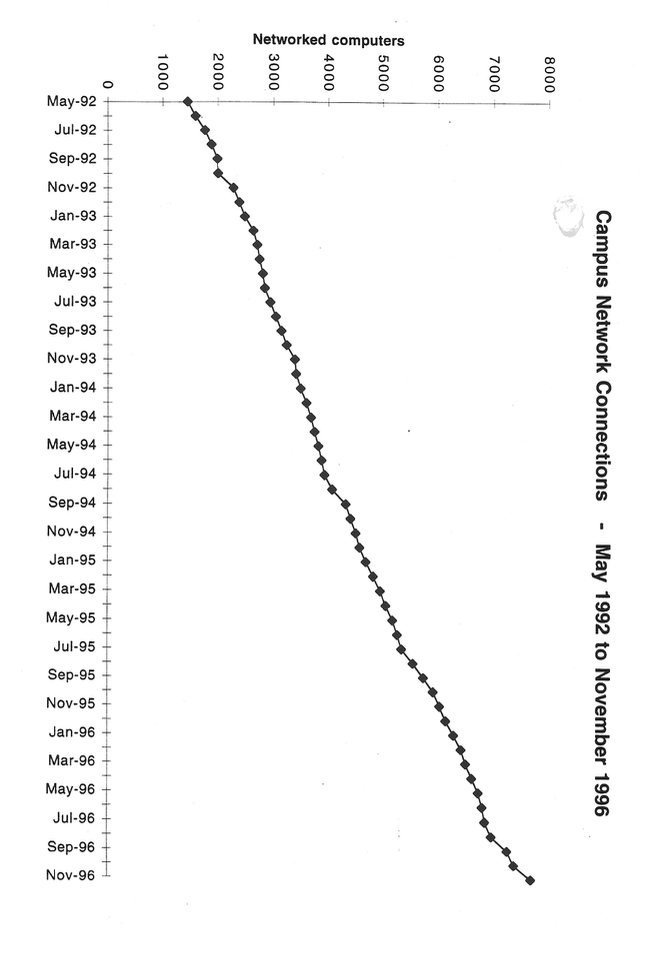
The number of computers being attached to the network is continuing to grow approximately linearly, bringing the July 1996 total to about 6800, and the November one to about 7400, with an overall attachment rate of about 120 per month. Four years ago there were about 1500 computers attached to the network. Appendix G shows the growth over the last four years. The University is about thirteenth in order of the number of campus connection points in UK universities.
Recent major network additions have been PC clusters in the Bedson, Cassie, Daysh, Ridley, and Robinson Library buildings, and the Training cluster in the Herschel. We have also been giving advice about networking the refurbished Old Library User Area. The Merz Court Mathematics area has been restructured. Other major work included provision of networking for University staff in Central Stores, RVI Claremont North Wing, Claremont Sports Hall, and the connection of the Postgraduate Institute for Medicine and Dentistry to the campus network. There were also many other smaller network developments on campus. For academic use, North Tyneside General Hospital has been connected to the network, as has South Tyneside Health Trust. The provision of an ISD.N link at the Dove Marine Laboratory is at an advanced stage. We have also given help and advice to MITS in connection with their changing communications requirements.
In 1995/96 ASSA and EFC made available funding for an ISDN dialup service, for network performance enhancement and management, for alternative routes for campus cabling, and for core ATM networking. Equipment for these has been bought and installed. The ISDN dialup service is being tested, and will be announced as a service in the near future when testing has been completed. Network performance enhancement equipment is being used for providing services to the new Robinson Library clusters. The latter clusters are linked to the backbone using newly available fast ethernet technology. Staff shortage has delayed progress with providing an alternative route to the Medical School and with ATM work. Work associated with the new PC clusters had to be given a higher priority, as ASSA was unable to make available all the staff resources that were requested to enable rapid implementation.
Earlier this year we applied to JISC for HEFCE funding of a link between Castle Leazes and Leazes Terrace halls of residence and the main campus, and also for linking the universities in the region, Although the former application was unsuccessful, the latter has been given provisional funding of £300,000 as a statement of intent, in order to strengthen the bargaining, position in further negotiations with other interested parties.
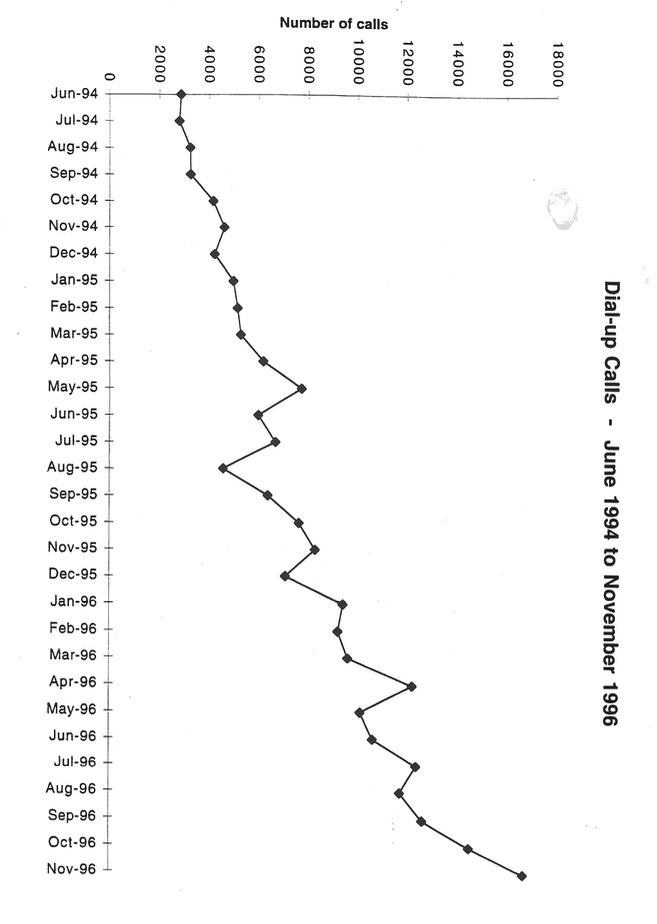
A noteworthy feature during the last year has been the increasing number of requests for access and for advice from dial-in users, from the growing number of off-campus sites with University staff, and from other organisations associated with, but not part of, the University. The recent relaxing of JANET connection rules may add to future demands. We are refining our local network connection rules to complement this.
E4.1.2 The North Eastern Universities Metropolitan Area Network (NORMAN)
The high speed link between Newcastle and Northumbria Universities now delivers the main JANET service to Northumbria University. This gives both Universities the benefit of sharing an improved link without extra cost to either University. The link will be operated by Newcastle under subcontract to UKERNA, and we will be reimbursed for the management effort involved in addition to the benefits of this sharing
During the year the opportunity arose to make a joint bid for a regional high speed network (MAN) to interconnect all five Universities in the region. In addition the proposed network will also provide connectivity to various sites of common interest to the Universities, including some of their split sites, major hospitals, halls of residence, the ECAl centre, etc. In order to address some of the special problems caused by the separation of the sites in the region, we have also, under the NiAA umbrella, applied for ERDF matching funding, and if this is successful, it will entail connecting further sites, such as the TECs, Business Links, and some SMEs. This project, which follows the national JISC strategy for developing network service, could well become a leading example of its type in the UK because of the diversity of its membership.
Newcastle University was the lead site for the bid, and is also leading the subsequent investigation and project management. The connectivity out of the region would be via Newcastle. The project is steered by a committee consisting of the directors of the computing services and equivalent in the Universities. The decision concerning ERDF funding is expected by the end of the present year, and, if it is successful, we expect to push ahead rapidly in the New Year.
E4.2 Core computing activities review – PC and Mac
This service continues to be mainly targeted at and used by students, and we expect the number registered to be over 12,300 once the students who left at the end of 95/96 are deleted from the system. In other words, most students are now UCS customers. In addition we have some 2,100 staff members registered.
An increasing number of departmental clusters (now 26) have their student filestore on the UCS data servers.
During 95/96 and early 96/97, substantial progress was made in several target areas in accordance with the University IT Strategy and the UCS Planning Statement.
We increased the number of public PCs:
• During 95/96, two PC clusters were accepted as ‘open’ (eomer; English; 10 seats and oracle; Maths; 29).
• The new Faculty of Law, Environmental and Social Sciences cluster (brae) of 40 PCs and the UCS Bedson (side) cluster of 30 were added to the Federation. The latter was the part-replacement for the older Sun timesharing machines
• In early 96/97, a new cluster (tyne) of 43 PCs was located in the Robinson Library extension. These machines are the replacement of the retired OLUA Sun workstations and were located in the Robinson Library rather than wait for the refurbished OLUA to be available.
• In addition 4 new ‘open’ departmental PC clusters have recently been accepted with approval by CSC. These are atlantis (Law, 24), isaac (Civil Engineering, 30), galen (Psychology, 38) and fayol (Accounting & Management, 19).
• A total of 263 extra PC stations were added by upgrading 6 existing clusters and installing 3 new ones. This brings the total number of stations to 684 (see Appendix H for details of growth and usage). Excellent co-operation with Estates made it possible for all the new equipment to be in service by the beginning of 96/97.
As part of the above, some re-deployment was done so that several departments benefited from reallocation of older machines. In particular: 386s and 486s from Chemistry went to Law. Social Policy and Economics; 386s from Law went to Archaeology and Economics. This improved student facilities in the recipient departments.
In addition,
• The closure of the OLUA meant major re-deployment of equipment, with some machines going temporarily into store, to be later re-installed in the Robinson Library extension. With the closure of the OLUA, we also lost our 24 hour access area and to compensate for this, the Bedson Foyer and Building Science were opened for 24 hour access.
• Mac facilities remained at the same number but of the cluster of 18, 2 are now in Bedson and l6 are in the Robinson Library extension.
• UCS has set up its first NT cluster located in the Robinson Library extension. Throughout the period reviewed, the PC Federation has continued to operate on Novell Netware 3.12 with local system extensions and has delivered a service of consistently high quality and reliability.
It is anticipated that the total number of Federation seats by the end of the 95/96 academic year will be in excess of 900. This includes 200 ‘closed’ departmental machines where the desktop is not managed by UCS but which do make use of the UCS-managed student filestore.
E4.3 Core computing activities review – Unix
During the first part of 95/96 the main timesharing machine (aidan) was upgraded by the addition of 4 more processors and 512 MB of memory. However, the last phase of that upgrade (increased network speed) had to wait for networking changes in the main machine room, and finally occurred during autumn 1996. During the first half of 1996 the smaller, older Unix timesharing services (eata and tuda) were retired. However in line with the Unix review conclusions, and with ASSA funding, a second timesharing machine is in the process of being purchased.
During June 96, the Sun Unix workstations, that were bought in 1990, were retired from user service. The intention is that they will be replaced in the OLUA by high quality graphics PCs.
Usage levels are illustrated in Appendix J. These diagrams show the usage for aidan and the HP clusters on a typical, term-time weekday, 15th May 1996. These diagrams are produced daily for system monitoring purposes and are therefore rather complex and require some further elucidation.
The diagram for aidan shows that the two long batch queues (for runs of up to 120 hours) were in continuous use, that there was sporadic use of the small (3 hr) queues but no activity on the intermediate queues. The diagram further shows that despite the lack of use of these queues the idle time on that machine fell to essentially zero during the 9 to S period, and that there were between 140 and 180 users logged in over that period.
In the workstation diagram it should first be noted that the shaded area shows the number of machines with remote logins. We can then see that the glen and pike clusters were heavily used from the console during the day with the pike usage continuing into the evening. The lake and mere clusters were less heavily used, while the remaining clusters show a disappointing level of use. The remote login users were active on bum, lake and especially the mere clusters outside prime shift, while the glens pikes, and denes were used remotely primarily during the day.
During the current year, a second Unix time-sharing system and a small number of high graphics performance Unix workstations will be brought into service using ASSA funding.
E4.4 Core Computing activities Review : Filestore
Additional diskspace has been provided in a phased plan for both Unix and Novell users. On the Novell side, four new fileservers were provided for the start of 95/96 and a further two fileservers have been provided for the start of 96/97. The number of fileservers required is determined both by the total number of users and restrictions within the Novell software which, in practice, limits the number of users who can coexist on the same server. The additional filespace was 32GB for 95/96 and 24GB for 96/97. In addition, one of the fileservers is configured as a RAID (Redundant Array of inexpensive Disks) device in order to improve the observable disk reliability.
For the Unix service, an additional fileserver was provided for 95/96 and additional disk space was provided on two of the fileservers for 96/97. Also during 95/96, some additional memory was added for server performance improvement and it is planned to provide higher-speed network connection during 96/97. In addition, for 96/97 a fileserver has been provided to which departmentally-owned disks can be attached rather than distributing them over all the other fileservers. The additional filespace was 28GB in 95/96 and 32GB in 95/97. Bocause of the high maintenance costs it is no longer cost effective to continue to use the Auspex fileserver (Townend) and this is being replaced during 96/97 funded solely by the saving in maintenance cost in the current financial year.
During the year the off-line storage system was brought into operation, and is gradually gaining use. This system is accessible by both Unix and Novell users. At present it is used by some 102 users.
E4.5 Core Computing activities Review: other support servers
During 95/96 we have made upgrades to the memory in the campus main mail hub machine. During 96/97 the mail hub and mail spool machines and the news server will be upgraded to faster machines. The Ingres services (including the UCS user registration database) will be moved to a faster server, and the local Mailbase service will be left with a dedicated machine.
E4.6 Student access to UCS clusters: review
The experiment that started in March 1994, in response to student demand, to keep the OLUA open to undergraduates during weekend hours has continued to prove successful and popular. The service continues to be manned by postgraduate demonstrators and UCS operations staff.
From the beginning of the 95/96 academic year, the OLUA has also been kept open to undergraduates until 11pm, Monday to Friday during term, manned by University porters and using funding made available by ASSA. The original target of midnight has not been achieved, largely due to the current conditions of service of University porters with an increased cost of employment after 11pm.
To compensate for the closure of the OLUA on 21st June 1996, the Bedson Foyer and Building Science were opened for 24 hour access.
E4.7 Improvement of student computer availability: review
The University has adopted the IT Strategy Group recommendation to achieve a 7:1 student to computer seat ratio. It was calculated in last year’s plan document that the figure by the end of 95/96 would be around 8.5:1
Recalculation, using EFC 1996 information together with network and micro maintenance data, would lead us to believe that the total number of student seats for 96/97 will be around 1,484. Using the 96/97 projected student figure of 12,370 this gives a ratio of 8.3:1, a slight improvement on last year’s figure of 8.5:1. The size of the improvement is disappointing but attributable to equipment funding cuts for 96/97 together with a slightly optimistic calculation for the previous year.
E4.8 Facilities management for departmental Netware clusters: review
At the beginning of 95/96, two departmental clusters decided to open to all students and therefore continue to benefit from UCS support and management.
Since then, the Faculty of Law, Environmental and Social Sciences were successful in their 1995 bid for a 40 seat PC cluster which was installed in the Daysh Building in January 1996. The Faculty successfully requested that this be an open cluster managed by UCS.
As part of an equipment exchange arrangement, Chemistry received priority access to the Bedson Foyer cluster, while Law ‘opened its cluster expanded by machines relocated from Chemistry.
Recently, a further three new clusters were accepted by CSC as ‘open’: Psychology, Accounting, & Management and Civil Engineering,
UCS is currently preparing for CSC a request from the department of History for its cluster to be similarly managed.
E4.9 Networked information and CWIS activities: review
The use of the University’s central web services has continued to grow, in terms of accesses to the web server itself, in the quantity and quality of information published on the server (there are now more than 700 registered information providers on the web server) and in the use of the proxy server to access the Web at large. Upgrades and enhancements were made to both the Web server and the proxy server, and both are now faster, with better capacity and improved network bandwidth.
The ACOCG/Sima project to investigate software tools for the World-Wide Web was successfully completed in May 1996, the results of which are available to browse on the web at the address http://www.ncl.ac.uk/wwwtools/.
The UCS was heavily involved in the initial implementation of the new University information structure, in liaison with the Library, AV centre and Registrar’s staff. The liaison with the Administration has become stronger since the retirement of the CWIS manager, and the webmaster group (Janct Wheeler and David Surtees of the UCS and Damon Querry of the Registrars) now holds fortnightly meetings to discuss all aspects of the service. These meetings have proven to be extremely productive.
In addition to the departure of the CWIS Manager from the Library, Tony McDonald (UCS) also left the webmaster team in 1996, with his role as CGI programmer being taken over by Ron Kerr (UCS).
We currently estimate 1.5 FTE are committed between these three staff to web matters
E4.10 Micro-maintenance scheme: review
During 95/96 the micro-maintenance scheme (MMS) had 1,230 additional systems registered and 340 existing ones removed, bringing the total to 5,190. In addition to the systems there are currently 1,706 printers registered.
The micro-maintenance scheme continued to offer a widely-used, cost-effective service at a cost of approximately 2.7% of capital investment per annum, the same as the previous year.
This compares favourably with the cost of running the scheme using, for example, the nationally negotiated CVCP agreement using an outside company, Getech, which would cost about 4.4% of capital investment at current rates.
However, with the increasing number of systems and increase in faults the scheme is due for an overhaul. See section 5 of Planning Statement for further details.
E4.11 The Mailbase project: review
The national Mailbase Service has grown from strength to strength. A recent independent review commented that “It is hard to imagine academic life without it.” There are currently more than 1400 scholarly discussion lists and over 100,000 members. This busy service was migrated successfully and seamlessly on to a new more powerful machine during the summer of 96.
Mailbase enjoys three year rolling funding from JISC. The recurrent annual funding is now at a level of £225,681 with a claims based grant this year of £52,000. The University has representatives on the Mailbase Steering Group.
Mailbase was successful once more in applying for an Academic Educational Grant from Sun and delivery has just been taken of nearly £20,000 worth of donated equipment.
During the year there was a significant tum over in staff. Successful recruitment of new staff, including for a new post of Mailbase Manager, has meant that all posts are once again filled. The new staff members have had the opportunity to take a fresh look at all aspects of the service. One immediate result of this has been the improved provision for disaster recovery which was implemented as part of the move to the new hardware. The additional new hardware donated by Sun will allow further improvements in the service to be investigated.
Operation of a busy and rapidly expanding service by a small team of staff is made possible by distributing the administrative load and for this the Mailbase staff relics very heavily on its list owners to take their share of supporting the service. This year saw additional effort directed at supporting and training these list owners; improved and additional documentation was developed and three training workshops for list owners were held.
The Mailbase Team have, over the years, brought benefit to the University by helping UCS staff set up and run the local Mailbase Service. This has developed into a valuable campus service which supports nearly 500 mailing lists. The general benefit to University staff at Newcastle of siting the National Service here was illustrated recently when a cluster graph of Mailbase membership indicated a large cluster centred on Newcastle. Contacts with individual staff in departments and the effect of regular local publicity has meant that Newcastle staff are even more aware of Mailbase than those at other sites and are taking advantage of the service and benefiting from it.
E4.12 The Netskills project: review
Netskills is a high profile UK-wide project which is funded for three years from October Ist 1995 as part of the extensive Electronic Libraries Programme (eLib). With a total funding of £1,018,237, Netskills is the largest single project funded through eLib. It is providing a programme of network training and awareness for UK HE users and providers of networked information and those supporting them. Use is made of both traditional and network based methods of training
During the first year of the project, the main aim was to create an immediate visibility within the UK HE community for both Netskills and eLib, and to raise the awareness of the HE community of the benefits of using networked information, by means of a series of training and awareness events. Delivering this series of courses and seminars, whilst still training Netskills staff, developing materials and defining quality assurance procedures, was a major challenge which the Netskills Team met successfully both as a Team and as individual staff members.
Major achievements during this first year of operation were:
• the delivery of 90 courses and seminars to over 3000 HE staff around the UK. (A total of 7500 person hours of training.) This included introductory Internet and HTML authoring courses for over 500 staff and rescarch students of the University of Newcastle
• the production of an interactive web-based tutorial, TONIC – The On-line Interactive Netskills Course – with over 7000 registered users
• release of Five Training Kits. The first two kits provide an introduction to the Internet and to effective searching using the World Wide Web. The other three kits cover introductory and advanced authoring on the World Wide Web. The pages from which the introductory kit may be downloaded, is accessed over 1000 times per month.
APPENDIX F
Appendix G
APPENDIX H
PC Federation Appendix
This appendix includes several important items of information regarding the PC Federation:-
• UCS PC cluster growth
• Software on the UCS PC clusters
• Cluster usage statistics
• UCS PC cluster growth
The diagram shows the growth from 1st October 1992 to the current total of 691 stations in 23 clusters. During summer 1996 a total of 180 new stations were added in 6 new clusters. [see http://www.ncl.ac.uk/~nucspcs/clusters/usage/ucs.html]. Much of the effort over summer 1996 went into investigating the migration from Windows 3.1 to Windows NT which took visible form the highly successful new TYNE cluster. UCS now has a full year to gain experience with running public Windows NT clusters.
Software on the UCS PC clusters
There are over 100 different software packages available on the UCS PC Federation covering many disciplines. Further specialist software is available on Hybrid clusters. The software portfolio now amounts to almost 1.5 Gigabytes on each PC cluster. In addition the MALL central server supports another 1.5 Gigabytes of less frequently used software, mainly Computer Aided Learning.
Over half the software has been mounted in response to requests from departments. The core software can now be updated whenever new versions are available, although development of the Windows 3.1 desktop has now slowed as UCS press ahead with the Windows NT desktop.
Cluster usage statistics
See later section.
Dr C. Gerrard, 27th November 1996
This file APPE.DOC