Executive Summary
Staff Listing
Computing Service Review
PC Federation
Cluster Usage Statistics
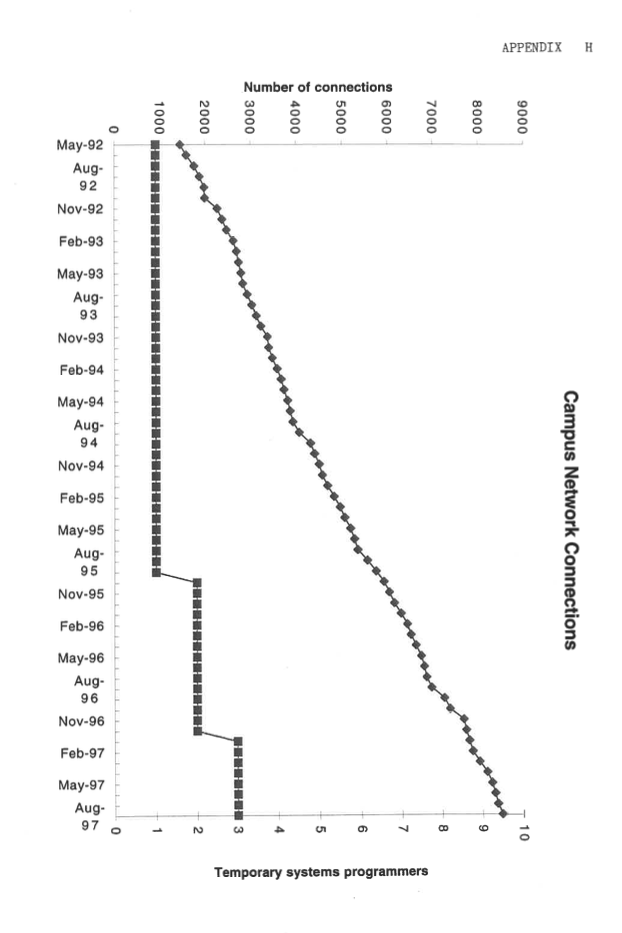
Campus Network Connections Graph
NorMAN
[Extracts from the 1998/99 Planning Statement for the University Computing Service]
Executive Summary
3rd December 1997
This year’s Planning Statement takes account of the significant role envisaged by Dearing for Communications and Information Technology (C&IT) in Higher Education and attempts to address a number of the recommendations of Chapter 13.
UCS is pleased to report to ASSA that targets set for 96/97 were largely achieved and a number of services enhanced and expanded.
For the 98/99 planning period, UCS proposes and estimates resources required for a number of developments:
• The recommendation is made that the University consider development of a support centre for information and learning technology (SCILT) to co-ordinate and maximise the benefits of C&IT training for staff.
• A major proposal is made that UCS should work towards development of a Common University Desktop service to support staff as well as students. A detailed proposal has recently been requested by ASSA in this arca. • For the campus network service, we intend to continue to invest in a resilient, fast, and all-pervasive infrastructure capable of serving the University’s expanding present and future needs in research, teaching and learning, and administration. In particular, we have requested phased funding to enable replacement of in-building equipment and cabling.
• We look forward to the commencement of the new SuperJANET IlI service and to the establishment of the NorMAN regional network for HE. Attention is however drawn to the probability of the introduction of JANET charges for international bandwidth and the possibility of recurrent costs of NorMAN.
• Proposals are made for actions required to improve the security of the Newcastle campus network.
• For the PC service, we intend to continue to replace 5-year old equipment and wish to provide a modest increase in the numbers of machines and clusters available to students.
• We intend to continue to implement the migration plan from Windows 3.1 to Windows NT.
• UP&RC funding will be deployed, guided by CSC, for the adoption and replacement of selected departmental and faculty student clusters.
• A significant feature for the Unix service is that we plan that most of the HP Unix workstations will be replaced by Windows NT machines, thus continuing a phased withdrawal of Unix from the student desktop.
• We propose to continue our replacement strategy for filestore systems and other support services in order to ensure adequate capacity and continuing reliability.
• WWW and Intranet infrastructure will continue to be developed as it becomes an increasingly important tool for the University.
• The Micro Maintenance scheme will be comprehensively reviewed in order to remain responsive and cost-effective.
[Extracted from Organisation Chart in Appendix D]
Director
P S Salotti
. . . . . . Project Director
. . . . . . G Foster
. . . . . . . . . . . . Mailbase
. . . . . . . . . . . . M J Findlay – Manager
. . . . . . . . . . . . M Embleton
. . . . . . . . . . . . E H Blair
. . . . . . . . . . . . B A Reid
. . . . . . . . . . . . G Younger
. . . . . . . . . . . . vacant post
. . . . . . . . . . . . vacant post
. . . . . . . . . . . . Netskills
. . . . . . . . . . . . D W Hartland – Manager
. . . . . . . . . . . . R S Allan
. . . . . . . . . . . . N R McKenzie
. . . . . . . . . . . . J A MacNeil
. . . . . . . . . . . . W B Scales
. . . . . . . . . . . . S L Stuart
. . . . . . . . . . . . E F Wright
. . . . . . . . . . . . C A Vincent
. . . . . . . . . . . . DESIRE
. . . . . . . . . . . . A M McDonald
. . . . . . Assistant Director (Systems & Operations)
. . . . . . T J Ratcliffe
. . . . . . . . . . . . Operations Superv.
. . . . . . . . . . . . R E Broughton
. . . . . . . . . . . . . . . . . . Shift Leaders
. . . . . . . . . . . . . . . . . . J M Gaffney
. . . . . . . . . . . . . . . . . . G Lynch
. . . . . . . . . . . . . . . . . . M R Paul
. . . . . . . . . . . . . . . . . . . . . . . . Operators
. . . . . . . . . . . . . . . . . . . . . . . . D. Alderson
. . . . . . . . . . . . . . . . . . . . . . . . P Baggott
. . . . . . . . . . . . . . . . . . . . . . . . A H Bush
. . . . . . . . . . . . . . . . . . . . . . . . D Harris
. . . . . . . . . . . . . . . . . . . . . . . . G B Taylor
. . . . . . . . . . . . Print Room
. . . . . . . . . . . . W D Foggo – Supervisor
. . . . . . . . . . . . H E Fleming
. . . . . . . . . . . . Unix Systems
. . . . . . . . . . . . F Greenwood
. . . . . . . . . . . . Q G Campbell
. . . . . . . . . . . . B C Hamshere
. . . . . . . . . . . . R Kerr
. . . . . . . . . . . . P Lomas
. . . . . . . . . . . . P Whillance
. . . . . . Assistant Director
. . . . . . D M Russell
. . . . . . . . . . . . WWW Infrastructure Support ALC
. . . . . . . . . . . . D P Surtees
. . . . . . . . . . . . D Querry (50%)
. . . . . . Assistant Director (Networks & Development)
. . . . . . I D Doak
. . . . . . . . . . . . Network & Development Staff
. . . . . . . . . . . . V J Bilton
. . . . . . . . . . . . P A Coates
. . . . . . . . . . . . J D Coleman
. . . . . . . . . . . . K Heron
. . . . . . . . . . . . N. Montecchieri
. . . . . . . . . . . . E Watson
. . . . . . . . . . . . . . . . . . Technical Network Staff
. . . . . . . . . . . . . . . . . . G A Brown
. . . . . . . . . . . . . . . . . . J Craig
. . . . . . . . . . . . . . . . . . S Hay
. . . . . . . . . . . . . . . . . . . . . . . . . Trainee Technician(s)
. . . . . . . . . . . . . . . . . . . . . . . . . F Gilbert
. . . . . . Assistant Director (Microcomputer Systems & User Services)
. . . . . . B Jones
. . . . . . . . . . . . Microcomputer Support
. . . . . . . . . . . . C Gerrar
. . . . . . . . . . . . M Agar
. . . . . . . . . . . . R J S T R Allan
. . . . . . . . . . . . T Betteridge
. . . . . . . . . . . . A M Lamont
. . . . . . . . . . . . vacant post
. . . . . . . . . . . . I Nicholson
. . . . . . . . . . . . D J Sedgwick
. . . . . . . . . . . . Documentation & Information
. . . . . . . . . . . . J M Hunter
. . . . . . . . . . . . J A Law
. . . . . . . . . . . . J E Wheeler
. . . . . . . . . . . . Micro Maintenance & Computer Technicians
. . . . . . . . . . . . J S Snowball – Dept Superintendent
. . . . . . . . . . . . Technicians
. . . . . . . . . . . . vacant post
. . . . . . . . . . . . vacant post
. . . . . . . . . . . . A Murphy
. . . . . . . . . . . . I Rutherford
. . . . . . . . . . . . D J Scott
. . . . . . . . . . . . Applications & Education
. . . . . . . . . . . . R Clout
. . . . . . . . . . . . R G C Pringle
. . . . . . . . . . . . G Shearing
. . . . . . . . . . . . L M Weatherill
. . . . . . . . . . . . C H Woodford
. . . . . . . . . . . . vacant post
. . . . . . . . . . . . Data Preparation Service
. . . . . . . . . . . . C L Hellier – D.P. Supervisor
. . . . . . . . . . . . E Brown
. . . . . . . . . . . . P E Bryson
. . . . . . . . . . . . S E Carrick
. . . . . . . . . . . . J H Coulson
. . . . . . . . . . . . M Foster
. . . . . . . . . . . . B A Hatrick
. . . . . . . . . . . . P A Johnson
. . . . . . . . . . . . J Mackay
. . . . . . . . . . . . J Powell
. . . . . . . . . . . . M Young
. . . . . . . . . . . . + 30 “outworkers” – casual
. . . . . . . . . . . . General Assistants (Cluster Rooms) Ancilliary
. . . . . . . . . . . . H E Fleming
. . . . . . . . . . . . S K Minto
. . . . . . Departmental Administration
. . . . . . M L Coleman
. . . . . . . . . . . . Clerical Staff
. . . . . . . . . . . . Director’s Secretary
. . . . . . . . . . . . J A Hall
. . . . . . . . . . . . General Office
. . . . . . . . . . . . P A Boyle
. . . . . . . . . . . . K Malcolm
. . . . . . . . . . . . C D Moffat
. . . . . . . . . . . . A Taylor
. . . . . . . . . . . . Reception & User Registration
. . . . . . . . . . . . R Dickinson
. . . . . . . . . . . . R V Ferguson
Appendix E
Computing Service Review of 1996/97
November, 1997
UCS provides and maintains the campus network and offers thereon a range of distributed computing facilities to all staff, postgraduates and undergraduates. These are underpinned by a range of support services many of which are also provided for faculty or departmental computing resources. Externally, UCS activities complement and enhance the reputation of the University.
E.1 Network services
E.1.1 Campus Network
The UCS network group’s objective is to provide the reliable and effective network service that is an essential part of the infrastructure needed by the University to support teaching, leaming, research and, increasingly, administration. Since user requirements are not static, the network itself is not static; there is continuous development taking place, both within departments and in the network infrastructure. This in tum is increasing the demand on UCS network staff for help and advice.
The last year has seen continued roughly linear growth in the numbers of computers being attached to the network, bringing the July 97 total to about 8,300, and the current one to about 8,700. This is shown in Appendix H. Five years ago there were about 1,500 computers attached to the network.
Major extensions to the network in the year to July 97 have been PC clusters in the Robinson Library Extension and the Training Cluster in the Herschel Building. The Robinson clusters were the first on campus to make use of both structured cabling and switches, and to pass traffic over a new technology link (fast ethernet) to the centre of the network. More recently, the new UCS clusters in the Old Library also make use of this new technology. The Open Access Centre for language teaching is the first cluster on campus in which every device uses fast ethernet technology, for the specialised application of transmission of moving images. A room in Castle Leazes has also been cabled in readiness for a future PC cluster.
New dial-up equipment has been bought to satisfy increasing user demand. Users currently make about 20,000 calls per month. The new equipment provides both a service similar to the old dial-up service, and a new service supporting ISDN dial-up from individual users. The new equipment supports more simultaneous calls, and call set-up times are shorter than with the old service. The service has recently been announced to users, who have commented very favourably.
Users of the networks at the Dove Marine Laboratory and in the Cardiology Department at the Freeman Hospital are now able to access central campus services transparently via separate ISDN connections, with consequent reduction of staff travelling time.
E.1.2 NorMAN – North Eastern Universities Metropolitan Area Network
The bid to HEFCE for a regional MAN to interconnect all the five Universities in the region together with the installation of fibre routes across Tyneside was successful, with the award of a little over £750,000, and much of the summer was spent in the negotiations involved in a procurement for the regional part of the MAN. We expect the placing of contracts before the end of 1997.
A part of this, a new fibre route via the Tyneside Metro to the Freeman Hospital and Coach Lane Campus is being planned. This will extend full LAN speeds to the Freeman Hospital, Henderson Hall, and Northumbria University’s Coach Lane Campus.
The contract for a new optical fibre route to connect the Medical School, Castle Leazes, and the General Hospital will extend full LAN speed connections to all these sites.
E.2 PC and Mac services
E.2.1 Further increase in student PC facilities.
This service was used by around 12,000 students.
Over the summer of 1996 the new extension of the Robinson Library received a large number of new and re-deployed machines. The facilities were further enhanced over Easter 97 with further introduction of new machines so that this important location now contains almost 150 machines (mostly Windows 3.1 and NT PCs, along with 16 Apple Macs). The usage of the PC clusters is shown in Appendix F.
The other major expansion during the year was associated with the closure, refurbishment and re-opening of the Old Library User Area (OLUA). This now has provision for disabled access and contains 30 new 200Mhz Pentium MMXs running Windows NT and 32 redeployed 486 machines running Windows 3.1. In addition, the OLUA contains a new Mac cluster of 14 machines and a cluster of HP Unix machines has also returned there.
As part of Computing Service Committee’s strategic replacement policy there was also complete replacement of the CAD clusters in the Stephenson building and Building Science. Both clusters now have 200M Pentium MMXs and in Summer 97 migrated to Windows NT4. Several departments benefited from the strategic re-deployment policy following the various new purchases. These included Law, Social Policy, Archaeology, Economics, History, Politics and Dove Marine Laboratory. The strategic re-deployment has resulted in a drastic reduction in the number of older 386s used for student teaching purposes.
There were minimum software costs involved with the above as UCS had purchased a 1,000 seat Softrack licence. This allowed the introduction of new ‘open’ clusters like Law without buying additional Microsoft licences. Other clusters that became ‘open’ were in Psychology and Accounting & Management. These clusters were purchased by the departments, but UCS installed the desktop and software and pay for the maintenance of the hardware.
E.2.2 Responding to recent Microsoft and Novell products.
The majority of the student Federation PCs are still based on Windows 3.1. UCS decided to bypass Windows 95 as an operating system, as it was felt to be unsuitable to build stations sufficiently robust for multiple student use. Windows NT is a better platform to use to build such stations. UCS continues to use Novell Netware 3.12 and does not intend moving to Netware 4 with its inherent problems.
During the Summer of 97, NT version 4 was introduced on 3 further clusters bringing the total number of such clusters to 7, representing 206 machines from a total of 820.
E.2.3 The University Common Desktop.
During 96/97, this project, which is intended to offer central management capability to staff PCs in order tc deliver office, academic and administrative software, received much discussion and planning in conjunction with MITS.
In mid-97, some interesting, potential software solutions became available (such as NTrigue), UCS has purchased licences for such products in preparation to demonstrating a prototype scheme.
E.3 Unix services
UCS provide a number of Unix based services. Those directly visible to users are the general Unix workstations, the multi-user computing facility, and some numerically intensive computing. In the background, a number of other facilities are Unix based including the central mail (and fax service), the laser printing service, world wide Web, news and database servers. There are some 9000 Unix users although this figure includes those registered simply to receive mail elsewhere or use dial-up facilities. A more detailed look into use shows that some 4,000 users have been ‘active’ in the past year.
E.3.1 Workstation Clusters
There are 144 HP 710 workstations (purchased in 1992) almost all of which are in clusters distributed around the campus. On average, the usage of these workstations is lower in 97 than in 95. This is probably due to the increasing numbers of PCs in clusters, and the fact that all the Federation PCs installed from Summer 95 onwards are more powerful than the HP workstations.
E.3.2 Multi-user (Timesharing) service
During the past year we have operated with a single multi-user machine (aidan, a 10 processor Sun SparcCenter2000 installed in 1993 and upgraded in 1995). The ongoing strategy is to move from a single timesharing machine to having two machines which are replaced alternately. A second timesharing machine (finan, a 6 processor Sun Enterprise3000) was purchased late in 96/97, and is being introduced into full service in 97/98. The number of concurrent users logged in to aidan averages around 120 and peaks at about 200. Much of the processing capacity on aidan is used by the six batch queues. We intend to provide three such queues on finan.
E.3.3 Unix specialist services
UCS continues to believe that the University is relatively weak in terms of high performance and compute intensive functions. Unfortunately, we were unable to find a department with which to collaborate in making a joint bid for Research Computing Funds, probably due to the restrictive financial rules placed on last years bidding. The provision of the small number of planned high graphics performance workstations was delayed but will be completed in 91/98.
E.4 Support facilities
E.4.1 File Server facilities
The bulk of the users’ files in Unix are stored on five file-servers. In addition a sixth fileserver is dedicated to attaching departmentally owned disks. In Summer % replacement disks amounting to 32GB were installed, and also during 96/97 we replaced a major fileserving, machine and introduced 24GB of RAID disks as its replacement. In Summer 97, Sun disks bought in 1992 were scheduled for partial replacement and replacement disks giving some 64GB will shortly be introduced.
On the PC side, we now have 11 fileservers in operation, mainly providing the student filestore. During Summer 96 we moved two more servers to RAID technology with replacement disks totalling 32GB. In late 97 a further two fileservers will migrate to RAID with a further 32GB of disk space.
We have also introduced an off-line storage facility and archive, accessible both from Unix and from the Federation PCs. The use is gradually increasing, with around 150 users currently using it.
E.4.2 Other support services (Unix and PC)
The main campus mail hub and mail spooler, E-mail/Fax Interfaces, the Usenet news, the NUInfo and World Wide Web service, and the DNS (domain naming service) all run on Unix equipment.
The mail-hub processes 800,000 to 900,000 messages per week, while the Unix mail spool supports 200,000 to 250,000 messages per week and also supports POP mail service at a level of 850 users per day. The increase in the load is such that the machines have had to be upgraded several times recently, and we are attempting to move the POP service to a separate machine
On the news-server, the number of connections has risen to 1,900 per day, we carry about 6,000 newsgroups, receive about 120,000 articles each day, and hold about 2,000,000 articles, occupying over 3GB of disk space
E.5. Applications software support
The University ‘core’ software was reviewed and the UCS software support staff resources concentrated on that portfolio. UCS provides full support for core software and can provide little or no support for other software, beyond installation of discipline-specific software on behalf of departments.
The UCS advisory helpdesk and helpline services, reinforced by further use of postgraduate demonstrators, became the main point of contact for undergraduate customers. UCS was able to man an advisory session in both the Robinson Library and the Herschel building from 9am to 5pm from 1st October 96 until 20th June 97.
Late opening of the Herschel until 11 p.m. involved paying for both a porter and adviser in order to comply with the Health and Safety regulations that came into effect in 1997. This was in operation from end of January 97 until 20th June. This was an unexpected extra expenditure.
The helpdesk service was supplemented by traditional documentation and increased use of on-line information, mailing lists and newsgroups. For resource reasons, the in-depth applications consultancy service to individuals continues to be restricted to staff and postgraduates.
E.6 Distributed cluster issues
E.6.1 OLUA move/refurbishment
The new Old Library User Area (OLUA) was fitted to a high standard by Estates. It was handed back to UCS in March 97. The equipment installed in this area is described above.
The helpdesk service was moved back to the OLUA from its temporary quarters in the Herschel in July 97.
We intend to provide out of hours access into this area once the card access mechanisms are completed.
E.6.2 Routine Cluster Maintenance
ASSA funded two part-time cluster room attendants who started mid May 97. With an increasing number of UCS cluster rooms to maintain, they have already proved invaluable. They tidy and clean the cluster rooms, report equipment faults and replenish printer paper, posters and documentation.
E.7 World Wide Web, networked information and NUInfo
The year has seen considerable activity. The growth in the use of the Web, both in the use of external Web sites, and the supply of Web services to the University has necessitated several upgrades. The Web and proxy servers have been replaced during the year, and a new CGI server installed.
This service began in March 94 with under 1000 accesses per month. In 1995 we were handling 350,000 accesses per month on the Web server and 500,000 accesses per month on the Web proxy server. The services moved to dedicated equipment in 1995, and have needed a number of memory, disk and process upgrades since then. The current situation is that the Web server is handling 75,000 accesses per day, and the proxy server is handling 225,000 accesses per day. A search engine for the entire University Web is now available, and we can now run “virtual servers” such as the one for HESIN and the Law journal among others. In July, Newcastle hosted the only “mirror” site of the full Dearing report.
The Web is used for an ever increasing variety of applications, including communicating with new and prospective students via the on-line prospectuses, and putting the University Calendar on-line. The appointment of staff to release Dr Surtees to work full time on the Web service, and the appointment of Web Trainer and Enabler to put central information on-line and to work with departments have also been of immense benefit.
E.8 Micro-maintenance scheme
The micro maintenance database was thoroughly reviewed. System numbers maintained continue to rise and an increasing proportion of work has been contracted out
After extensive discussions with insurers and existing external contractors, UCS opted to put about 35 the systems with an external contractor. This is the first time that the UCS have taken this step. The advantages are that there will be an engineer on site each day who can carry out repairs both to system the contract as well as to systems not on contract (with no further call-out charge). The users on camp should see a better response and repair time. This major change will be monitored closely.
Two of the three scheme technicians resigned and were replaced during the year. In the intervening pe the pressure was tremendous on the remaining technician.
E.9 Reprographics service
Whilst awaiting the outcome of the University Reprographics review, the service continued with increasingly unreliable equipment and consequently with higher costs. Towards the end of 96/97 ASS accepted a paper from UCS showing that it was cost-effective for UCS to continue to operate this service to departments. UCS will be procuring new networked equipment during 97/98 and has had consultations with the Administration’s reprographics section to ensure commonality wherever possible.
E.10 Printing facilities
The new printing system capable of providing fast and medium speed, charged laser printing in the student cluster rooms was introduced during August 96. In October 96 the UCS started this service with A4 chargeable monochrome laser printing for the clusters in the Robinson Library (4 printers), the Herschel area (4), the Cookson areas (3), and the Bedson area (2). We also provided, in two clusters, a chargeable A3 laser printing service, with one printer in the Stephenson cluster and a second in Building Science. The local cluster printers are charged at the same rates as the corresponding central printers.
In Spring 97, the service was expanded by increasing the number of printers in the Robinson Library to 6 and introducing A4 chargeable printers into the clusters in: Building Science, the Daysh building (2), the Language Centre (3), the Law Library (2), the Stephenson building (2), and the refurbished OLUA (4).| The new system printed over 150,000 pages in May 97. A histogram of the pages printed per month is shown as Appendix G.
Centrally, UCS provides monochrome and colour A4 and A3 laser printing services and during Summer 97 a new central colour printer was introduced. By October 97, we intend to have expanded the A4 laser service to all the open clusters and to have introduced colour printing in the Robinson Library and OLUA areas.
E.11 C&IT Education and Training
The main focus of the UCS policy on educating users has been on ‘self-teaching’ tutorials and other materials. This has been found to be a cost-effective method in terms of the numbers of staff required. It is also a flexible way of delivering a wide range of information to both staff and students.
There are a variety of approaches and cross links between different methods. For example, electronic sources of help are referred to in paper documentation and vice versa. The idea of training our users through a variety of appropriate methods underpins the training policy of UCS.
E.12 Mailbase National Mailing List Service
The National Mailbase service has continued to grow rapidly. In July 97 there were 120,000 individual users and 1,800 mailing lists. A thorough review of its functionality, performance and maintainability has taken place and a great deal of consolidation and documentation of the system and procedures, and efficiency gains have been achieved. This was undertaken by the new members of staff, who took up their posts during 1996, and who were in an ideal position to take a fresh look at all aspects of the service. The distribution of the service over a larger number of smaller machines was an area of priority and significant progress has been made along this path. This was helped by additional hardware obtained through another successful bid to Sun under their Academic Educational Grant scheme.
During this period JISC moved Mailbase to the care of ACN (Advisory Committee on Networking). A review of services was commissioned by JISC from the consultants KPMG. The review included a survey of users. Over 2,900 Mailbase users responded (many extremely positively) compared with only a few hundred who responded for the other services. The provisional results of the full review look very positive, but JISC has yet to decide on a final action plan.
On January 10th, 97 Mailbase featured in the Timrs Higher, where the ‘caching-university-science’ list was featured prominently on page 2. A favourable feature on Mailbase was also included in the Times Higher on April 11th.
E.13 Netskills
Netskills is a national JISC funded project which provides a comprehensive programme of activities to help the UK higher education community develop the network skills to make effective use of the Internet for teaching and learning, research and administration.
Netskills has consistently delivered high quality products on time in line with their ambitious project deliverables and milestones. Following on from the success of Year 1, the second year has seen a maturing and a broadening of the Netskills products. During this stage, the focus is shifting from the introductory materials and courses to courses and support for information managers and trainers. The expectation is that other trainers will take up the introductory material and deliver the bulk of the introductory courses. Resources for trainers are, therefore, an important part of the Netskills programme.
Major achievements during 96/97 have been:
• The delivery of nearly 100 more workshops and seminars to 2,200 people giving almost 10,000 person hours of training
• Release of 4 new Training Kits in September 9 with a 6-monthly update of these kits in March 97.
• Launch of NETEG (Network Education and Training Electronic Gateway) and over 15,000 user registrations for TONIC, the Web-based Internet tutorial.
• A favourable mention in the Dearing Report.
• Substantial Internet training and awareness activities provided for Newcastle academic and support staff. Over 325 University members have benefited during 96/97, receiving a total of around 1000 person hours of training.
E.14 UCS Training Suite
The 40 seat Training Suite was installed and opened in the Herschel Building in early 1997. It is currently managed by Netskills staff on a day to day basis. The suite is hired out to Netskills for its national workshops and is also available to other internal and external customers. The most significant external commercial usage was for a period of three weeks this summer by the SmallWorld software company. This company is planning to run more courses during the coming year.
There are currently three levels of charging; • No charge is made where use is for internal cross University training (for example by MAIS and Sta Development). Other internal use incurs a nominal charge. Academic courses and conferences for the educational sector are charged at a discounted rate • All other use is charged at the full commercial rate
APPENDIX F
PC Federation Appendix
This appendix includes several important items of information regarding the PC Federation:-
• UCS PC cluster growth
• Software on the UCS PC clusters
• Cluster usage statistics
UCS PC cluster growth
The diagram shows the growth from Ist October 1992 to the current total of 823 stations in 25 clusters. During summer 1997 a total of 62 new stations were added in 2 new clusters. [see http://www.ncl.ac.uk/~nucspcs/clusters/usage/ucs.htmlJ.
Much of the effort over summer 1997 went into rolling out the migration from Windows 3.1 to Windows NT4. A total of 250 stations in 6 public clusters plus the training cluster now run a fully configured Windows NT4 desktop.
Software on the UCS PC clusters
There are over 100 different software packages available on the UCS PC Federation covering many disciplines. Further specialist software is available on Hybrid clusters. The software portfolio now amounts to almost 1.5 Gigabytes on each PC cluster. In addition the MAIL central server supports another 1,5 Gigabytes of less frequently used software, mainly Computer Aided Leaming. Access to this software has been made available from both Windows 3.1 and Windows NT4 clusters.
Over half the software has been mounted in response to requests from departments. The core software can now be updated whenever new versions are available, although development of the Windows 3.1 desktop has now ceased as UCS press ahead with the Windows NT4 desktop.
Cluster usage statistics
See later section.
Dr C.Gerrard, 1st December 1997
This file APPE.DOC
APPENDIX F
Cluster usage statistics
The graphs below were produced using Excel 5 software from data collected automatically from all UCS managed PC clusters. They show the average use over the week of 17-21 November 1997.
Summary
The most popular public location continues to be the Robinson Library containing the TARN and BECK Windows 3.1 clusters and the new Windows NT cluster TYNE cluster with near 100% utilisation from 10am to Spm. There are often queues for these locations despite booking sheets, only very slight fall off in usage is visible on any of these older clusters despite the installation re-opening of the newly refurbished OLUA. New clusters TURF and GILL in the new OLUA are showing very heavy usage The graphs show consistent heavy demand on all clusters during prime time during the week.
It is notable that usage at the halls of residence scems to have stabilised at an average of ten stations, most likely this indicates a self limiting effect due to the inadequate bandwidth of the kilostream link serving these locations. Also of significant interest is the extremely high usage figures (nearly 100%) at the weekend on the open PC clusters (TYNE, BECK, TARN) between 1lam and 4pm. showing a high level of unsatisfied demand for undergraduate access to the PC clusters at the weekend.
Interpretation of graphs
The scale on the graphs represents the total number of stations in the cluster with quartiles shown dotted. Note the 24hr use of the SIDE cluster (24hr access arca whilst OLUA is closed), also of EDGE and PARK.
Dr C. Gerrard 1 December 1997
NETWORK CONNECTIONS GRAPH
Appendix I
NorMAN details
The Newcastle General Hospital (NGH) Link
This part of the MAN was taken out of the revised application and has been funded mainly from the Postgraduate Institute of Medicine and Dentistry, with additional funding from the UCS. This involves installing a fibre optic cable from the Dental School through a heating duct to Castle Leazes halls. From Castle Leazes, a new duct is being laid along public roads and footpaths to the Newcastle General Hospital. This link will allow high speed communication between the campus network, Castle Leazes halls, and buildings within the NGH site. Cabling within the Castle Leazes halls has been completed. The issue of cabling across the NGH site, is being pursued in conjunction with the City Health Trust and the RVI Trust. Both trusts have an interest in using the cable and we are developing a mutual relationship whereby the trusts help the University communications across the hospital sites in return for use of the cable capacity for their interests. This kind of mutual benefit is the archetypal reasoning for MAN developments and follows the existing pattern of co-operation within the RVI site.
Freeman – Coach Lane
This project involves installing a fibre along the Tyneside Metro from the ventilation shaft in the Barras Bridge Car Park to Longbenton Metro Station. Then a new duct will be installed from Longbenton Metro station across Benton Park Road and the disused Coxlodge Wagonway to the Freeman Hospital. The duct will then continue along the Wagonway, across Benton Road to Coach Lane, where it branches to Henderson Hall and the Coach Lane Campus of Northumbria University (CLC). This link will allow high speed communication between the Computing Service and Freeman, Henderson, and CLC. In conjunction with the existing duct between Newcastle and Northumbria Universities, this will also allow “internal” high speed connection between Northumbria’s main campus and CLC. The expensive and slow link to Henderson Hall will be replaced by this link. Various academic activities within the Freeman will have much improved connectivity to the rest of campus.
The present status of this project is that we have discussed the conditions of installing the cable along the Metro, and have letters of intent from the Metro containing indicative prices and are in the process of discussions with the Metro in order to turn the letters of intent into a formal agreement. We also have indicative quotes from several contractors concerning the trenching and cabling work required and need to obtain firm quotes from the contractors for this work before we can proceed to let the final contracts. We have made application to the city for an appropriate licence, and received a verbal permission to proceed. We have had to make emergency arrangements with contractors who are presently active in both Benton Road and Coach Lane in order to ensure that the project could proceed.
Regional Interconnection
The regional part of the MAN project involves installing a high speed network to interconnect all five Universities, plus Durham’s University College in Stockton. We are currently in the final stages of an open procurement, so details are still confidential. The project will involve the installation of an ATM network that will carry a data service between the six sites. In addition, this network will be able to transport other kinds of traffic, including video and telephones.
What the MAN is, and isn’t
The MAN is a general telecommunications service to interconnect various sites of common interest, and exploit opportunities and synergy. It aims to deliver high speed and high quality services at affordable costs over distances of up to a few tens of kilometres. Generally such facilities are extremely expensive on the open market. The MAN aims to deliver this service to a single point at a remote location. The MAN most emphatically does not aim to deliver the infrastructure within the remote location to exploit this high speed connection. The location must have the appropriate infrastructure within in order to distribute the service to the final places where it is needed. In the case of a simple location like Henderson Hall this probably consists of replacing an existing slow speed connection to a LAN by the high speed MAN connection. At the other extreme, the NGH site is expected eventually to house up to a dozen groups scattered around the site. In this case, each of the buildings to be occupied must be suitably wired and supplied with a switch (i.e. a LAN must be installed), and the expensive NGH site needs an appropriate infrastructure across the site to interconnect the various locations and buildings, and connect them all to each other and back to the MAN connection point. This work is a necessary complement to the MAN project, but is not part of the MAN project.