See also accompanying Photograph Gallery
1 November 2025
The NUHC Committee is a group of volunteers, largely current and retired staff from the School of Computing (SC) and the University IT Service (NUIT)[1], chaired by Brian Randell and John Lloyd. The two organisations share a common heritage, the University Computing Laboratory, which was created in 1957 and was initially housed in Kensington Terrace. In December 1957 it acquired its first computer, a Ferranti Pegasus.
The Committee is responsible for the maintenance and utilisation of the NUHC Collection. This Collection has its origins in the extensive collection of computer artefacts and documents that were assembled, curated, and catalogued over several decades by the late Roger Broughton, Computing Service Operations Supervisor. [2]
To date the Committee’s work has been mostly funded through one-off donations, mainly from SC and NUIT. The Committee’s aim is to tell the history of computing – particularly for research purposes – throughout Newcastle University. We do this using the large NUHC Collection of artefacts and documents, which we estimate already comprises about 2500 items.
Our new online NUHC artefact catalogue, developed by Lindsay Marshall from Roger’s PC-based catalogue, is visible at https://nuhc.ncl.ac.uk. It currently comprises well over 600 entries, but is not yet totally complete – a number of the artefacts that have been collected since 2016 still have only summary (“place-holder”) entries. This new catalogue is extensively illustrated with photographs. (If its search window is left open it will start to sequence slowly through a random selection of artefact photographs.) In addition, a separate linked catalogue has being developed of the extensive and wide-ranging collection of historical documents that Roger had also carefully preserved.
The Collection was stored for decades in the Claremont Tower (now the Henry Daysh Building) Sub-Basement, space that was generously provided by NUIT. However, for some five years, from 2018 when refurbishment of the Tower started, and then during the Covid pandemic, John Law was the only Committee Member allowed general access to the Collection. He worked on it and its Catalogue heroically, as in effect our Sole Curator, though more recently has had the assistance of Margaret Gray, who was employed through the JOBSOC scheme to create a catalogue of the documents in our Collection. In 2023 the Collection was moved to a store in the Urban Sciences Building (Room G044)[3]. This ambitious one-day operation, which was jointly resourced by SC and NUIT, has totally transformed the Collection’s accessibility. Indeed, we are making G044 into “Visible Storage”, open to (escorted) interested visitors.
The NUHC Collection also includes nearly 2000 documents and manuals related to the history of computing in Newcastle and the North East. Many of these documents directly complement the material artefact collection, such as machine specifications and user manuals. Highlights of the document collection include the personal project diaries of Roger Broughton, reports on the research and operations of the Newcastle University Computing Lab and NUMAC, and a large set of IBM machine manuals for the 360/370 systems.
Our first major permanent Display, on “Campus-Wide Computing”, was inaugurated on 13 June, 2019. This event is reported on at https://www.societies.ncl.ac.uk/nuhc/inauguration-day , which also contains a video of the talks, and also the 60-page illustrated booklet produced for the Celebration. This initial display (in the USB Atrium) showed a variety of exhibits, with the IBM System 360/67 mainframe operator’s panel, an illuminated miniature model of the computer room as it was in 1970, a collection of early microcomputers, and examples of various generations of hardware – all of this equipment having been used within the University, for that is NUHCC’s general aim.
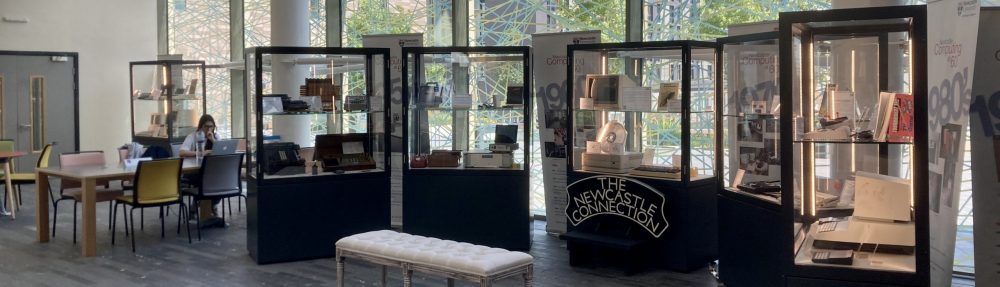
Since 2020 our display has been significantly expanded. Until May 2024 it was distributed across several floors of the Urban Sciences Building (USB), in a total of eight high-security museum cabinets, plus two cabinets that had been acquired many years ago. However, except for one small wall cabinet in the School Reception area, all our cabinets are now at last in position in the Atrium, where they are complemented by a set of large informative pop-up banners.
The five additional high-security museum cabinets contain exhibits on topics including “Computing Before Computers”, the SC’s and NUIT’s pioneering work on computer networking, and two cabinets devoted to Games Science research, which also show a variety of historical computer gaming devices. Many of the artefacts displayed have explanatory labels carrying QR codes which link to the detailed illustrated descriptions given of them in our catalogue.
Also on display in the Atrium is a souvenir of the 1980s software development led by Lindsay Marshall, in the long-running Dependability Research Project, of the pioneering “Newcastle Connection”. This “transparent” sub-system was the basis of one of the earliest distributed UNIX systems, “UNIX United”. The souvenir is a full-size cast aluminium railway engine name plate, a gift from Nigel Hall, one that he had created to commemorate the name of Lindsay’s software!
The one other cabinet in the Atrium, which is due to be replaced by a high-security museum cabinet, shows circuit boards from the Pegasus, KDF9, IBM 360, and Amdahl computers. The small wall cabinet (in the School Reception area) houses the results of Brian Randell’s historical investigation that in 1972 uncovered the hitherto completely secret Colossus wartime code-breaking effort.
On the walls of Floor 2 of the USB are now to be found three very different historical artworks:
- a large abstract painting by the German computer pioneer Konrad Zuse (bearing his pseudonym “Kuno See”),
- what appears to be a fine engraving of the famous picture of Joseph-Marie Jacquard (which is in fact an exact replica of the famous 1839 original woven picture of Jacquard, made in 1970 on a pioneering computer-controlled Jacquard Loom),
- and a large high-relief mural, based on the MICR type-font (introduced by banks in the 1960s): this was installed in the entrance hall of Claremont Tower in 1968. (Claremont Tower was the home of the University Computing Laboratory and its successors from 1968 until 2017.)
Our efforts have also been devoted to improving our web presence, now here at https://www.societies.ncl.ac.uk/nuhc/. There are a large number of pages now visible under the “Events” and “Documents” menu items which gather various stories and documents from the history of the Computing Lab, as it was affectionately called, and its later iterations.
Our future plans include setting up museum display cabinets devoted to work and artefacts from the various SC research groups, and also work and artefacts from elsewhere in the University, as we are interested in covering computer-related developments from beyond SC and NUIT, indeed across the entire University. As a first step in this direction one of our museum display cabinets is devoted to the 1980s BBC Domesday Project and shows a BBC Master computer system and a 12-inch Phillips laser disk drive. These come from the Centre for Urban and Regional Development Studies (CURDS), which was a major contributor to this pioneering national project.
In fact we hope to build further cross-faculty connections, and so are keen to explore how best to co-operate with and involve interested individuals from the various parts of the University, in order that the University’s pioneering, and indeed its continuing, computing-related activities can be appropriately commemorated and celebrated.
See accompanying Photograph Gallery
[1] We would be very happy to have more Committee members from across the University and beyond!
[2] Roger Broughton’s original Museum of Computing Artefacts website (https://nuhc.ncl.ac.uk/moca/) is now a historical artefact itself, well worth visiting.
[3] In fact five bulky artefacts were excluded from this move. These have now been transferred to a temporary location in the Urban Sciences Building – the Cycle Store!